
Hello! Welcome to the next lesson in our Mechanics of Materials module.
In our previous lessons, we've explored stress in one dimension, focusing on axially loaded bars. You learned to calculate elongation and solve for forces in statically indeterminate systems by combining equilibrium equations with compatibility equations based on deformation.
Today, we'll expand our analysis from a 1D to a 2D stress state. We'll examine a very common and important type of structure: the thin-walled pressure vessel. This topic is highly relevant to your goal of studying aerospace engineering, as aircraft fuselages, rocket propellant tanks, and hydraulic systems are all examples of pressure vessels. Our learning outcome is to determine stresses in thin-walled pressure vessels using hoop and longitudinal stress formulas.
1. Introduction to Pressure Vessels and Stresses
A pressure vessel is a container designed to hold fluids (liquids or gases) at a pressure substantially different from the ambient pressure. The internal pressure exerts an outward force on the walls of the vessel, which in turn creates tensile stresses within the material. To prevent the vessel from failing, we must be able to calculate these stresses.
For the most common shapes—cylinders and spheres—these stresses act in two principal directions. Let's start with a video that provides an excellent overview of these concepts.
Understanding Pressure Vessels
This video from The Efficient Engineer introduces pressure vessels, their common shapes, and the two main types of stress that develop in a cylindrical vessel's walls: hoop stress and longitudinal stress.
Please watch the first 1 minute and 34 seconds of the video. Focus on understanding the purpose of pressure vessels and visualizing the two stress directions described.
As the video explained, the two key stresses in a cylindrical pressure vessel are:
- Hoop Stress (or circumferential stress): Acts along the circumference, resisting the force that tries to split the cylinder open along its length.
- Longitudinal Stress (or axial stress): Acts along the length of the cylinder, resisting the force that tries to blow the ends off.
2. Stresses in Cylindrical Pressure Vessels
To find the magnitude of these stresses, we can use the same method of sections and equilibrium analysis that you've used for axial loads and trusses. By making an imaginary "cut" and drawing a free-body diagram, we can balance the force from the internal pressure with the force from the stress in the material.
The video you just started continues by deriving the formulas for both hoop and longitudinal stress.
Understanding Pressure Vessels
Let's continue with the same video to see how the formulas for hoop and longitudinal stress are derived from basic equilibrium principles.
Watch from 01:34 to 04:20. Pay attention to how the free-body diagrams are set up for each case and which 'projected area' the pressure acts on. Notice the final relationship between the two stresses.
Let's summarize these crucial formulas. For a cylindrical vessel with internal gauge pressure , inner diameter , and wall thickness :
-
Hoop Stress ():
-
Longitudinal Stress ():
Note: You may also see these formulas written using the inner radius (). In that case, they become and , which are equivalent.
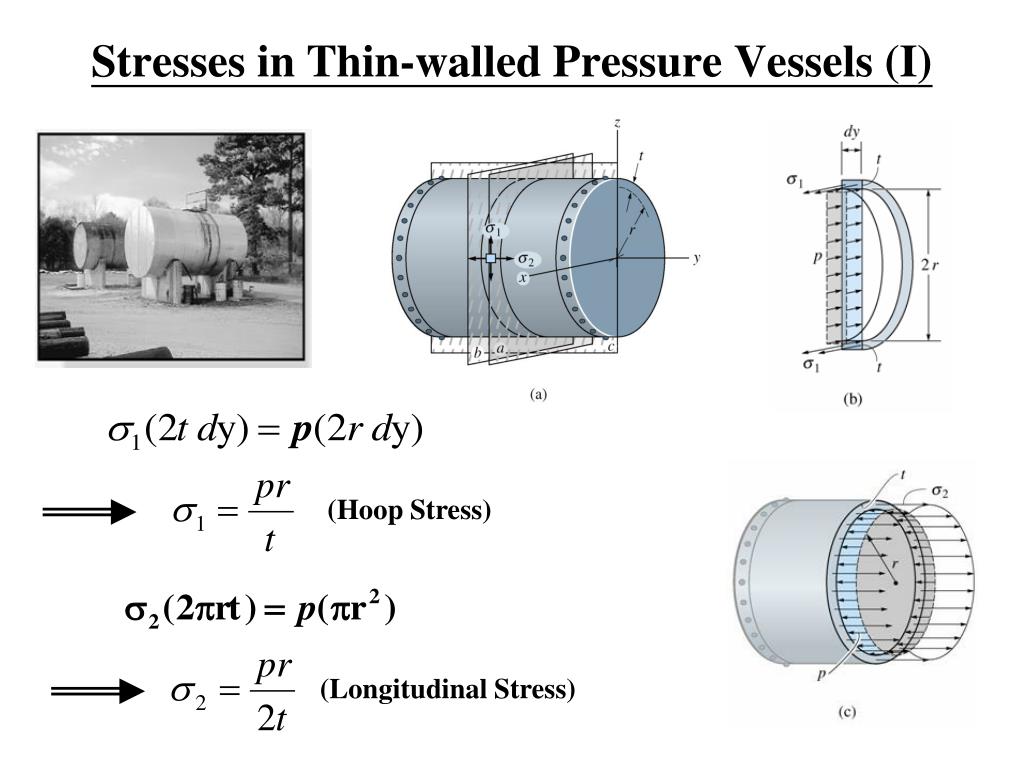
The most important insight here is the relationship between the two stresses:
The hoop stress is twice the longitudinal stress. This means that if the pressure is increased, the material will reach its yield strength in the hoop direction first. Therefore, hoop stress is the critical stress that governs the design of a cylindrical pressure vessel. This is why a pressurized tank is more likely to split along its length than break across its circumference, a phenomenon you might have seen if a sausage or hot dog splits while cooking.
3. Stresses in Spherical Pressure Vessels
What about spherical vessels? Due to the perfect symmetry of a sphere, the stress is the same in all directions along the wall. We can derive this using the same equilibrium method as for the longitudinal stress in a cylinder.
This text from Eng.LibreTexts provides a concise derivation for the stress in a spherical vessel. It uses the same free-body diagram approach we've been discussing.
Please read the short section on spherical vessels under the 'Stresses' heading. Notice how the force balance leads to the final formula.
As the text shows, the stress () in the wall of a spherical pressure vessel is:
Notice that this is identical to the longitudinal stress in a cylinder. This means that for the same pressure, diameter, and wall thickness, the maximum stress in a spherical vessel is only half the maximum stress in a cylindrical one. This makes spheres the most structurally efficient shape for containing pressure. However, they are significantly more difficult and expensive to manufacture, which is why cylindrical vessels with domed ends are far more common in industry.
4. The "Thin-Walled" Assumption
The formulas we've derived are simple and powerful, but they rely on a key assumption: the vessel is "thin-walled". This means the wall thickness is much smaller than the vessel's radius or diameter .
This assumption allows us to make two key simplifications:
- We can assume that the stress is distributed uniformly across the thickness of the wall.
- We can neglect the radial stress (), which acts through the thickness of the wall.
So, when are these simplifications valid? Let's return to our main video for a clear explanation.
Understanding Pressure Vessels
The final section of this video explains the simplifications made in our analysis and provides the rule of thumb for what qualifies as a 'thin-walled' vessel.
Watch from 07:01 to 09:12. Focus on understanding why we can neglect radial stress for thin walls and the common criterion used to define a thin-walled vessel.
As a general rule, these formulas are considered accurate when the ratio of the inner radius to the wall thickness is greater than 10 (), or equivalently, the diameter-to-thickness ratio is greater than 20 (). For "thick-walled" vessels that don't meet this criterion, more complex formulas (known as Lamé's equations) are required. For this course, we will focus only on thin-walled analysis.
Test your understanding!
An aircraft fuel tank is cylindrical with a diameter of 1.2 m and a wall thickness of 5 mm. It is designed to hold fuel at a gauge pressure of 250 kPa.
- Is this considered a thin-walled pressure vessel?
- Which stress will be larger, hoop or longitudinal?
- Calculate the value of this larger stress.
Show answer
-
Check the thin-walled criterion:
Diameter .
Thickness .
Ratio .
Since , yes, it is a thin-walled vessel. -
Identify the larger stress:
For a cylindrical vessel, the hoop stress is always twice the longitudinal stress. So, the hoop stress will be larger. -
Calculate the hoop stress:
Pressure (or 0.25 N/mm²).
The hoop stress is 30 MPa. (For completeness, the longitudinal stress would be 15 MPa).
Conclusion
In this lesson, we made the jump from 1D to 2D stress analysis by examining thin-walled pressure vessels. You learned how to apply fundamental equilibrium principles to derive the formulas for the stresses that develop in their walls.
Key Takeaways:
- Internal pressure creates hoop (circumferential) and longitudinal (axial) stresses in cylindrical vessels.
- For a cylinder, the hoop stress is twice the longitudinal stress (), making it the critical design parameter.
- For a sphere, the stress is uniform in all directions ().
- These formulas are valid for thin-walled vessels, typically where .
Next Lesson Preview:
We have now covered axial loading (1D stress) and pressure vessels (a simple 2D stress state). The next major topic in Mechanics of Materials is bending. When a beam is bent (like an aircraft wing under aerodynamic lift), it develops internal shear forces and bending moments that create stress. Before we can analyze those stresses, we need to understand the geometric properties of the beam's cross-section. Therefore, our next lesson will focus on how to calculate centroids and area moments of inertia for common and composite cross-sections.
Can't find a good explanation? Sign up and we'll make it for you
Sign up