
Hello! Welcome to your sixth lesson in the "SaaS Ideation & Market Validation" module.
In our last lesson, you learned how to find and analyze the online communities where your Ideal Customer Profile (ICP) is active. By "lurking" and listening, you've started gathering raw, unfiltered voice-of-customer data—their frustrations, their wishes, and the exact words they use to describe them.
Today, we will put that raw intelligence to work. The goal of this lesson is to develop a unique value proposition and positioning statement using the Value Proposition Canvas. This is where you translate customer problems into a product promise. We'll use a structured framework to ensure the solution you envision is directly tied to the real-world needs you've observed. This process is the critical bridge between understanding your customer and crafting a message that resonates with them.
Part 1: The Value Proposition Canvas - Achieving Product-Market Fit
A great SaaS product isn't just about cool features; it's about solving a problem so effectively that customers can't imagine going back. The Value Proposition Canvas (VPC) is a strategic tool designed to help you achieve this alignment, often called product-market fit.
It consists of two parts that must fit together perfectly: the Customer Profile (what your customer needs) and the Value Map (what your product delivers).
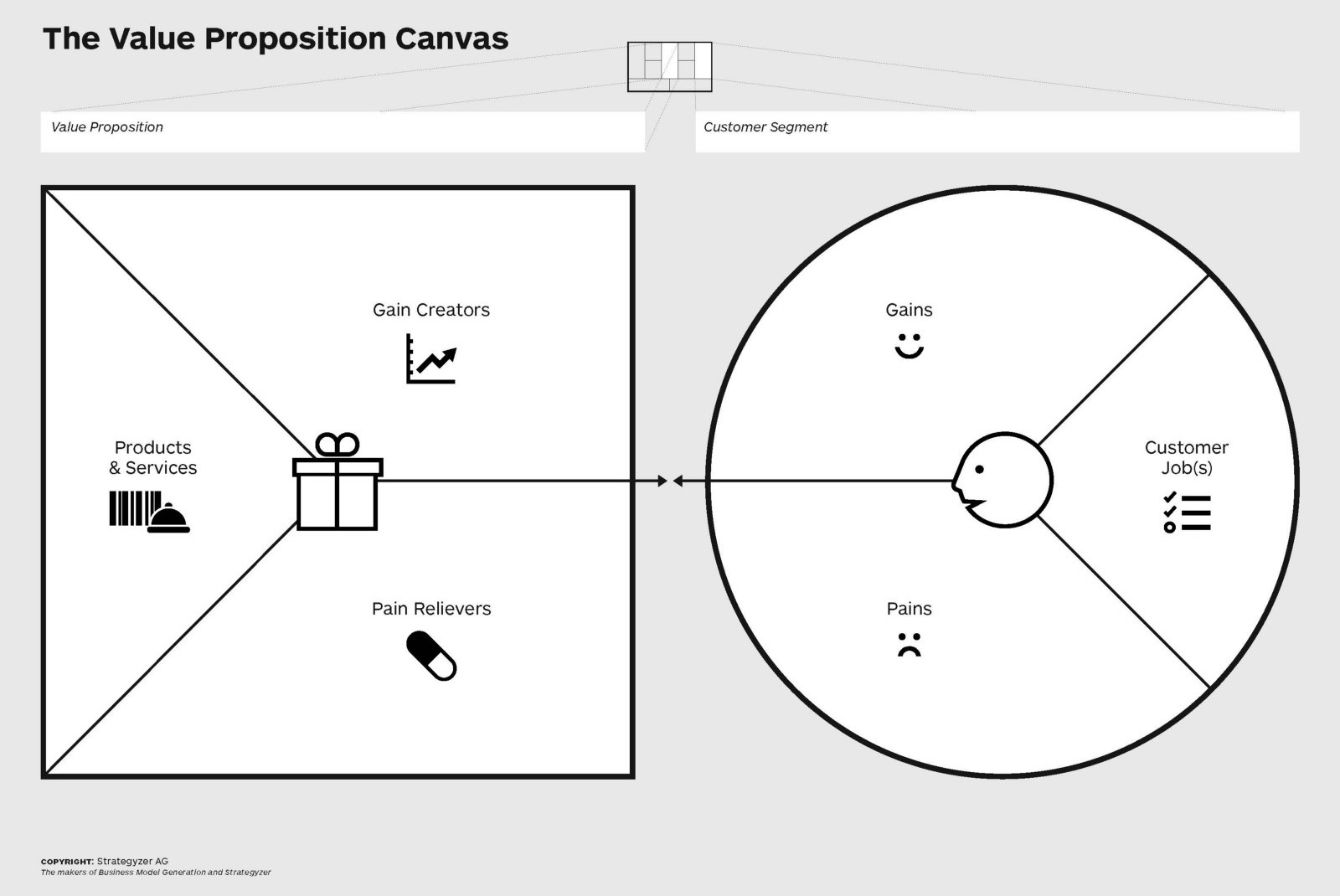
Let's break down each side.
The Customer Profile (The Circle)
This side is all about developing deep empathy for your ICP. You should fill this out using the direct observations and "voice of customer" data you gathered in the previous lesson. It consists of three parts:
- Customer Jobs: The tasks your customer is trying to accomplish in their work or life. It's not just about functional tasks; consider their social and emotional goals as well. For example, a functional job might be "generate a monthly report," while a social job is "look competent to my boss," and an emotional job is "feel less stressed about deadlines."
- Pains: The negative emotions, undesired costs, situations, and risks your customer experiences before, during, or after getting a job done. Think of the complaints you read in those Reddit threads—that's pure gold for this section.
- Gains: The benefits and outcomes your customer expects, desires, or would be surprised by. This includes functional utility, social gains, positive emotions, and cost savings.
To see this in action, let's watch a practical walkthrough.
A Value Proposition Canvas Example
In this video, 'A Value Proposition Canvas Example', SaaS entrepreneur TK Kader breaks down the canvas using a highly relevant B2B example: a sales engagement platform for VPs of Sales. First, let's focus on how he deconstructs the customer.
Watch from 00:02:58 to 00:11:13. Pay close attention to how he identifies the specific 'Jobs to be Done,' 'Pains,' and 'Gains' for his ICP before even mentioning the product.
The Value Map (The Square)
Once you have a clear picture of your customer, you can start designing your solution. The Value Map details how your product will create value by directly addressing the elements in the Customer Profile.
- Products & Services: This is a list of what you offer. It could be a single piece of software, different subscription tiers, or professional services.
- Pain Relievers: These describe how your product's features specifically alleviate your customer's pains. A great pain reliever is explicit: it eliminates a frustration, reduces a risk, or fixes a poor outcome.
- Gain Creators: These describe how your product produces the outcomes and benefits your customer desires. They show how you help them achieve their aspirations.
Now, let's see how TK Kader connects his product to the customer profile he just built.
A Value Proposition Canvas Example
Now for the second half of the canvas. Watch how the product's features are framed as direct solutions to the customer's problems.
Continue watching from 00:12:15 to 00:17:58. Notice the clear line he draws from a customer pain (e.g., 'ramp time is a huge problem') to a pain reliever (e.g., 'more at bats' reduces ramp time).
When your Pain Relievers and Gain Creators directly address the most important Pains and Gains of your customer, you have achieved fit.
Here is what a completed canvas can look like for a B2B SaaS product.

For a detailed, step-by-step guide on filling out the canvas, including how to rank items by importance, the following article is an excellent resource.
Mastering Value Proposition for SaaS: The Ultimate Guide
The article 'Mastering Value Proposition for SaaS' provides a written guide to complement the video. It walks through each step of using the canvas and iterating on your ideas.
Read the sections 'Value Proposition Canvas', 'How to Use a Value Proposition Canvas (With Example)', and 'Fit Overview and Reiteration'. This will reinforce the concepts and show you how to test and refine your canvas.
Test your understanding!
From the community research you did in the last lesson, recall one specific pain point you observed. Now, describe a corresponding Pain Reliever. Be specific about the feature and how it solves that exact pain.
Example:
- Pain: "I waste hours every month manually copying and pasting sales data from our CRM into a Google Sheet to build my forecast report for my boss."
- Pain Reliever: "A one-click integration that automatically syncs CRM data to Google Sheets in real-time, with pre-built forecasting templates."
Show answer
Your answer will depend on the SaaS idea you're exploring. The key is to create a direct and tangible link between the problem and the solution. A good answer will move beyond a generic feature (e.g., "reporting") to a specific benefit that targets the observed pain (e.g., "automated, pre-built reports that save you X hours").
Part 2: Positioning - Winning in a Crowded Market
Having a strong value proposition is the foundation. But in a crowded market, you also need to communicate why you are the best choice among all the alternatives. This is positioning.
Positioning expert April Dunford describes it as the "opening scene of a movie." It sets the context and helps customers quickly understand what your product is and why they should pay attention. While the VPC helps you achieve product-customer fit, positioning helps you achieve product-market fit.
A critical insight from Dunford is that your positioning must start by understanding the competitive alternatives. What would your customers do if your product didn't exist? They might use a direct competitor, a spreadsheet, an intern, or simply do nothing. Your unique value only matters in comparison to those alternatives.
Let's dive into April Dunford's masterclass on the topic.
Positioning in Crowded Markets: How to Make Any Offering Obviously Awesome - April Dunford
This talk, 'Positioning in Crowded Markets', is essential viewing for any founder. April Dunford provides a clear, actionable process for positioning that is far more powerful than simple templates.
This video is packed with value, but let's focus on two key parts: The Positioning Process (00:19:34 - 00:25:34): Pay close attention to her 5-step process and why she insists on starting with 'Competitive Alternatives,' not your product features. A Real-World Example (00:27:40 - 00:33:57): Listen to the story of how repositioning an 'enterprise CRM' as a 'CRM for investment banks' transformed the business. This is a perfect example of positioning in action.
Dunford's 5-step positioning process provides the tactical framework you need:
- Competitive Alternatives: What would customers do if you didn't exist? (Hint: It's often "use a spreadsheet" or "hire an intern").
- Unique Attributes: What features or capabilities do you have that the alternatives don't?
- Value: What is the benefit that those unique attributes enable for customers?
- Target Market Characteristics: Who is the specific segment of the market that cares deeply about that value?
- Market Category: What is the "box" you put your product in (e.g., 'CRM', 'email marketing tool', 'autonomous vehicle') so that your unique value is obvious?
Your Value Proposition Canvas provides the answers for steps 2, 3, and 4. Dunford's framework forces you to ground them in the reality of the market (steps 1 and 5).
Part 3: Crafting Your Positioning Statement
Now, let's combine the insights from your VPC and your positioning analysis into a single, clear statement. This isn't your final website headline, but rather an internal "true north" that will guide your messaging.
A great template to start with comes from the GTMDialogues article you read earlier.
Mastering Value Proposition for SaaS: The Ultimate Guide
Let's revisit the article 'Mastering Value Proposition for SaaS' to grab a practical template for summarizing our work.
Refer to the section 'Value Proposition Statement Template'. This provides a simple but powerful structure.
The template is:
"Our [product/service] helps [target customer] who want to [customer job] by [minimizing a customer pain] and [increasing a customer gain]. Unlike [competing value proposition], we [unique differentiator]."
Example for our fictional hiring tool:
"Our AI-powered screening tool helps CTOs at early-stage startups who want to hire senior engineers quickly by eliminating 90% of time spent on unqualified candidates and surfacing hidden gems from non-traditional backgrounds. Unlike generic applicant tracking systems (ATS), we analyze a candidate's public code contributions to assess real-world skill, not just their resume."
This statement is powerful because it contains all the key components: your customer, their job, the pain you solve, the gain you create, the competitive alternative, and your unique differentiator.
Conclusion
You've now moved from passive listening to active synthesis. By structuring your customer research into the Value Proposition Canvas and a sharp positioning statement, you have created the strategic foundation for your entire go-to-market strategy.
Key Takeaways:
- The Value Proposition Canvas is your tool for ensuring you build something people actually need by mapping customer Jobs, Pains, and Gains to your product's Pain Relievers and Gain Creators.
- Positioning contextualizes your value proposition within the market, starting with a clear understanding of the competitive alternatives.
- A well-crafted positioning statement serves as your internal guide, clearly articulating who you help, what problem you solve, and why you are the best choice.
Preview of the Next Lesson:
A value proposition is just a hypothesis until it's tested. In our next lesson, you will craft a non-promotional post to validate your core value proposition on a selected platform (e.g., Indie Hackers, Reddit). You'll take the statement you developed today, turn it into a conversation starter, and get direct feedback from your target audience.