
Hello! Welcome to your seventh lesson in the "SaaS Ideation & Market Validation" module.
In our last lesson, you did the critical internal work of translating your customer research into a clear hypothesis. By using the Value Proposition Canvas and crafting a positioning statement, you now have a structured idea of the problem you solve, for whom, and what makes your approach unique.
Today, we take that hypothesis and expose it to the real world. This lesson is all about testing your core idea before you invest significant time and resources into building it. Your learning outcome is to craft a non-promotional post to validate your core value proposition on a selected platform (e.g., Indie Hackers, Reddit).
This is a pivotal moment in the lean startup journey: moving from assumption to evidence. Instead of pitching a product, you'll learn to start a conversation around a problem to see if anyone cares.
Part 1: The Validation Mindset - Give Value, Don't Pitch
Platforms like Reddit and Indie Hackers are communities, not marketplaces. Their members value authenticity and mutual support, and they have a strong aversion to spam and self-promotion. Trying to "market" your product here before building trust is the fastest way to get ignored or even banned.
The goal of a validation post is not to get sign-ups. It is to get honest feedback. You're a founder-scientist running an experiment, and your hypothesis is your value proposition.
To succeed, you must shift your mindset from "selling" to "seeking." You are not an advertiser; you are a fellow community member exploring a problem.
How I Used Reddit to Hit $17K MRR (With ZERO Audience)
To understand the power and subtleties of using Reddit, let's watch this clip from a talk with Diego, a founder who grew his SaaS to $17k MRR almost entirely through this platform. Pay attention to his core philosophy.
Watch from 00:06:42 to 00:09:17. Notice his key insight: most people fail because their posts are too pushy. The successful formula is to provide value in your niche first, and only then introduce your product idea as a related solution.
As Diego explains, the key is to feel natural. You achieve this by focusing the conversation on the problem your target users face, not the solution you've imagined.
Part 2: How to Craft a Non-Promotional Validation Post
A successful validation post is an art. It needs to be genuine, spark curiosity, and invite discussion. We can break down the structure into a repeatable formula.
The Core Formula
The most direct way to validate an idea is to frame it as a question. The article "How to Validate Your App Idea Using Reddit" provides a simple and effective template.
How to Validate Your App Idea Using Reddit
This article by Mr Rehan offers a wonderfully direct approach to validation. We'll focus on the section that provides a template for the post itself.
Read the short section titled '3. Craft a Natural, Helpful Post'. The example provided is the essence of a good validation post.
The template is:
"I’ve noticed a lot of people here struggle with [problem]. If there was a tool that [simple solution], would that be useful? Curious to hear honest thoughts before building anything.”
This works because it:
- Shows you've listened: It starts with an observation about the community's struggles.
- Focuses on the problem: It centers the conversation on a shared pain point.
- Frames the solution abstractly: It talks about "a tool that does X," not "my amazing product, SaaS-A-Tron 5000."
- Explicitly asks for feedback: It's a genuine request for help and opinions.
Here is an example of a real Reddit post that follows this principle perfectly:
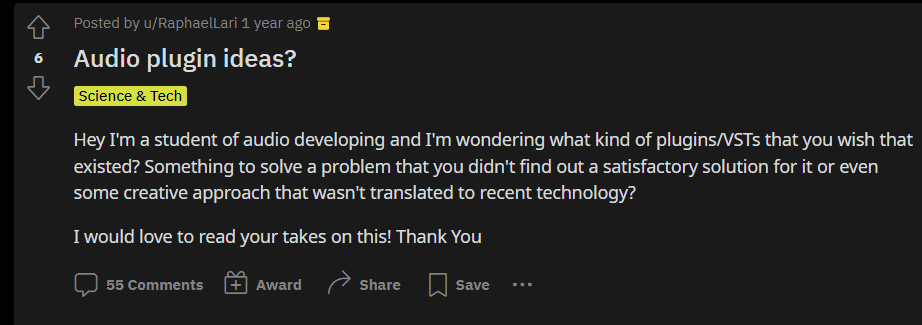
A Step-by-Step Guide to Writing Your Post
Let's combine this with insights from the Zora Insights blog to create a more detailed process.
How to validate your startup idea using Reddit
For a more detailed breakdown, the Zora Insights blog has an excellent guide on crafting the perfect Reddit post for validation. It adds nuance to our core formula.
Read the section titled 'How to craft the perfect Reddit post for startup validation'. Pay attention to the six bullet points on how to write correctly for this context.
Here is a consolidated process based on these resources:
-
Craft a Human-Sounding Headline: Make it a question or a relatable statement.
- Bad: "Announcing My New AI Code Refactoring Tool!"
- Good: "How do you tackle technical debt in a large legacy codebase?"
- Good: "Is anyone else tired of manually hunting for bugs before a deploy?"
-
Start with the Problem or a Personal Story: Use your positioning statement as a guide. Remind the reader of the pain point you discovered in your research.
- Example: "I was working on a project with a 5-year-old React codebase, and figuring out which components were safe to refactor was a nightmare. I spent days just mapping dependencies and potential side effects."
-
Introduce the Solution Conceptually: This is where you test your core value proposition. Describe what the tool does, not what it is.
- Example: "It got me thinking, what if there was a tool that could scan a repo, visualize the component hierarchy, and flag 'high-risk' components based on factors like code churn, complexity, and test coverage? Basically, a heat map for technical debt."
-
Ask Clear, Open-Ended Questions: Your goal is to start a conversation.
- "Would a tool like this actually be useful in your workflow?"
- "How do you currently handle this? Am I just over-complicating things?"
- "What would a 'must-have' feature be for something like this?"
-
Engage in the Comments: Reply to every comment. Ask follow-up questions. If someone is critical, thank them for their honesty and try to understand the root of their objection. Remember, you're here to learn.
Test your understanding!
Let's say your SaaS idea is a tool that helps freelance writers manage their clients and invoices. Your positioning statement is: "Our tool helps freelance writers who want to spend more time writing by automating client onboarding and invoice chasing. Unlike using spreadsheets and calendar reminders, we provide a single dashboard for everything."
Using the framework above, draft a non-promotional validation post title and the first few sentences.
Show answer
There are many good answers, but here's one possible version:
Title: Freelance writers, what's your most hated admin task?
Post: "Hey everyone, I've been freelancing for a few years, and it feels like I spend half my time juggling spreadsheets for client info, setting calendar reminders to chase invoices, and manually sending onboarding docs. It's a huge time-sink away from actual writing.
I'm curious if there's a better way. I was thinking about a simple dashboard that could automate sending follow-up emails for unpaid invoices and have templates for client onboarding. Would something like that actually save you time, or have you found a workflow that already solves this?"
Part 3: Rules of Engagement - How to Not Get Banned
Knowing what to write is only half the battle. You also need to know where and how to post it. Each community has its own culture and explicit rules.
Choosing Your Platform
-
Reddit: A collection of thousands of niche communities (subreddits).
- Pros: You can find a subreddit for almost any ICP imaginable (e.g.,
r/sales,r/sysadmin,r/podcasting). The feedback is brutally honest. - Cons: Many subreddits have strict rules against self-promotion. You'll need an account with some history and "karma" (a reputation score) to not be seen as a spammer.
- Relevant Subreddits for Founders:
r/startups,r/SideProject,r/IndieHackers,r/Entrepreneur.
- Pros: You can find a subreddit for almost any ICP imaginable (e.g.,
-
Indie Hackers: A single community specifically for bootstrapped founders.
- Pros: The audience is entirely made of founders and tech enthusiasts. They are very open to new ideas and "building in public."
- Cons: The feedback will be from other founders, not necessarily from your end-users (unless your product is for founders).
General Best Practices
Jonathan Rintala, another founder who found success on Reddit, provides a great step-by-step guide for engaging responsibly.
How I hacked growth on Reddit to build a $1M SaaS
In this video, Jonathan Rintala shares his tactical guide for getting started on Reddit. This is your playbook for being a good community member.
Watch from 00:06:50 to 00:08:39. He outlines five key steps, from finding subreddits to playing by the rules. Pay close attention to his points about 'building karma' and being resilient to feedback.
Here’s a summary of the most critical rules to follow:
- Warm Up Your Account: If you're new to a platform, spend a week or two just reading, upvoting, and making helpful comments on other posts. A brand new account posting about an idea is a huge red flag.
- Read the Subreddit Rules: Every subreddit has a sidebar with rules. Read them carefully. Some explicitly forbid "idea validation" posts, while others encourage them with a specific flair (e.g., "Feedback Wanted").
- DO NOT Include Links (At First): Your initial post should not contain any links to a landing page, website, or waitlist. This is the clearest sign of self-promotion. If your post gets positive traction and people ask for a link, you can then share it in the comments (if rules permit) or via direct message.
- Be Humble and Resilient: Some people might be harsh. Thank them for the feedback. Arguing is pointless and makes you look bad. Your goal is to learn from the criticism, not to win an argument.
Conclusion
You are now equipped to take one of the most important and nerve-wracking steps in a startup's life: seeing if anyone else cares about the problem you're trying to solve. By crafting a non-promotional, problem-focused post, you gather invaluable evidence that can save you months of building the wrong thing.
Key Takeaways:
- Frame your idea as a conversation about a problem, not a pitch for a product.
- Use a simple formula: State an observation -> Describe a solution concept -> Ask open-ended questions.
- Respect community culture: Warm up your account, read the rules, avoid links, and be genuinely curious.
- The goal is learning and evidence, not immediate sign-ups or universal praise.
Preview of the Next Lesson:
Once you post your validation question and the feedback starts rolling in, what do you do with it? In our next and final lesson of this module, you will learn how to synthesize feedback from community validation to refine your SaaS idea and core features. We'll cover how to sort signal from noise and use the community's insights to make your idea stronger.