
Hello again. In the previous lesson, you traced carbohydrate from food through digestion, absorption, and finally into cells, where glucose can help produce ATP. Now we shift to a practical companion skill: recognizing where everyday foods fit in the five MyPlate food groups.
By the end of this lesson, you should be able to sort common single foods into fruits, vegetables, grains, protein foods, and dairy. The central idea is simple, but a few common mix-ups—such as confusing a food group with the nutrients in food, or using botanical definitions instead of nutrition definitions—are worth clearing up.
MyPlate is a food-classification tool
MyPlate groups foods with broadly similar nutritional roles so that people can think about eating patterns without tracking every vitamin, mineral, carbohydrate, fat, and protein gram individually. A food group is not the same thing as one nutrient.
For example:
- Bread belongs to the grains group, even though it contains some protein.
- Cheese belongs to the dairy group, even though it contains protein and fat.
- Beans can be a protein food, even though they also contain carbohydrate and fiber.
- Avocado is usually counted with vegetables in MyPlate-style food sorting, despite containing substantial fat.
The five groups are:
- Fruits
- Vegetables
- Grains
- Protein foods
- Dairy
Cooking oils are important in eating patterns, but they are not a sixth MyPlate food group.
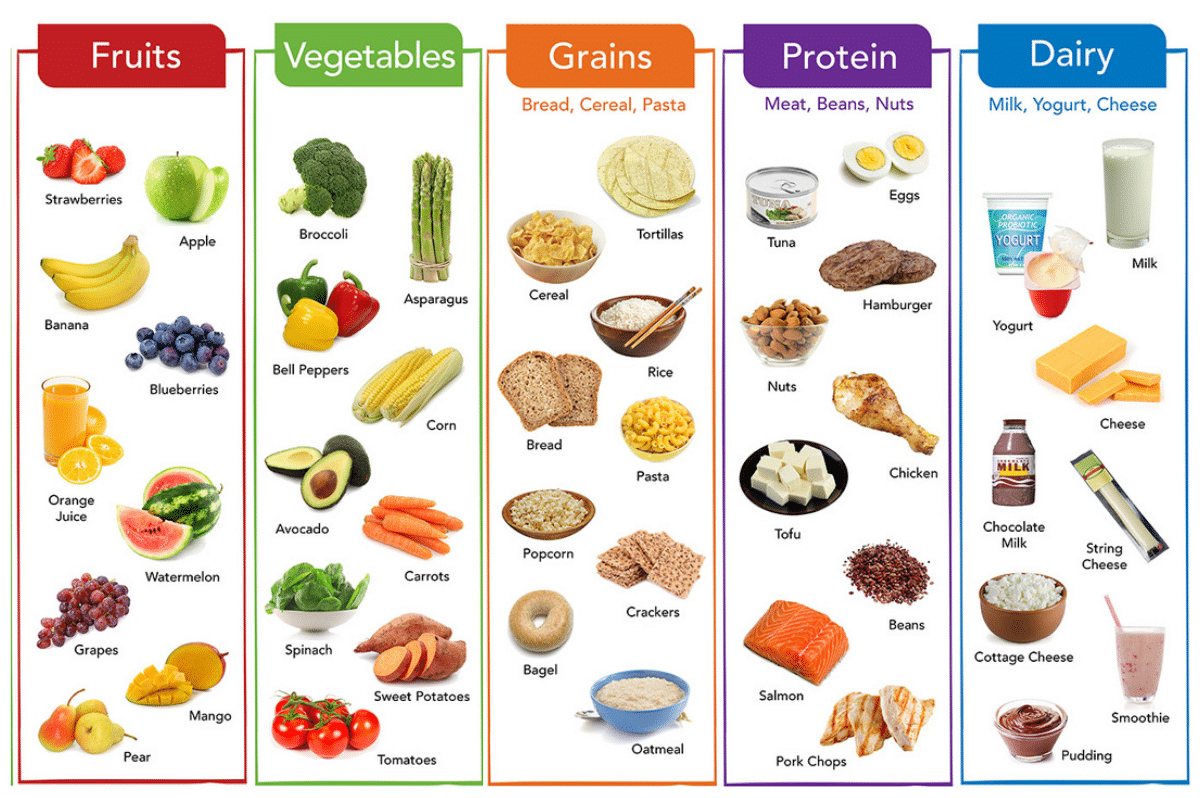
A useful visual memory cue is the color order in the chart: red fruit, green vegetables, orange grains, purple protein, and blue dairy. The colors are just labels; what matters for a quiz is identifying what kind of food it is.
The five groups: identify the food’s main identity
Start by learning the “home base” of familiar foods. Ask: What is this food primarily made from?
| Food group | Main sorting question | Common examples | Frequent confusion |
|---|---|---|---|
| Fruits | Is it a fruit or 100% fruit juice? | Apple, banana, grapes, berries, orange juice | Juice can count as fruit, although whole fruit is generally preferred. |
| Vegetables | Is it a culinary vegetable or 100% vegetable juice? | Broccoli, carrots, spinach, corn, tomatoes, peppers | Tomatoes and peppers are botanical fruits but are counted as vegetables in this context. |
| Grains | Is it made from wheat, oats, rice, corn, barley, or another grain? | Bread, pasta, rice, oatmeal, tortillas, cereal | Potatoes are vegetables, not grains. |
| Protein foods | Is it meat, poultry, seafood, eggs, beans, peas, nuts, seeds, or soy food? | Chicken, tuna, eggs, tofu, beans, nuts | “Protein food” means a food-group category, not every food containing protein. |
| Dairy | Is it milk or a food made from milk, or a qualifying fortified soy beverage? | Milk, yogurt, cheese, cottage cheese | Dairy is not simply “anything white” or any food with calcium. |
Fruits
The fruit group includes whole fruits and 100% fruit juice. Fruits may be fresh, frozen, canned, or dried. An apple, banana, blueberries, grapes, mango, pear, and watermelon are straightforward fruit-group examples.
A fruit-flavored drink does not automatically count as fruit. The key wording is 100% fruit juice. A sweet beverage with a small amount of juice or fruit flavoring is not classified the same way.
Vegetables
The vegetable group includes fresh, frozen, canned, and whole vegetables, along with 100% vegetable juice. Examples include broccoli, asparagus, carrots, spinach, sweet potatoes, corn, tomatoes, bell peppers, and avocado.
For MyPlate sorting, use the culinary nutrition definition, not the botanical definition. A tomato develops from a flower and contains seeds, so botanically it is a fruit. But it is used in savory meals and is classified as a vegetable in MyPlate. The same practical rule generally applies to peppers and cucumbers.
Grains
A grain food is made from a grain such as wheat, oats, rice, barley, or corn. Bread, cereal, pasta, rice, oatmeal, crackers, bagels, popcorn, and corn tortillas all belong in the grains group.
A common assessment trap is to place all starchy foods into grains. Instead, classify by source:
- Rice is a grain.
- Pasta is a grain because it is generally made from wheat.
- Corn tortillas are grains because they are made from corn.
- Potatoes and sweet potatoes are vegetables, even though they contain carbohydrate and starch.
Grains can be whole or refined. Whole-grain choices such as oatmeal, brown rice, and whole-wheat bread are still all in the grains group; “whole” does not create a separate food group.
Protein foods
The MyPlate protein foods group includes both animal- and plant-based foods. Familiar examples include meat, poultry, seafood, eggs, beans, peas, nuts, seeds, and soy foods such as tofu.
This is another place where wording matters. Chicken is a protein food, but so are black beans and tofu. You do not need animal foods for a food to belong to the protein-food group.
Beans and peas can be treated as either vegetables or protein foods in some detailed MyPlate guidance. For a basic sorting question, if beans appear alongside chicken, fish, eggs, tofu, nuts, or lentils, classify them as protein foods unless the question specifically directs you to use them as vegetables.
Dairy
Milk and foods made from milk, including yogurt, cheese, cottage cheese, and many smoothies made with dairy, belong to the dairy group. Fortified soymilk can also count as dairy in MyPlate guidance because it is used as a nutritionally comparable milk alternative.
Do not sort a food into dairy merely because it contains protein. An egg is a protein food, not dairy. Likewise, chicken is a protein food. The word dairy refers to the food’s source and category, not simply to one nutrient it contains.
Use the official descriptions to sharpen the boundaries
The University of Illinois Extension’s “MyPlate: Your Five Food Groups” provides a compact reference for exactly these classifications. Read its short sections once, paying special attention to the defining words rather than trying to memorize every example.
MyPlate: Your Five Food Groups | Eat.Move.Save. | Illinois
In “MyPlate: Your Five Food Groups” from University of Illinois Extension, review how each group is defined and notice that foods may be fresh, frozen, canned, or plant-based depending on the group.
Read the “Fruits” and “Vegetables” sections first, from the sentence beginning “Fruits that are fresh” through the end of the vegetables paragraph. Then read “Grains,” “Protein,” and “Dairy and dairy alternatives.” In “Grains,” focus on the definition and examples. In “Protein,” note that choices may be meat- or vegetable-based. In “Dairy and dairy alternatives,” read from “Dairy is the blue circle” through the milk-based definition, then note the statement about fortified soymilk.
One detail from the reading reinforces a broader pattern: how a food is preserved usually does not change its group. Frozen broccoli is still a vegetable; canned peaches are still fruit; dried oats are still a grain. The food’s basic identity matters more than whether it is fresh, frozen, dried, or canned.
A dependable sorting routine
When a question gives you a food, avoid jumping immediately to its nutrients. Use this short routine instead:
-
Name the food itself.
Is it produce, a grain product, an animal food, a bean/nut/soy food, or milk-based? -
Identify the source ingredient.
Bread comes from grain; yogurt comes from milk; tofu comes from soybeans. -
Use MyPlate’s practical definition.
Sort tomatoes and peppers as vegetables, even though botany may label them differently. -
Choose the primary group expected by the question.
In a basic one-food sorting question, chicken belongs in protein foods and oatmeal belongs in grains. -
For mixed dishes, separate the components when possible.
A burrito might contain a grain tortilla, protein foods such as beans or chicken, vegetables such as peppers, and dairy such as cheese. A complete meal can include several groups at once.
This final point is important: a plate or recipe is not usually assigned one single group in real life. Individual ingredients are sorted into groups. If an assessment asks about a mixed food, look for what it emphasizes: its main ingredient, a named component, or the food groups represented in the entire dish.
For a rapid visual review, this short USDA video pairs one clear example with each group.
Discover MyPlate “Reach for the Sky” Music Video
“Discover MyPlate ‘Reach for the Sky’ Music Video” from the USDA Food and Nutrition Administration gives a quick visual set of five representative foods.
Watch the five examples. Match each item to its group: apple with fruits, broccoli with vegetables, chicken with protein foods, whole-grain bread with grains, and yogurt with dairy. Use these five foods as mental anchors when recalling the categories.
Common quiz traps
Here are the distinctions most likely to improve your accuracy:
-
Fruit versus vegetable:
In nutrition classification, tomatoes, peppers, and cucumbers are typically vegetables. Sweet fruits such as apples, berries, bananas, grapes, and mangoes are fruits. -
Grain versus starchy vegetable:
Oatmeal, bread, rice, cereal, pasta, and tortillas are grains. Corn is commonly treated as a vegetable in basic MyPlate sorting, while corn tortillas are grains because they are made from corn grain. Potatoes and sweet potatoes are vegetables. -
Protein food versus dairy:
Eggs, chicken, fish, beans, nuts, and tofu are protein foods. Milk, yogurt, and cheese are dairy. Both groups can provide protein, but they are not the same group. -
Food group versus nutrient:
Carbohydrate does not mean grain automatically: fruit, milk, and beans contain carbohydrate too. Protein does not mean protein-food group automatically: cheese contains protein but is dairy. -
Single ingredient versus mixed food:
A grilled cheese sandwich contains at least two groups: bread is grain and cheese is dairy. Sort the parts rather than trying to force the whole sandwich into only one category.
Key takeaways
MyPlate organizes foods into fruits, vegetables, grains, protein foods, and dairy. These are food categories, not nutrient categories: foods in every group can contain more than one macronutrient or micronutrient.
Use the food’s main source to sort it. Fruit and vegetables are plant foods, with MyPlate using practical culinary categories for items such as tomatoes and peppers. Grains are foods made from grains such as wheat, oats, rice, and corn. Protein foods include meat, seafood, eggs, beans, nuts, seeds, and tofu. Dairy includes milk and foods made from milk, along with qualifying fortified soymilk.
Next, you will distinguish two closely related appetite terms: satiation, the feeling that helps end a meal, and satiety, the longer-lasting fullness after a meal.
Can't find a good explanation? Sign up and we'll make it for you
Sign up