
Welcome back. Previously, you sorted individual foods into the five MyPlate groups. That skill focuses on what kind of food something is. This lesson shifts to what happens to appetite across the course of a meal: why you stop eating now, and why you do or do not feel hungry again later.
By the end, you should be able to distinguish satiation, the set of signals that helps bring a meal to an end, from satiety, the longer-lasting fullness that delays the next meal. The two terms sound nearly identical, so timing is the most reliable way to separate them.
Two related “stop” signals, at different times
Both words describe part of appetite regulation, but they answer different questions.
| Term | When it occurs | Main effect | Question it answers |
|---|---|---|---|
| Satiation | During a meal | Helps you stop eating; influences meal size | “When have I had enough of this meal?” |
| Satiety | After a meal | Suppresses hunger for a period; influences time until the next meal | “How long will I remain satisfied before hunger returns?” |
A useful memory cue:
- Satiation has an “end-the-meal” role.
- Satiety is the “between-meals” period of fullness.
In ordinary conversation, someone may say, “I’m full,” without specifying which process they mean. In nutrition questions, however, use the timing:
- Feeling satisfied and deciding not to take another bite while eating is satiation.
- Still not feeling hungry two or three hours after eating is satiety.
Follow one meal through time
Imagine eating lunch at noon.
- Before lunch, hunger and appetite encourage you to seek food.
- As you eat, taste, portion size, stomach filling, and signals from the digestive tract contribute to a growing feeling of having had enough. When you put your fork down because you do not want more, that is satiation.
- Once lunch is over, fullness may continue. This reduced desire to eat for the next few hours is satiety.
- Eventually, fullness fades and hunger returns. Satiety has declined, helping set the stage for another meal.
So, satiation is not simply “being full.” It is the process that develops during eating and leads to meal termination. Satiety is the post-meal state that postpones further eating.
The scientific definition: meal size versus meal timing
This short passage gives a precise academic version of the distinction.
Read the section “Idea Generation: Three Routes to Enhanced Satiation and Satiety” from the PMC article. It gives concise definitions and shows that the two processes work together in appetite control.
Begin at the paragraph that starts “Reduction in food intake can be achieved,” and read through the discussion immediately following the definitions. Focus especially on the paired definitions. Notice the separate outcomes: satiation leads to ending the current meal, whereas satiety lasts after the meal and eventually gives way to a new eating occasion.
The distinction can be stated compactly:
- Satiation affects how much is eaten at one eating occasion.
- Satiety affects how long it is before the next eating occasion.
They are complementary, not competing, processes. A meal can cause enough satiation for a person to stop eating, yet provide relatively little lasting satiety. Conversely, a meal’s composition may help sustain satisfaction afterward even though it did not feel especially filling at the first few bites.
For a basic nutrition assessment, do not try to decide the term by guessing which nutrient is involved. Decide it by asking: Is the question describing the end of the current meal, or the time after the meal?
What contributes to each process?
Your prior digestion lesson provides useful context here. Food begins producing signals before all nutrients have been fully absorbed. Taste and texture matter immediately; as food enters the stomach and intestines, physical and chemical signals also contribute. Later, absorbed nutrients and the body’s energy status can influence hunger and fullness.
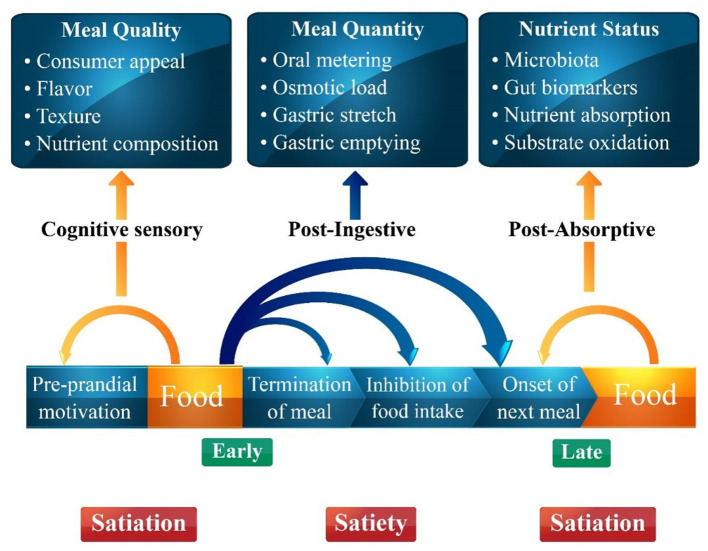
The diagram organizes influences by when they are most prominent.
During eating: signals that promote satiation
Satiation builds over the course of a meal. Important influences include:
- Sensory and cognitive cues: flavor, texture, expectations, and the perceived amount eaten.
- Eating rate and portion characteristics: eating more slowly may give internal signals more time to register before a large amount is consumed.
- Stomach and intestinal filling: food creates physical stretch in the stomach and gut.
- Digestive signals: the digestive tract responds as food enters and moves through it.
These influences help explain why satiation is sometimes described as an early appetite-control process. It does not wait until digestion is completely finished. The body is already receiving information while the meal is in progress.
After eating: signals that sustain satiety
Satiety reflects the period following a meal when motivation to eat remains reduced. It is affected by:
- how much food remains in the digestive tract;
- the rate at which the stomach empties;
- nutrients being absorbed and used by the body;
- hormonal and neural signals that communicate information between the gut, blood, and brain.
Satiety gradually weakens rather than ending at one identical time for everyone. A person’s next eating occasion can also be shaped by schedules, food availability, social settings, emotion, and appealing food cues. Thus, hunger is not determined by biology alone, even though biology is important.
The central lesson remains simple: satiation helps end eating; satiety helps delay eating again.
A visual explanation of the timing
The following animation is useful because it separates the two terms visually and connects them to stomach stretch, gut signals, and brain-based appetite regulation.
Watch “Hunger and Satiety” by NutritionSteps. These two short segments clearly contrast fullness while eating with fullness after eating.
In the segment on satiation, focus on the phrase “builds up throughout a meal” and on the illustration of stomach and gut stretching. Then continue with satiety, focusing on its role in determining the interval before the next eating occasion. The hormone names are secondary for this lesson; prioritize the timing and outcome of each process.
You do not need to memorize every hormone named in the video for this outcome. The important causal ideas are:
- Food entering the stomach and intestines produces signals that can reduce the desire to continue a current meal.
- Signals continue after eating and help maintain a period of reduced hunger.
- As these post-meal signals lessen, hunger can return.
Avoid the most common mix-ups
Mix-up 1: Treating the terms as synonyms
They are closely related, but not interchangeable in a quiz answer.
- “I stopped eating because I had had enough” describes satiation.
- “I was still satisfied several hours after lunch” describes satiety.
Mix-up 2: Confusing hunger with satiation
Hunger is a drive to eat. Satiation is a collection of “enough food” signals that develops as eating continues and counters that drive during the meal.
A person may begin a meal hungry, experience satiation near the end, remain satiated after stopping, and later become hungry again once satiety fades.
Mix-up 3: Assuming fullness is determined only by Calories
Calories matter to energy balance, but the immediate sensation of fullness is affected by more than energy content. Volume, water content, fiber, texture, eating speed, meal composition, and psychological factors can all influence how a meal feels.
For example, a large bowl of broth-based vegetable soup may create strong satiation because it occupies substantial volume. Whether it produces prolonged satiety is a different question: that concerns how hunger changes in the hours afterward.
Mix-up 4: Assuming “satiating” means “healthy”
A food might make someone feel full quickly, but that fact alone does not determine its overall nutritional quality. Nutrition assessments may ask you to identify the appetite concept, not to make a broad judgment about whether a food is good or bad.
A fast test-taking routine
When you see either word in a question, locate the event in time.
- Look for clues such as while eating, portion size, stop eating, or meal ends. These indicate satiation.
- Look for clues such as after a meal, hours later, time until hunger returns, or between meals. These indicate satiety.
- If both are mentioned, identify their separate roles: satiation ends the present meal; satiety delays the next one.
A compact answer suitable for many assessment questions is:
Satiation is the feeling of enough fullness that develops during a meal and causes eating to stop. Satiety is the lasting fullness after a meal that delays the return of hunger and the next meal.
Key takeaways
Satiation and satiety are both appetite-control processes, but their timing differs. Satiation occurs during eating and contributes to meal termination. Satiety occurs after eating and influences the time until hunger and the next meal.
Signals from sensory experience, stomach and intestinal filling, digestion, nutrient absorption, and the brain contribute to these processes. For assessment questions, the clearest strategy is to identify whether the situation occurs within the meal or after the meal.
This completes the first module on nutrients, digestion, and everyday food choices. Next, you will begin examining vitamins and minerals by distinguishing water-soluble from fat-soluble vitamins, especially how the body absorbs, stores, and excretes them.
Can't find a good explanation? Sign up and we'll make it for you
Sign up