
Hello again. Last time, you used the -- rule to calculate that carbohydrate supplies Calories per gram. This lesson follows that energy one level deeper: it explains how carbohydrate from food is digested into absorbable sugars, especially glucose, and how cells capture glucose’s energy in ATP.
By the end, you should be able to trace the central nutrition pathway: carbohydrate food is broken down, glucose enters the blood, cells take it up, and cellular respiration makes ATP for cellular work.
From carbohydrate food to absorbable sugars
Carbohydrates in food come in different sizes. The digestive system must reduce most of them to monosaccharides, single sugar units small enough to cross the intestinal wall.
- Starch is a long chain of glucose units, found in foods such as bread, rice, pasta, and potatoes.
- Disaccharides contain two sugars. Examples include sucrose (table sugar), lactose (milk sugar), and maltose.
- Monosaccharides include glucose, fructose, and galactose.
- Fiber is carbohydrate too, but humans cannot digest it with their own enzymes.
Digestion includes two complementary kinds of breakdown:
- Mechanical digestion physically breaks food into smaller pieces and mixes it with digestive fluids. Chewing is the first example.
- Chemical digestion uses enzymes to break large carbohydrate molecules into smaller sugar molecules.
Watch this short visual overview first. It is useful for seeing the main locations and enzyme names without having to memorize molecular details immediately.
Carbohydrate Digestion And Absorption - Carbohydrate Metabolism
Watch Carbohydrate Digestion And Absorption - Carbohydrate Metabolism by Whats Up Dude. It gives a compact visual route from starch and dietary sugars to absorbed glucose and liver processing.
Watch the full sequence from 0:00:16 to 0:02:56. Begin with carbohydrate types to distinguish single, double, and long-chain sugars. Then watch mouth and stomach for salivary amylase and why the stomach largely pauses carbohydrate digestion. Focus especially on small intestine digestion, where pancreatic amylase and brush-border enzymes produce monosaccharides for absorption. Finish with liver and cells to connect absorbed sugars with glucose, glycogen storage, and cellular fuel.
Use the following image as a route map. The major idea is that digestion begins in the mouth but is completed primarily in the small intestine.
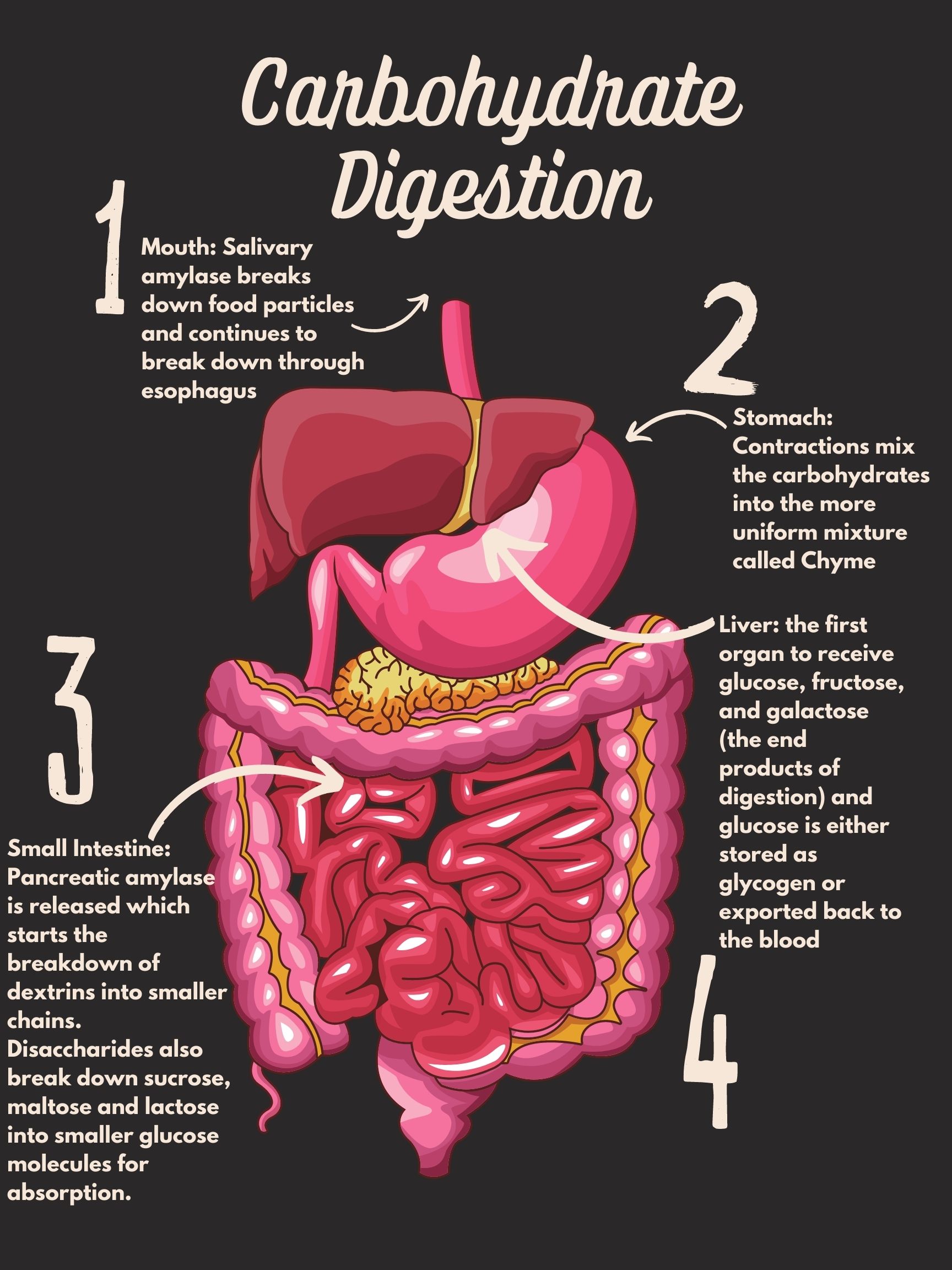
The route through the digestive tract
In the mouth, chewing breaks food into smaller pieces and mixes it with saliva. Saliva contains salivary amylase, an enzyme that begins digesting starch. It cuts long starch chains into shorter carbohydrate chains and maltose.
In the stomach, food is mixed mechanically, but there is little chemical carbohydrate digestion. The stomach’s acidic environment inactivates salivary amylase. This is why the stomach is not a major site of carbohydrate enzyme action.
In the small intestine, most carbohydrate digestion occurs:
- The pancreas releases pancreatic amylase, which continues breaking starch into shorter chains and maltose.
- Enzymes on the lining of the small intestine complete the job:
- Maltase splits maltose into two glucose molecules.
- Sucrase splits sucrose into glucose and fructose.
- Lactase splits lactose into glucose and galactose.
The final absorbable products are glucose, fructose, and galactose.
Read the “Carbohydrate Digestion” section in the following resource to reinforce the locations, enzymes, and final products. The enzyme names matter, but the larger test-ready idea is that digestion turns larger carbohydrates into absorbable monosaccharides.
Digestion and Absorption of Carbohydrates – Nutrition: Science and Everyday Application
Read Digestion and Absorption of Carbohydrates from Open Oregon Educational Resources. It provides a clear, food-based explanation of where carbohydrate digestion occurs and what each carbohydrate becomes.
In the “Carbohydrate Digestion” section, read the subsections “1 – Mouth or Oral Cavity,” “2 – Stomach,” and “3 – Small intestine.” In the small-intestine subsection, begin at most carbohydrate digestion. Track each enzyme and its product, especially the three disaccharide-enzyme pairs. Then read “4 – Large Intestine or Colon” and “Summary of Carbohydrate Digestion,” including Table 4.3. Focus on the summary to contrast digestible starch and sugars with fiber.
Absorption, the liver, and blood glucose
Digestion is not the same thing as absorption.
- Digestion breaks food molecules apart.
- Absorption moves the resulting small molecules from the small intestine into the body.
The small intestine has a very large absorbing surface. Its lining contains tiny projections that allow monosaccharides to move into the bloodstream. From there, these sugars travel first to the liver.
The liver acts as a processing center:
- Glucose can continue circulating in the blood for body cells to use.
- Fructose and galactose are largely converted to glucose in the liver.
- If glucose is not needed immediately, the liver can store some as glycogen, a stored form of carbohydrate. Muscles can also store glycogen.
So even though a meal may contain starch, sucrose, lactose, glucose, fructose, and galactose, glucose becomes the main carbohydrate form circulating in the bloodstream.
A useful example is a meal containing toast, milk, and fruit:
| Food component | Main carbohydrate | Digestion or processing result |
|---|---|---|
| Toast | Starch | Digested ultimately to glucose |
| Milk | Lactose | Lactase produces glucose and galactose |
| Fruit | Glucose, fructose, and fiber | Glucose can be absorbed directly; fructose is processed largely by the liver; fiber is not enzymatically digested |
This pathway also explains lactose intolerance. When someone has too little lactase, lactose is not fully broken down in the small intestine. It moves into the large intestine, where bacteria ferment it; gas, bloating, and diarrhea can result.
The important exception: fiber
It would be inaccurate to say that all carbohydrate becomes glucose. Fiber does not. Humans lack the digestive enzymes needed to split most fiber into monosaccharides.
Instead, fiber reaches the large intestine, where gut microbes can ferment some of it. This can produce gas and certain short-chain fatty acids that cells of the large intestine can use. But fiber is not digested and absorbed as glucose in the same way that starch is.
From blood glucose to ATP inside cells
Once glucose is circulating in the blood, body cells can take it up and use it as fuel. The cell does not use the glucose molecule directly to power every task. Instead, it transfers the energy released from glucose into ATP, adenosine triphosphate.
ATP is often called the cell’s “energy currency.” It supplies usable energy for activities such as:
- muscle contraction,
- active transport across cell membranes,
- building and repairing cellular materials,
- nerve signaling and many other cellular processes.
The relationship to the previous lesson is important:
- A Calorie is a unit used to describe the energy supplied by food.
- ATP is a molecule cells make and spend to transfer usable energy for immediate work.
The overall cellular process that captures energy from glucose is cellular respiration. It occurs in stages rather than in one sudden reaction. This controlled process lets the cell capture energy in ATP instead of losing most of it as heat.
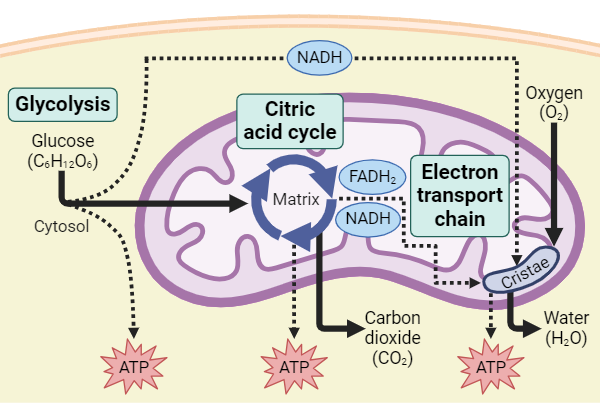
The three big stages
You do not need every chemical intermediate to understand the core pathway. Focus on what enters, where each stage occurs, and what it accomplishes.
-
Glycolysis occurs in the cell’s cytosol, the fluid outside the mitochondria. One glucose molecule is split into two smaller molecules called pyruvate. This stage makes a small amount of ATP and captures some energy in NADH.
-
The citric acid cycle occurs in the mitochondria when oxygen is available. It continues extracting energy from the products of glycolysis. Carbon dioxide is produced during this process.
-
The electron transport chain is also in the mitochondria. NADH carries high-energy electrons to this stage. Oxygen is required at the end of the chain, and the released energy is used to make most of the ATP produced during aerobic cellular respiration. Water is formed as oxygen accepts electrons and hydrogen ions.
At its most basic, ATP formation can be represented as:
In oxygen-rich conditions, cellular respiration is very effective at producing ATP. If oxygen is limited, cells can still obtain a small amount of ATP through glycolysis, but they cannot obtain as much energy from each glucose molecule.
Read the introductory paragraph in the next resource for a concise connection between carbohydrate digestion, glucose delivery to tissues, and ATP production. Do not try to memorize the precise ATP totals presented there; courses and textbooks may use different accounting conventions. The essential point is that glucose is broken down in stages and oxygen allows later stages to produce much more ATP.
24.2 Carbohydrate Metabolism – Anatomy & Physiology 2e
Read the introduction to 24.2 Carbohydrate Metabolism from Anatomy & Physiology 2e. It connects digestive absorption directly to cellular respiration and identifies glycolysis, the citric acid cycle, and the electron transport chain.
Read the introductory paragraph before the “Glycolysis” heading, from digestion to ATP. Identify the sequence of locations: digestive tract, bloodstream, body tissues, cytosol, and mitochondria.
Build the whole explanation
For a quiz response asking how carbohydrate digestion supplies glucose for ATP, organize your answer around these four ideas:
- Break down: Mechanical digestion and carbohydrate-digesting enzymes break starches and disaccharides into monosaccharides.
- Absorb: The small intestine absorbs glucose, fructose, and galactose into the bloodstream.
- Process and deliver: The liver converts much of the fructose and galactose to glucose. Glucose then circulates in the blood or is stored as glycogen for later use.
- Make ATP: Cells take up glucose and break it down through cellular respiration. Glycolysis begins the process; with oxygen, mitochondrial stages produce much more ATP.
Here is a model short-answer response:
Carbohydrates are mechanically and chemically digested, mainly in the mouth and small intestine. Enzymes break starches and disaccharides into monosaccharides, including glucose. These sugars are absorbed through the small intestine into the bloodstream and travel to the liver, where fructose and galactose can be converted to glucose. Cells take up glucose from the blood and use cellular respiration to transfer energy from glucose into ATP, which powers cellular activities.
Notice what this answer does not claim: that every carbohydrate becomes glucose. Fiber is the key exception because it is not enzymatically digested by humans.
Key takeaways
Carbohydrate digestion begins with chewing and salivary amylase, pauses in the acidic stomach, and occurs mostly in the small intestine through pancreatic amylase and enzymes such as maltase, sucrase, and lactase.
The small intestine absorbs the monosaccharides glucose, fructose, and galactose. The liver processes much of the fructose and galactose into glucose, making glucose the main carbohydrate sugar in the bloodstream. Cells then use glucose in cellular respiration to produce ATP, the molecule that provides immediately usable energy for cellular work.
Next, you will shift from what carbohydrate does in the body to where it appears in everyday eating: sorting foods into the five MyPlate food groups.
Can't find a good explanation? Sign up and we'll make it for you
Sign up