
Hello again. In the previous lesson, you learned the -- rule: carbohydrate provides Calories per gram, protein provides Calories per gram, and fat provides Calories per gram. Now you will use those values to solve the kind of Nutrition Facts and quiz problems that ask, “How many Calories come from this nutrient?” or “How many Calories do these macronutrients provide altogether?”
By the end of this lesson, you should be able to calculate Calories from specified grams of carbohydrate, protein, and fat, both separately and as a total.
The one operation: grams times Calories per gram
The central calculation is multiplication:
Use the factor that matches the nutrient:
| Macronutrient | Calculation factor |
|---|---|
| Carbohydrate | Calories per gram |
| Protein | Calories per gram |
| Fat | Calories per gram |
For example, suppose a food contains grams of carbohydrate:
So, grams of carbohydrate supply Calories.
The units are helpful: the “grams” cancel conceptually, leaving Calories. You do not add , , and together first. Instead, identify the nutrient, multiply its grams by its own factor, and then add results only if the question asks for a total.
Here are three single-nutrient examples:
Notice that grams of fat supply more Calories than grams of protein because fat has the higher energy value per gram.
Watch Professor Makkieh’s short worked example before moving on. It models the exact process you will use: calculate each macronutrient separately, then combine the results.
Easy Guide: How to Calculate Calories
In “Easy Guide: How to Calculate Calories,” Professor Makkieh walks through a clear three-macronutrient calculation. Watch it to see the calculation organized from grams to a final Calorie total.
Watch the worked example. Track the three separate multiplications for carbohydrate, protein, and fat, then notice that the three Calorie results are added only at the end.
Finding the right numbers on a Nutrition Facts label
A label gives nutrient amounts per serving. For a Calorie-from-macronutrients calculation, find these three lines:
- Total Fat
- Total Carbohydrate
- Protein
Then multiply each gram amount by the correct factor.
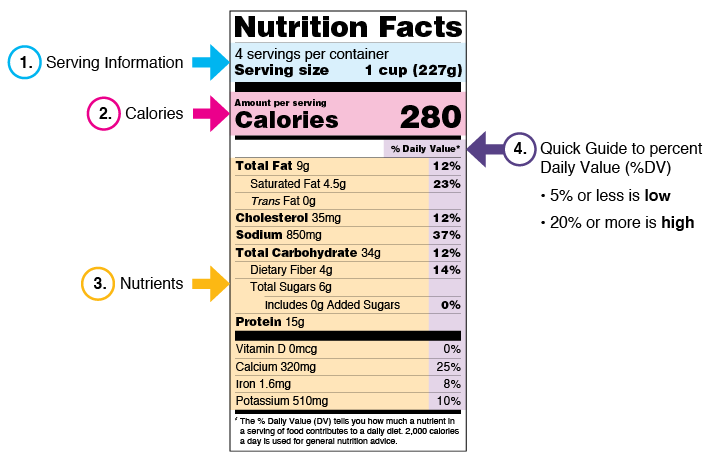
Using the Nutrition Facts label guide, calculate the Calories from each macronutrient in one serving.
Calories from fat
The label lists grams of total fat.
Calories from carbohydrate
The label lists grams of total carbohydrate.
Calories from protein
The label lists grams of protein.
Total Calories estimated from macronutrients
Finally, add the separate Calorie contributions:
The label itself says Calories per serving. A difference of a few Calories is normal because nutrient grams and total Calories on food labels are rounded. For most class questions, use the given grams and the -- factors exactly; your calculation is the answer expected.
Read this short explanation and comparable label example from Classification of Nutrients by Open Oregon Educational Resources. It reinforces why a calculated total can be close to, but not perfectly identical to, the Calories printed on a package.
Classification of Nutrients – Nutrition
Read the worked Nutrition Facts example from Open Oregon Educational Resources to see the same method applied to fat, carbohydrate, and protein on a different label.
In the “Energy-Yielding Nutrients” section, locate Figure 1.7 and begin with the sentence “From these values, you can estimate the amount of calories coming from the different macronutrients.” Read the label calculation and rounding explanation. Focus on the separate multiplication for each nutrient and the reason the final sum may differ slightly from the label total.
A reliable template for total-Calorie questions
When a question gives grams of all three macronutrients, organize your work in three lines. This keeps fat’s -Calorie factor from getting mixed up with the two -Calorie factors.
Then:
Consider a snack with:
- g carbohydrate
- g protein
- g fat
Calculate each contribution:
Now total them:
This snack provides Calories from carbohydrate, protein, and fat combined.
A useful observation: carbohydrate and fat each contributed Calories here, even though the snack contains more than twice as many carbohydrate grams as fat grams. That is the practical effect of fat’s greater Calorie density.
Avoiding label-calculation traps
Nutrition questions often test whether you can choose the correct number from a busy label, not just whether you can multiply.
Use total carbohydrate, not the sugars line
On the Nutrition Facts label guide, total carbohydrate is g and total sugars is g. Sugars are already included within total carbohydrate.
For calculating Calories from all carbohydrate, use:
Do not calculate Calories from g of carbohydrate and then add another calculation for g of sugars. That would count the sugar twice.
Use grams, not percent Daily Value
The percentage in the right-hand column is % Daily Value. It is not used in the -- calculation. Use the gram amount beside the nutrient name.
For example, the label shows total fat as g and Daily Value. To calculate Calories from fat, use g:
The is useful for a different kind of nutrition decision, but not for this calculation.
Keep serving size in view
All label values usually refer to one serving. The Nutrition Facts label guide lists:
- cup as the serving size
- servings per container
If you eat two servings, you consume twice the listed grams of carbohydrate, protein, and fat. You can either double each nutrient amount before doing the math or calculate one serving’s Calories and double the final result.
For the label example, one serving estimates to Calories from macronutrients:
The package’s listed Calories would similarly be:
Again, the small difference reflects rounding. The key point is that serving size determines what the numbers mean.
Answer exactly what is being asked
Questions generally use one of two formats:
| If the question asks... | Your calculation should be... |
|---|---|
| “How many Calories are supplied by grams of fat?” | |
| “How many Calories are supplied by grams of carbohydrate?” | |
| “How many Calories are supplied by grams of protein?” | |
| “How many total Calories come from these macronutrients?” | Calculate all three separately, then add |
If only one nutrient is named, stop after that nutrient’s multiplication. Do not calculate the Calories of the entire food unless the prompt asks for a total.
A fast visual routine for quiz questions
When you encounter a label or word problem, use this brief routine:
- Circle the nutrient named: carbohydrate, protein, fat, or all three.
- Write the factor: carbohydrate , protein , fat .
- Multiply grams by the factor.
- Add only if a total is requested.
- Check serving size if the numbers came from a package label.
For a quick visual study habit, choose one packaged food at home, cover the Calories line with your hand, and calculate an estimated Calorie total from its total fat, total carbohydrate, and protein lines. Then uncover the listed Calories and compare. A small mismatch is expected; a very large mismatch usually means a factor, nutrient line, or serving-size detail was missed.
Key takeaways
To calculate Calories from a macronutrient, multiply its grams by its energy value:
For a food containing all three, calculate each contribution separately and add them. Use Total Carbohydrate, not total sugars; use grams, not % Daily Value; and always confirm whether the question refers to one serving or multiple servings.
Next, you will move from calculating carbohydrate’s energy value to the biological process behind it: how digestion breaks carbohydrate down into glucose that cells can use to produce ATP.
Can't find a good explanation? Sign up and we'll make it for you
Sign up