
Hello again. Previously, you separated nutrients into those that yield energy—carbohydrate, protein, and fat—and those that do not, such as water, vitamins, and minerals. This lesson adds the essential numbers that make food-label questions possible.
By the end, you should be able to recall the standard energy values: carbohydrate provides 4 Calories per gram, protein provides 4 Calories per gram, and fat provides 9 Calories per gram. These are often called the -- rule.
The -- rule
A Calorie on a Nutrition Facts label is a unit of food energy. More precisely, the capitalized “Calorie” used in nutrition is a kilocalorie, but for classwork and labels, you can simply use the term Calorie.
The three energy-yielding macronutrients have standard Calorie values:
| Macronutrient | Energy provided by gram | Recall cue |
|---|---|---|
| Carbohydrate | Calories | First |
| Protein | Calories | Second |
| Fat | Calories | for fat |
The compact memory phrase is:
Carbs , protein , fat .
Carbohydrate and protein are equal in energy per gram. Fat provides more than twice as much energy per gram as either carbohydrate or protein. That does not mean fat is automatically “bad,” or that carbohydrate and protein are automatically “better.” It only tells you how energy-dense each macronutrient is.
Watch this brief segment from How to Calculate Macronutrients (Carbohydrate, Protein, Fat) by Cooking Calories. It presents the three values in a single visual chart.
How to Calculate Macronutrients (Carbohydrate, Protein, Fat) || Determine the Amount of Macro
Watch this short segment to see the standard energy values grouped together. Its main purpose is memorization: carbohydrate and protein share one value, while fat has the higher value.
Watch the energy chart. Focus on the statement that carbohydrates provide 4 kilocalories per gram, proteins provide 4, and lipids or fats provide 9. Pause at the chart and say the three values aloud without looking.
Seeing the rule on a Nutrition Facts label
Food labels list the grams of total carbohydrate, protein, and total fat per serving. The -- rule tells you how much energy each type of macronutrient contributes per gram. The next lesson will use those values to calculate the Calories from a food’s macronutrients.
For now, focus on identifying the three lines that matter:
- Total Fat
- Total Carbohydrate
- Protein
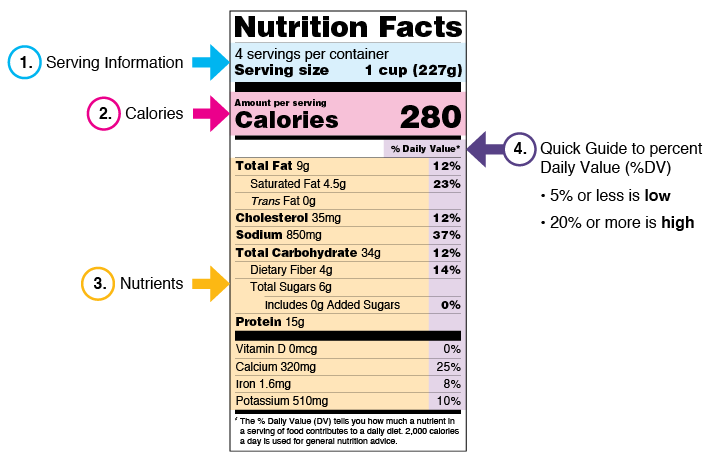
In the sample label, the food has grams of fat, grams of carbohydrate, and grams of protein per serving. Before using any values from a label, always check the serving information at the top. The grams and Calories shown refer to that listed serving size, not necessarily the entire package.
A useful way to read a label is:
- Find the serving size.
- Locate the grams of fat, carbohydrate, and protein.
- Recall the factor for each nutrient: for fat, for carbohydrate, and for protein.
At this stage, do not let the order on the label fool you. Fat is listed first, but its factor is not . Fat is the one associated with .
Avoiding common mix-ups
The values are simple, but several common misconceptions can make quiz questions feel trickier than they are.
Protein does provide Calories
Protein’s major role includes building and repairing body tissues, but it is still an energy-yielding nutrient. Therefore:
“Protein builds muscle” and “protein provides energy” can both be true.
Carbohydrate includes sugars, but the basic factor stays the same
Sugars are carbohydrates. In introductory nutrition questions, carbohydrate is assigned:
So a food being sweet does not change carbohydrate’s standard energy value.
Fat is the only one of the three with
All types of dietary fat contribute energy at the same standard value used on nutrition labels:
The question might say fat, lipid, oil, or total fat. In each case, use Calories per gram.
Vitamins, minerals, and water are outside the -- rule
The rule applies only to the three energy-yielding macronutrients:
| Nutrient named in a question | Calorie rule |
|---|---|
| Carbohydrate | Calories per gram |
| Protein | Calories per gram |
| Fat or lipid | Calories per gram |
| Vitamin or mineral | Calories |
| Water | Calories |
For your assessment, begin by sorting the item into the correct nutrient category. Then the number is much easier to recall.
Make the numbers stick
Use a short visual-and-verbal memory routine:
- Picture three boxes labeled carbohydrate, protein, and fat.
- Put a in the carbohydrate box and a in the protein box.
- Put a in the fat box.
- Say: “Carbs four, protein four, fat nine.”
The pattern matters more than isolated memorization:
- Carbohydrate and protein are a pair: and .
- Fat stands apart with the higher number: .
When you see a food label, mentally place these values beside the macronutrient rows. This creates the bridge between recognizing the label and using it for later calculations.
Key takeaways
The standard energy values for the energy-yielding macronutrients are:
All values are Calories per gram. The most efficient recall phrase is --: carbohydrate , protein , fat .
Next, you will apply these factors to calculate how many Calories come from specified grams of carbohydrate, protein, and fat.
Can't find a good explanation? Sign up and we'll make it for you
Sign up