
Welcome back. In the last lesson, you sorted nutrients by the amount the body needs: carbohydrates, proteins, and fats are central macronutrients, while vitamins and minerals are micronutrients. Now we add a second, very testable distinction: whether a nutrient supplies Calories.
By the end of this lesson, you should be able to identify carbohydrate, protein, and fat as energy-yielding nutrients and explain why water, vitamins, and minerals provide no Calories. This distinction will lead directly into the next lessons on the number of Calories each macronutrient provides and how to calculate Calories from a food label.
Two different ways to classify nutrients
A nutrient can be classified in more than one way. This is why water can seem confusing at first.
- Macronutrient versus micronutrient describes the amount the body needs.
- Energy-yielding versus non-energy-yielding describes whether the nutrient provides usable food energy, measured in Calories.
The key map is:
| Nutrient | Amount category | Provides Calories? |
|---|---|---|
| Carbohydrate | Macronutrient | Yes |
| Protein | Macronutrient | Yes |
| Fat (lipid) | Macronutrient | Yes |
| Water | Macronutrient in the broad, amount-based classification | No |
| Vitamins | Micronutrients | No |
| Minerals | Micronutrients | No |
So, the three energy-yielding macronutrients are:
Water is needed in a large amount, which is why many nutrition texts classify it as a macronutrient. But water is not an energy nutrient: it supplies zero Calories.
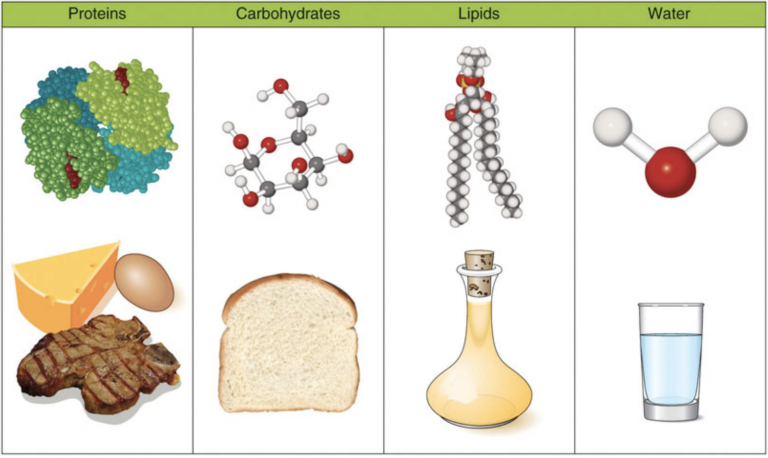
Notice that this image shows four nutrients required in relatively large amounts: proteins, carbohydrates, lipids, and water. The important difference is not how essential water is—it is indispensable—but whether it can be used as a source of dietary energy. It cannot.
What does “provides Calories” actually mean?
In nutrition, a Calorie is a unit of energy; on food labels, “Calories” conventionally means kilocalories, or kcal. Cells need energy to perform work: maintaining a heartbeat, breathing, moving muscles, building tissues, and carrying out countless chemical reactions.
Carbohydrate, protein, and fat contain chemical energy that the body can metabolize into cellular energy, including ATP. They are therefore called energy-yielding nutrients.
Each has other important functions as well:
- Carbohydrate is an important fuel source and can be digested into glucose.
- Fat supplies and stores energy, while also helping form cell structures and protect organs.
- Protein helps build and repair tissues and can also provide energy.
A nutrient does not have to serve only as fuel to be energy-yielding. Protein is a good example: tissue maintenance is a major role, but protein can still contribute Calories.
This short visual review from Introduction, Overview of Nutrients by Level Up RN reinforces the three energy-yielding nutrient classes. The exact Calorie values mentioned will be the focus of the next lesson.
Introduction, Overview of Nutrients - Nutrition Essentials | @LevelUpRN
Watch “Introduction, Overview of Nutrients” by Level Up RN to connect carbohydrates, fats, and proteins with dietary energy.
Watch energy nutrients. Focus first on the three names—carbohydrate, fat or lipid, and protein—and on the fact that each supplies energy. You do not need to memorize the per-gram numbers yet.
Why water provides no Calories
Water does many things that make life possible. It transports substances, supports chemical reactions, helps regulate body temperature, lubricates joints, and cushions organs. Yet none of those functions make it an energy source.
Think of water as part of the body’s working environment, not as fuel. Your body requires it in large quantities, but it cannot metabolize water to obtain dietary Calories.
This produces an important quiz-ready statement:
Water is essential and needed in large amounts, but it is not energy-yielding and provides no Calories.
The same point applies even if the water comes from a food rather than a glass. For example, an orange contains a great deal of water. Any Calories in the orange come mainly from its carbohydrate, not from its water.
Why vitamins and minerals provide no Calories
Vitamins and minerals are micronutrients: the body requires them in smaller amounts than macronutrients, but they remain essential. They support normal functions such as immune health, bone maintenance, blood-cell formation, fluid balance, nerve signaling, and metabolism.
They do not supply Calories. Instead, many vitamins and minerals help the body use the energy supplied by carbohydrates, fats, and proteins. In other words, they help the metabolic machinery work, but they are not the fuel being used.
A useful distinction is:
| Question | Correct answer |
|---|---|
| Does vitamin C provide energy? | No |
| Does iron provide energy? | No |
| Are vitamins and minerals still necessary for health? | Yes |
| Can they help the body process energy-yielding nutrients? | Yes |
| Do carbohydrate, protein, and fat provide Calories? | Yes |
Read the indicated sections of Introduction to Nutrition and Wellness for the textbook explanation of this classification system.
Chapter 1: Introduction to Nutrition – Nutrition Essentials
Read the “Macronutrients” and “Micronutrients” sections to see the distinction between nutrients needed in large versus small quantities and nutrients that do versus do not yield Calories.
In the “Macronutrients” section, read from the definition of macronutrients. Pay particular attention to why water qualifies as a macronutrient by amount but not as an energy nutrient. Then, in the “Micronutrients” section, read from the micronutrient explanation. Focus on the phrase that vitamins and minerals assist energy production but do not contain kcal themselves.
A food contains a mixture, not just one nutrient
Quiz questions sometimes name a nutrient directly, such as “iron” or “fat.” Other times they name a food, which is more complicated because most foods contain a mixture of nutrients.
Consider a slice of bread. It may contain:
- carbohydrate, which contributes Calories;
- a smaller amount of protein, which also contributes Calories;
- perhaps a little fat, which contributes Calories;
- water, which contributes no Calories;
- vitamins and minerals, which contribute no Calories.
The food’s total Calories come from the carbohydrate, protein, and fat—not from its water, vitamins, or minerals.
This is why a food can be nutritious without every nutrient in it being a source of Calories. A vegetable, for example, can provide water, fiber, vitamins, minerals, and some carbohydrate. Its vitamins and minerals are valuable, but its Calories come from the carbohydrate portion.
A quick method for answering assessment questions
When you encounter a nutrient on a quiz, use these two checks.
First: Is it carbohydrate, protein, or fat?
If yes, it is an energy-yielding nutrient and provides Calories.
Second: Is it water, a vitamin, or a mineral?
If yes, it provides no Calories.
Common examples:
| If the question names... | Your answer should include... |
|---|---|
| Starch | Carbohydrate; provides Calories |
| Olive oil | Fat or lipid; provides Calories |
| Amino acids from food protein | Protein; provides Calories |
| Water | No Calories |
| Vitamin A | Micronutrient; no Calories |
| Vitamin C | Micronutrient; no Calories |
| Calcium | Mineral; no Calories |
| Iron | Mineral; no Calories |
One possible distractor is alcohol. Alcohol does provide energy, but it is not considered an essential nutrient. For this outcome, keep the main rule clear: the energy-yielding nutrients are carbohydrate, protein, and fat.
Key takeaways
You now have two classification systems working together:
- Macronutrient versus micronutrient tells you the relative amount required.
- Energy-yielding versus non-energy-yielding tells you whether a nutrient provides Calories.
The three energy-yielding nutrients are:
- Carbohydrate
- Protein
- Fat (lipid)
Water, vitamins, and minerals all provide zero Calories. Water is a special case in terminology: it is often called a macronutrient because the body needs a large amount of it, but it is not an energy-yielding macronutrient.
Next, you will learn the exact Calorie values for carbohydrate, protein, and fat: the numbers needed to interpret labels and calculate the Calories supplied by a food.
Can't find a good explanation? Sign up and we'll make it for you
Sign up