
Hello. In the previous lesson, you built a map of the bass fretboard: each prompted pitch could be derived from the open strings, the 12-note cycle, and enharmonic pairs. Rhythm is the second coordinate of a bass line. A note is only useful in a groove when it arrives at a precise place in time.
This lesson focuses on one skill: counting aloud a single bar in containing quarter notes, eighth notes, quarter rests, and eighth rests. For now, leave the bass aside. The aim is to make the time grid clear in your voice and body first; the next lesson will transfer that grid to prompted notes on the fretboard.
Plan for about 35–40 minutes: learn the grid, watch a short demonstration, then complete several slow spoken-count passes.
: four beats, eight possible eighth-note positions
A time signature tells you how time is organized in a bar. In :
- The top means there are four beats in each bar.
- The lower tells us that a quarter note receives one beat.
Every new bar begins again at one. The fundamental spoken pulse is therefore:
one, two, three, four
A useful way to make the rhythm more precise is to divide each beat into two equal halves. Those halves are eighth-note positions:
| Beat | First half: downbeat | Second half: upbeat |
|---|---|---|
| 1 | one | and |
| 2 | two | and |
| 3 | three | and |
| 4 | four | and |
So the complete internal grid of a bar is:
one and two and three and four and
The numbers are the downbeats: they align with the four main pulses. The word and marks the halfway point between one beat and the next. Do not rush the word “and”; it has exactly as much time as a number.
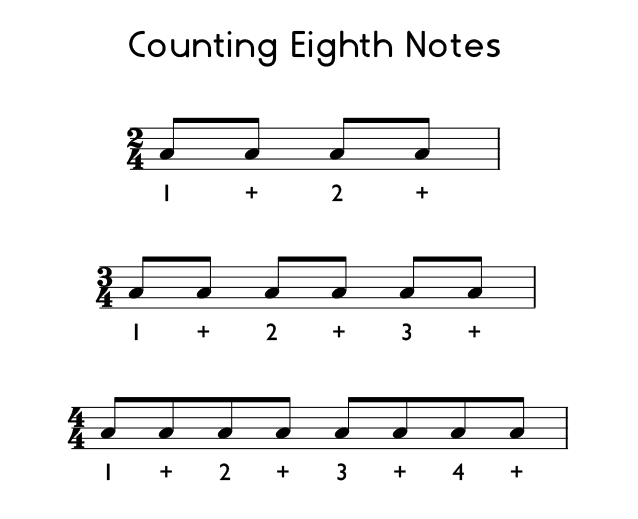
For this lesson, make a small, silent physical pulse while you count: tap a foot or lightly move your hand downward on one, two, three, four. The movement must continue when the notation contains a rest. That is how you prevent a rest from becoming an accidental pause in the bar.
Note lengths and rest lengths occupy the same grid
A note produces sound; a rest produces silence. But both occupy a specific amount of time. A rest is not “nothing happened, so time stopped.” It is a scheduled piece of silence.
In , the values you need are:
| Symbol type | Duration | Space occupied in the eighth-note grid |
|---|---|---|
| Quarter note | 1 beat | a number and its following “and” |
| Quarter rest | 1 beat of silence | a number and its following “and” |
| Eighth note | half a beat | one grid position |
| Eighth rest | half a beat of silence | one grid position |
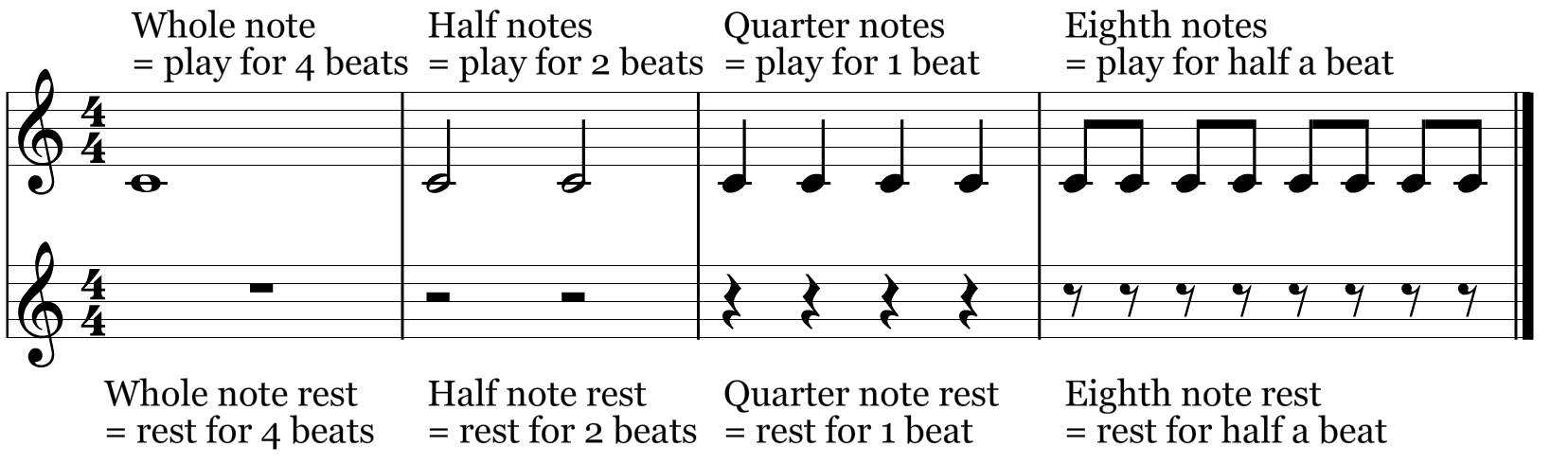
A quarter note lasts through both halves of its beat. If a quarter note begins on beat three, its duration covers three and. When counting it, you normally say three at its start and sustain the sound across the rest of the beat.
Two eighth notes fill the same amount of time as one quarter note. If they occur together on beat three, you say:
three and
Eighth notes may be connected by a beam in written music, but do not depend on the beam alone. Think in durations: two half-beat notes fill one complete beat.
Learn the standard spoken-count convention
There are several ways musicians describe rhythm. In this course, use this practical convention:
- Say the count at every sounding eighth-note position.
- Remain vocally silent during a rest.
- Keep the full eight-position grid internally, even while silent.
- Maintain the four main foot taps throughout the entire bar.
That third point is the difficult one. Your voice may omit a count because the notation says rest, but your sense of time must not omit its position.
For example, consider this one-bar rhythm:
| Beat 1 | Beat 2 | Beat 3 | Beat 4 |
|---|---|---|---|
| quarter note | two eighth notes | quarter rest | two eighth notes |
Your full internal grid is always:
one and two and three and four and
But the spoken result is:
one, two-and, [silent], four-and
During the quarter rest on beat three, do not say “three” or “and.” Still tap the third foot pulse and feel the two silent eighth-note positions pass. The fourth beat must arrive on time.
The brackets are not a substitute for silence; they are merely reminders while learning. When you actually count the rhythm, be quiet there.
How To Count Music - Quarters and Eighths - Music Theory Crash Course
Watch “How To Count Music - Quarters and Eighths - Music Theory Crash Course” from Odd Quartet. It gives a compact demonstration of the number-and-“and” system and, crucially, shows how a rest still has a measured duration.
Begin with the basic pulse to connect 4/4 with four numbered beats. Then watch eighth-note counting, listening for the even placement of each “and.” Finish with mixed values and rests. Notice that the speaker becomes silent for a rest but does not lose the underlying pulse.
Decode a bar from its time slots, not from its appearance
When a rhythm looks busy, do not try to absorb the entire bar at once. Read it from left to right and assign every note or rest to its place in the fixed grid.
Here is a reliable procedure.
1. State the grid before reading the notes
For every bar containing only quarters and eighths, establish:
one and two and three and four and
There are always eight eighth-note slots. The rhythm simply decides which slots contain sound and which contain silence.
2. Identify what occupies each beat
Ask whether each numbered beat contains:
- one quarter note,
- one quarter rest,
- two eighth notes,
- an eighth note followed by an eighth rest, or
- an eighth rest followed by an eighth note.
The last two situations are especially useful to recognize because they create different kinds of silence.
3. Speak only the sounding positions while retaining the grid
Consider this bar:
| Beat 1 | Beat 2 | Beat 3 | Beat 4 |
|---|---|---|---|
| eighth rest + eighth note | quarter note | eighth note + eighth rest | quarter rest |
The full internal count remains:
one and two and three and four and
Now place the events:
- Beat 1: silent on one, sound on and
- Beat 2: sound on two, held through its “and”
- Beat 3: sound on three, silent on its “and”
- Beat 4: silent for both four and
The audible count is:
and, two, three
That may initially feel incomplete. It is incomplete vocally, but it is complete rhythmically because your internal grid and physical beat pulse continued through every rest.
A common mistake is to say “rest” out loud. Avoid that in performance-style counting. A rest is the absence of sound; saying the word creates sound where silence belongs. Use “rest” only when explaining or analyzing the notation.
Three rhythms to internalize
Use these as spoken-reading drills. First read the “full grid” silently, then speak the sounding counts at a steady pace. Tap your foot on each number throughout.
Rhythm A: quarter note, eighth pair, quarter rest, eighth pair
| Beat 1 | Beat 2 | Beat 3 | Beat 4 |
|---|---|---|---|
| quarter note | eighth note + eighth note | quarter rest | eighth note + eighth note |
- Internal grid: one and two and three and four and
- Spoken count: one, two-and, four-and
- Silent span: all of beat three
This rhythm tests whether you can re-enter accurately on beat four after a full beat of silence.
Rhythm B: eighth pair, quarter rest, quarter note, eighth note plus eighth rest
| Beat 1 | Beat 2 | Beat 3 | Beat 4 |
|---|---|---|---|
| eighth note + eighth note | quarter rest | quarter note | eighth note + eighth rest |
- Internal grid: one and two and three and four and
- Spoken count: one-and, three, four
- Silent span: all of beat two, then the final “and”
This rhythm is a good test of whether a final eighth rest makes you cut the bar short. It does not. The bar ends only after the silent last “and” has elapsed.
Rhythm C: quarter rest, eighth note plus eighth rest, eighth rest plus eighth note, quarter note
| Beat 1 | Beat 2 | Beat 3 | Beat 4 |
|---|---|---|---|
| quarter rest | eighth note + eighth rest | eighth rest + eighth note | quarter note |
- Internal grid: one and two and three and four and
- Spoken count: two, and, four
- Silent span: beat one, the “and” after two, and the downbeat of three
This is the most mentally demanding of the three because the first sounding event appears after silence and because beat three begins with an eighth rest. Keep the foot pulse absolutely even: tap one, two, three, four whether or not your voice makes a sound.
A focused 12-minute counting routine
Work slowly enough that every silence feels intentional. A moderate walking speed is plenty; accuracy matters more than speed.
-
Grid calibration — 2 minutes.
Speak one and two and three and four and repeatedly. Tap only on the numbers. Aim for identical spacing between every spoken word. -
Quarter-note and quarter-rest contrast — 3 minutes.
Alternate a bar of four quarter notes with a bar containing a quarter rest on beat three. In the second bar, say one, two, four, but keep all four foot taps. Repeat until beat four arrives evenly after the silence. -
Eighth-rest contrast — 3 minutes.
Alternate these two beat-level fragments:- eighth note then eighth rest: say one, then remain silent
- eighth rest then eighth note: remain silent, then say and
Repeat the same idea on beats two, three, and four so that the labels are not tied to a single familiar location.
-
Whole-bar reading — 4 minutes.
Count Rhythms A, B, and C above three times each. On the first pass, trace the eight internal positions with a finger. On the second, tap the quarter-note pulse. On the third, look away from the table and reconstruct the rhythm from memory.
If a rhythm falls apart, do not repeat it faster. Return to the full internal grid, locate the first rest, and rebuild the bar one beat at a time.
Key takeaways
In , each bar contains four quarter-note beats and eight eighth-note positions: one and two and three and four and. Quarter notes and quarter rests occupy a full beat; eighth notes and eighth rests occupy half a beat.
The central skill is to distinguish audible counting from internal timekeeping. You speak the counts where notes sound, remain silent during rests, and preserve the complete grid with a steady physical pulse. A rest changes what you play or say, never where the beat is.
Next, you will apply this exact counting system to bass: playing one-bar quarter- and eighth-note rhythms on prompted fretboard notes while maintaining a metronome pulse through every rest.
Can't find a good explanation? Sign up and we'll make it for you
Sign up