
Welcome. This eight-week course builds two demanding but complementary skills: a usable bass-language system for creating lines from chord symbols, and gradual Mandarin foundations. In this first module, the bass work begins with the physical map underlying everything else: knowing exactly where a named note lives before rhythm, scales, chords, and funk vocabulary are added.
Today’s target is precise: on a standard four-string bass in low-to-high E–A–D–G tuning, you will be able to locate and play named notes from the open strings through fret 12. For the five pitches with two common names, you will give both names—for example, F-sharp / G-flat. The goal is not to stare at a chart until it looks familiar; it is to build a small set of rules that lets you derive any answer and then retrieve it quickly.
The fretboard is four copies of one 12-note cycle
First, tune or verify that your open strings are:
- E: lowest, thickest string
- A
- D
- G: highest, thinnest string
A fret is not merely a physical location: every fret raises the pitch by one half-step. There are only 12 pitch classes before the pattern repeats an octave higher at fret 12.
Moving upward in pitch from A, the complete cycle is:
A, A-sharp / B-flat, B, C, C-sharp / D-flat, D, D-sharp / E-flat, E, F, F-sharp / G-flat, G, G-sharp / A-flat, then A again.
Two features make the cycle manageable:
- B to C are adjacent: one fret apart.
- E to F are adjacent: one fret apart.
Every other pair of neighboring natural letters has one accidental pitch between it. For instance, the pitch between F and G is F-sharp, which is also G-flat.
A sharp name means “one fret higher than the named natural note”; a flat name means “one fret lower.” Therefore, F-sharp and G-flat are two names for the same sounding fret. This is called an enharmonic spelling. At this stage, use these five standard pairs:
| One pitch, two names |
|---|
| A-sharp / B-flat |
| C-sharp / D-flat |
| D-sharp / E-flat |
| F-sharp / G-flat |
| G-sharp / A-flat |
For this course’s fretboard work, natural notes such as C and F are simply called C and F. More unusual spellings such as B-sharp or E-flat-sharp belong to later notation contexts and are not required here.
At fret 12, every string reaches the same letter as its open string, one octave higher:
- E string: open E and fret 12 E
- A string: open A and fret 12 A
- D string: open D and fret 12 D
- G string: open G and fret 12 G
That double-dot fret marker, if your bass has one, is not decoration. It marks the reset point of the entire system.
Memorize the Bass Fretboard in 9 Minutes
Watch Memorize the Bass Fretboard in 9 Minutes from BassBuzz for a concise visual introduction to low-position “anchor” notes and the say-and-play method. It reinforces the idea that the fretboard is navigable rather than a giant list to memorize.
Watch the anchor notes first. Notice how the natural notes in the first few frets form a continuous letter sequence across the strings. Then watch say and play, which demonstrates naming each fret while ascending and descending a string. When the presenter uses a sharp name going up and a flat name going down, pause briefly at each accidental and say both names aloud.
Build the map from natural-note landmarks
You do not need to memorize 52 unrelated string-and-fret facts. Learn the natural notes on each string first; every remaining fret is the accidental between two neighboring natural notes.
Here are the natural-note landmarks through fret 12:
- E string: E (open), F (1), G (3), A (5), B (7), C (8), D (10), E (12)
- A string: A (open), B (2), C (3), D (5), E (7), F (8), G (10), A (12)
- D string: D (open), E (2), F (3), G (5), A (7), B (9), C (10), D (12)
- G string: G (open), A (2), B (4), C (5), D (7), E (9), F (10), G (12)
Read each line as a route rather than a fact sheet. For example, on the A string: A is open; B is two frets up; C is one more fret; D is two more. Once you can say that route, the accidental locations become inevitable:
- A-string fret 1 lies between A and B, so it is A-sharp / B-flat.
- A-string fret 4 lies between C and D, so it is C-sharp / D-flat.
- A-string fret 6 lies between D and E, so it is D-sharp / E-flat.
The same reasoning works on every string.
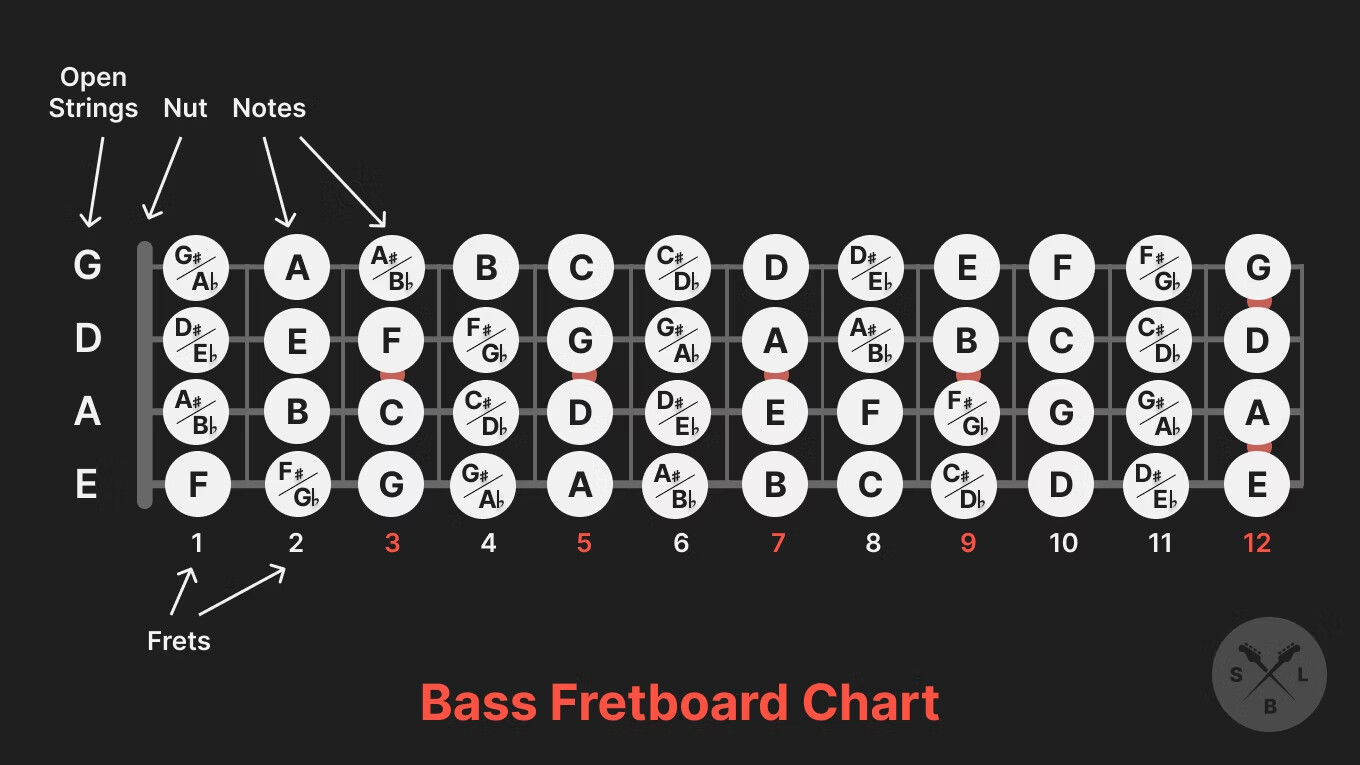
Use the chart as a checking device, not as the primary memory method. Cover a row, name its notes from the rules, then uncover it to check. When reading it, pay special attention to the fret numbers rather than the visual orientation of the strings: charts often place the G string at the top even though your physical viewpoint of the instrument may differ.
Three navigation rules that prevent guessing
A prompted note can appear in more than one place on the neck. Those are not different notes; they are the same note name at different octaves, or sometimes the same exact sounding pitch on adjacent strings. These relationships give you reliable ways to verify an answer.
1. Find the nearest natural note, then move one fret if necessary
Suppose the prompt is E-flat. Start from E, then move one fret lower in pitch. E-flat is therefore also D-sharp.
On the E string, D is fret 10 and E is fret 12. The fret between them, fret 11, must be D-sharp / E-flat.
This method works in either direction:
- To find a sharp, start from the lower natural letter and move one fret higher.
- To find a flat, start from the higher natural letter and move one fret lower.
2. The same named note appears 12 frets away
If you know G is at fret 3 on the E string, then fret 15 is also G. This lesson stops at fret 12, but the repetition rule is useful because it makes the first 12 frets the core map of the whole neck.
Within today’s range, treat fret 12 as a landmark. If you become uncertain near the high end, reason backward from it. For example, fret 11 on the E string is one fret below E, so it is D-sharp / E-flat.
3. Use cross-string checks
Because adjacent open strings are five semitones apart, a note can be found on the next higher string five frets lower. For example:
- C at fret 8 on the E string is the same sounding pitch as C at fret 3 on the A string.
- F at fret 8 on the A string is the same sounding pitch as F at fret 3 on the D string.
There is also an octave shape:
- From a note on the E or A string, go two strings higher and two frets higher to find the same letter one octave above.
For example, C at E-string fret 8 has an octave C at D-string fret 10. This is a confirmation tool, not a substitute for knowing the string itself.
Consider the note C-sharp / D-flat. Derive its locations through fret 12:
- E string, fret 9
- A string, fret 4
- D string, fret 11
- G string, fret 6
Say the complete name before you play each one: “C-sharp, also D-flat.” Doing so ties the visual fret location, hand movement, sound, and two spellings into one memory.
A short, deliberate playing routine
For fretboard memory, slow active recall is more valuable than a long passive glance at a diagram. Work cleanly: fret close to the wire on the body side without resting on the wire, pluck one clear note, and let your voice keep pace with your hands.
Use this 12–15 minute routine during today’s session:
-
Natural-note pass, 4 minutes.
Play the natural notes on one string at a time from open through fret 12. Say every letter aloud. Start with the E and A strings, then complete D and G. -
Chromatic pass, 4 minutes.
Play every fret from open through fret 12 on one string. Ascend using sharp names, then descend using flat names. For example, when ascending from E: E, F, F-sharp, G, G-sharp, and so on. On the descent, call the same frets G-flat, E-flat, D-flat, and so forth. At each accidental, deliberately say its alternate name once. -
One-note sweep, 3 minutes.
Choose one note name and locate it everywhere between open and fret 12. Start with C, then try a dual-named pitch such as B-flat / A-sharp. Keep the note name in your mind while changing strings; do not merely follow a shape. -
Random-location naming, 2–4 minutes.
Look away, place a finger on a random fret from 0 through 12, look back, name the pitch, then play it. If it is an accidental, provide both names. Check with the chart only after you have committed to an answer.
The ability being trained is retrieval: seeing “G-flat,” recalling its relationship to F and G, locating it, and then making the sound. That is the form of memory you will need when a chord chart eventually says “G-flat minor seven” and the band does not pause for you to calculate.
Bass Guitar Notes: Fretboard Charts for 4, 5 & 6-String Bass
Use the interactive Fretboard Note Finder on PosiDovega after your first recall attempt. It gives immediate feedback while keeping the task narrow: one target note on one string from open through fret 12.
At the top of the page, find the “Fretboard Note Finder” before the standard-tuning explanation. Use the note finder in three short rounds. First choose natural notes only; next choose the flat-named targets and say their sharp equivalents aloud; finally use “Random Challenge.” Before clicking, identify a nearby natural-note landmark and explain to yourself how many frets separate it from the answer.
Make enharmonic naming automatic
There is a small but important distinction between finding the fret and naming the fret fully. If you play fret 6 on the A string and say only “E-flat,” you have found the pitch correctly but have not yet demonstrated its alternate name. Add the companion name immediately: “E-flat, also D-sharp.”
A useful verbal pattern is:
- “One fret above F is F-sharp, also G-flat.”
- “One fret below A is A-flat, also G-sharp.”
- “One fret above C is C-sharp, also D-flat.”
Avoid treating sharp and flat names as competing answers. They describe the same sounding position. In later lessons, chord spelling will determine which name is musically preferable, but today both names are part of your fretboard vocabulary.
A practical standard for this lesson is accuracy first. Given a string and a note prompt, pause long enough to derive the position, play a clean note, and state the full answer. With repeated short sessions, the derivation becomes fast without becoming guesswork.
You now have a complete through-fret-12 system: four open-string starting points, a 12-note cycle, the two one-fret natural-note pairs, five enharmonic pairs, and cross-string checking shapes. Those rules let you name and play any prompted pitch rather than memorize an arbitrary grid.
Next, you will keep this fretboard map active while learning to count one-bar 4/4 rhythms with quarter notes, eighth notes, and rests. The essential new challenge will be maintaining the pulse even when you do not play.
Can't find a good explanation? Sign up and we'll make it for you
Sign up