
Welcome back. In the previous lesson, you learned to hold an internal eighth-note grid—one and two and three and four and—while your voice remains silent for rests. Now the task is to transfer that grid to the bass.
By the end of this lesson, you will be able to read a one-bar rhythm, decide where each prompted pitch will be played, and perform quarter notes, eighth notes, and rests with a metronome. The central challenge is not fretboard knowledge or speed: it is letting the click continue to organize your time when your hands are silent.
Keep three jobs separate
When playing a written rhythm on bass, three things happen at once:
- The metronome supplies the quarter-note pulse. At a starting tempo of bpm, each click is one beat: one, two, three, four.
- Your internal count supplies the eighth-note positions. Each “and” lands exactly midway between two clicks.
- Your hands decide whether that position contains a note, a held note, or silence.
A rest does not interrupt the first two jobs. It changes only the third job: you do not attack a note, and any preceding note must stop sounding when the rest begins.
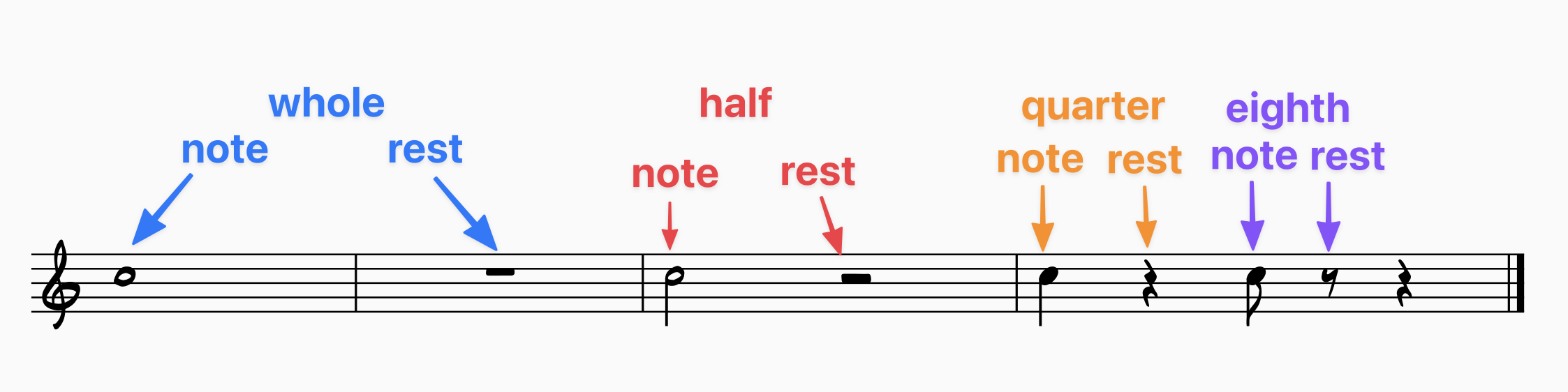
Before you play any bar, make two decisions:
- Choose the pitch location before the count-in. If the prompt is C, decide on a location such as A string, third fret before you begin. Do not search for the note halfway through the bar.
- Identify all eight time slots. Even a bar with several rests still contains the complete internal grid: one and two and three and four and.
For this lesson, use fingerstyle or whichever plucking motion feels most controlled. Do not work on slap or pop here; clean time and muting are the priorities.
Hear the space between clicks
The most common rhythmic error with eighth notes is placing an upbeat too close to one click or the next. The “and” must sit in the middle. If the metronome clicks on beats three and four, the and of three is not a little before beat four; it is halfway between them.
Read the following short excerpt from StudyBass before playing. It focuses specifically on making eighth notes even and locating offbeats independently.
The Eighth Note Subdivision | StudyBass
Read “The Eighth Note Subdivision” from StudyBass to reinforce the physical meaning of even eighth-note spacing and offbeat placement on bass.
In the subsection “Playing Steady Eighth Notes,” read the explanation of even spacing. Notice the emphasis on the “ands” falling exactly between beats. Then move to “Playing the Off-Beats.” Read the offbeat practice guidance. Focus on the instruction to count while plucking on the “ands,” rather than drifting onto the metronome click.
A useful reality check: record ten seconds of yourself playing only the “ands.” If your notes seem to merge with the clicks, they are probably late or early. A correctly placed upbeat feels balanced between clicks.
A rest requires muting, not merely no new note
On bass, rests require intentional technique. If you simply refrain from plucking, the previous note may continue ringing across the rest. That contradicts the notation: a rest is scheduled silence.
At the beginning of a rest:
- Release the fretting pressure while keeping the fretting finger lightly touching the string. This stops the pitch without allowing an open string to ring.
- Let your plucking-hand thumb or unused fingers help control sympathetic string noise.
- Keep your foot pulse and internal eighth-note grid going.
Consider a beat containing an eighth note followed by an eighth rest:
| Count | one | and |
|---|---|---|
| Action | Play the prompted note | Mute; remain silent |
The note lasts only until the midpoint of the beat. The mute happens on the “and,” precisely where the eighth rest begins.
Now reverse it:
| Count | one | and |
|---|---|---|
| Action | Remain silent | Play the prompted note |
This is more demanding because the attack comes between clicks. Feel the click on one, retain the internal midpoint, then place the note on and without rushing toward beat two.
The following video addresses exactly this issue: rests that are accidentally shortened, extended, or treated as empty time.
Watch “Reading Rhythms (Bass Lesson)” by No Treble for a bass-specific explanation of why rests must retain their full duration and how a subdivision grid prevents timing mistakes.
Watch rests and pulse. Focus on the explanation of why cutting a rest short changes the rhythm, even if the notes themselves are correct. Then watch the grid method. The instructor’s “lowest common denominator” idea is the same eight-slot grid you will use for quarter and eighth-note rhythms.
Build coordination in four layers
Set a metronome to bpm. At this speed, resist the temptation to make the eighth notes faster than the gaps between them. Treat every bar as a small timing problem to solve accurately.
Layer 1: Play only the quarter-note pulse
Choose a single prompted pitch: C at A string, third fret.
Play one note on each click for four bars. Count quietly or aloud:
one, two, three, four
Each note begins with a click. Let it last approximately one beat, then prepare cleanly for the next attack. This is the simplest way to connect your hands to the metronome.
Next, repeat with a few prompts from your existing fretboard map:
- D at A string, fifth fret
- E at D string, second fret
- F-sharp at D string, fourth fret
- G at D string, fifth fret
Do not move to a new pitch until the quarter-note pulse is stable.
Layer 2: Fill every eighth-note position
Choose D at A string, fifth fret. Play eight even eighth notes in each bar while the metronome continues at bpm.
Your hands play:
one-and two-and three-and four-and
The numbers coincide with clicks; the “ands” fall in between. Use alternating plucking fingers if that is already comfortable, but do not sacrifice timing to force alternation. The goal is eight evenly spaced attacks.
Then play only the offbeats. Stay silent on every click and play only on the “ands”:
one-[play] two-[play] three-[play] four-[play]
This is a direct test of whether you can locate the midpoint of every beat.
Layer 3: Re-enter after a full beat of silence
Use this rhythm with the prompt G at D string, fifth fret:
| Beat 1 | Beat 2 | Beat 3 | Beat 4 |
|---|---|---|---|
| quarter note | two eighth notes | quarter rest | two eighth notes |
Your internal grid remains:
one and two and three and four and
Your played attacks are:
one, two-and, four-and
On beat three, stop the sound, keep the foot pulse, and silently feel both three and and. Beat four must arrive exactly with the next click—not early because you anticipated it, and not late because you lost the bar.
Loop the bar four times. On the fourth repetition, listen especially for whether the first note on beat four still lands with the click.
Layer 4: Combine rests with changing pitches
This bar adds fretboard decisions without adding any faster subdivision. Use the indicated locations initially so that rhythm, not note-searching, remains the main problem.
| Slot | 1 | and | 2 | and | 3 | and | 4 | and |
|---|---|---|---|---|---|---|---|---|
| Action | C, quarter note | hold C | E, eighth note | eighth rest | eighth rest | F-sharp, eighth note | A, quarter note | hold A |
| Suggested location | A string, 3rd fret | — | D string, 2nd fret | mute | silent | D string, 4th fret | G string, 2nd fret | — |
The audible count is:
one, two, and, four
The “and” you say is the and of beat three, not the and after beat two. Your internal count carries you through both silent slots: the and of beat two and beat three.
Use this order:
- Speak the rhythm while tapping four steady foot pulses.
- Finger the locations silently and imagine the plucks and mutes.
- Play at bpm for four repetitions.
- Stop immediately if the rhythm shifts. Rebuild it from the eight slots rather than attempting to correct in the middle of the bar.
A compact performance routine
Spend about 15 minutes on this routine. Keep the tempo at bpm until every re-entry feels predictable.
| Time | Activity | What to monitor |
|---|---|---|
| 3 minutes | Quarter notes on changing prompts | Every attack aligns with a click |
| 3 minutes | Continuous eighth notes on one pitch | Equal spacing; no hurried “ands” |
| 3 minutes | Offbeats only | Every note is midway between clicks |
| 3 minutes | The G rhythm with a beat-three quarter rest | Beat four returns exactly on time |
| 3 minutes | The changing-pitch rhythm above | Clean pitch changes and complete silence during rests |
For the final three minutes, replace the suggested pitches in the changing-pitch rhythm with new prompts from across the fretboard—for example B-flat, D, F, and A. Decide each location before the metronome count-in. If the note search disrupts the pulse, simplify: retain the rhythm but return to a single pitch, then add one new pitch at a time.
A successful repetition has four features:
- The metronome click remains your reference, not something you chase after an error.
- Every eighth-note attack is clearly on a number or an “and.”
- A rest contains no ringing note or accidental open string.
- The next note after a rest arrives at its scheduled slot without hesitation.
Raising the tempo is optional. If you can perform each pattern correctly three times in succession at bpm, try or bpm. If rests become noisy or offbeats drift, return to bpm.
Key takeaways
A bass rhythm is not a series of notes separated by vague gaps. It is a sequence of decisions placed on a fixed grid. In with quarter and eighth values, that grid contains eight positions: one and two and three and four and.
The metronome supplies the quarter-note pulse; your internal subdivision locates the “ands”; your hands execute notes and full-duration silences. During a rest, keep counting internally, maintain the pulse physically, and mute the previous sound cleanly. This discipline is the foundation for the more syncopated sixteenth-note funk rhythms later in the course.
Next, the course briefly shifts to the Mandarin track: you will begin separating Pinyin into initials and finals for the numerals one through ten and the pronouns for “I,” “you,” “he,” and “she.”
Can't find a good explanation? Sign up and we'll make it for you
Sign up