
Welcome back. In the previous lesson, you kept an eighth-note pulse on bass even when rests created silence. This lesson shifts to the Mandarin strand. The equivalent discipline here is to keep the structure of a syllable clear even when its spelling looks unfamiliar.
Mandarin Pinyin represents the sound of a Chinese character. Before working on tones, you will learn to separate each target syllable into its initial and final, then say its consonant and vowel sequence as one connected syllable. By the end, you should be able to analyze the Pinyin for the numerals 一 through 十 and the pronouns 我、你、他、她 without treating every printed letter as a separate sound.
For today, ignore the tone marks in the visual references. We will write such forms as yi, wo, and san and use a comfortable, even speaking pitch. Tone will become essential in the next Mandarin unit; it is deliberately not the task yet.
The blueprint: initial, final, and tone
A Mandarin syllable usually contains three layers:
- An initial: a consonant sound at the beginning, if there is one.
- A final: the vowel-based part, which may include a glide or a nasal ending.
- A tone: the pitch contour carried by the whole syllable.
The final is indispensable. But an initial is optional. This matters immediately: yi, wu, wo, and er have no consonant initial in the analysis we will use.
Watch the following short selections from Mandarin Pronunciation: Everything You Need to Know in Under 1 Hour by Mandarin Blueprint. They establish the initial–final framework, then introduce the spelling conventions and consonant contrasts needed for this lesson.
Mandarin Pronunciation: Everything You Need to Know in Under 1 Hour
Watch “Mandarin Pronunciation: Everything You Need to Know in Under 1 Hour” from Mandarin Blueprint for a concise orientation to Pinyin syllables, aspiration, and the special spelling of syllables beginning with i or u.
Start with the syllable map. Focus on the distinction between consonant-like initials and vowel-based finals. Then watch aspiration contrasts. Notice the difference between the relatively unaspirated Pinyin b and the distinctly breathy Pinyin t. Finish with i and y spelling. Pay particular attention to the explanation that yi is written with y even though the underlying syllable begins with the final i, and to the tongue placement for j and q. Stop before the discussion of tone changes.
A useful way to think about the task is:
- Spelling tells you how Pinyin is conventionally written.
- Analysis identifies the initial and final.
- Articulation joins them into one syllable, with no extra “uh” between parts.
For example, san is not “ess-uh-en.” It is one breath: consonant s, then final an.
When y and w are not initials
English habits can mislead you here. The first printed letter is not automatically the initial.
Pinyin uses y and w in certain syllables that begin with vowel-based finals. They help make the spelling readable, but they do not represent a separate consonant initial in the syllable breakdown used in this course.
| Written Pinyin | Initial | Final | Practical result |
|---|---|---|---|
| yi | none | i | The numeral 一 begins with the final i. |
| wu | none | u | The numeral 五 begins with the final u. |
| wo | none | uo | The pronoun 我 begins with the final uo. |
| er | none | er | The numeral 二 is a final by itself. |
There is still a natural glide at the beginning when you say yi or wo. The important point is analytical: do not split them as or . Their written first letters are part of Pinyin’s spelling convention.
This distinction is worth learning accurately now because it turns an apparent exception into a predictable pattern. When you later encounter words beginning with ya, you, wa, or wo, you will recognize that the Pinyin spelling is signaling an initial-less syllable.
The numeral set: see the patterns, not ten isolated words
Use this reference image to connect the Arabic numerals, characters, and conventional tone-marked Pinyin. For the analysis table below, temporarily read the Pinyin without its tone marks.
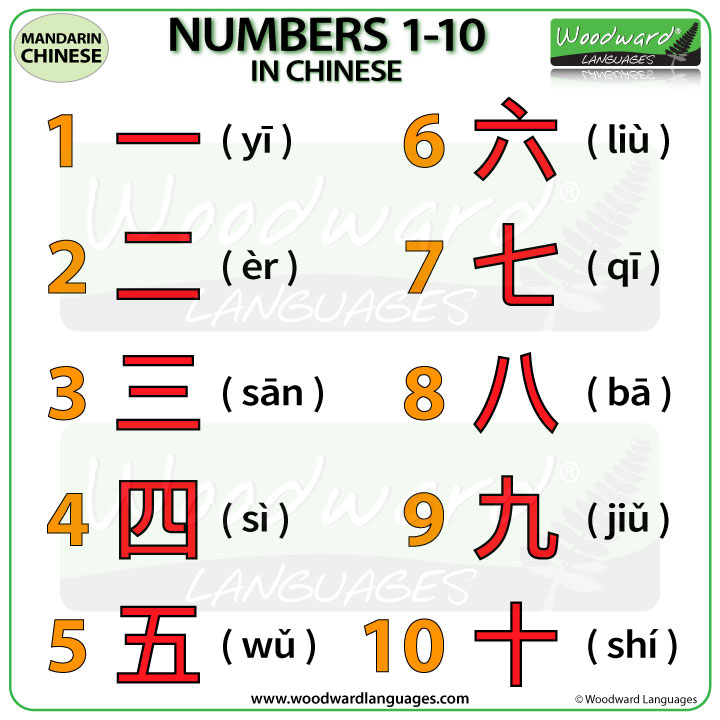
| Character | Meaning | Pinyin without tone | Initial | Final | What to say before tones |
|---|---|---|---|---|---|
| 一 | one | yi | none | i | A single high-front vowel, roughly “ee,” without adding a separate English y sound. |
| 二 | two | er | none | er | One rhotic final; do not make it two separate English sounds, “eh-r.” |
| 三 | three | san | s | an | Begin with a hissing s, then open into an, ending with tongue contact for n. |
| 四 | four | si | s | i | The written final is i, but after s it is not the ordinary “ee” vowel. Keep a sustained hissing, vowel-like continuation after s. |
| 五 | five | wu | none | u | Rounded u, similar to the vowel in “food,” but shorter and contained in one syllable. |
| 六 | six | liu | l | iu | Start with l, then glide smoothly from i toward ou. Do not say “lee-oo” as two beats. |
| 七 | seven | qi | q | i | An aspirated, front-of-mouth consonant followed by an i vowel. It is only an approximation to English “chee.” |
| 八 | eight | ba | b | a | A relatively unaspirated b, then an open a. |
| 九 | nine | jiu | j | iu | A less breathy partner to q, then the same compact iu final as in liu. |
| 十 | ten | shi | sh | i | sh is one initial, not s plus h. The written i is again a special vowel-like continuation, not “shee.” |
Three patterns make the list less burdensome to memorize:
- Zero-initial syllables: yi, er, and wu.
- The final iu: liu and jiu. It represents a rapid, connected glide, historically related to iou.
- The written final i after s and sh: si and shi. Its sound differs from i in ni and qi.
The goal is not a flawless accent after one session. It is to build a dependable map: when you see jiu, you should immediately retrieve j plus iu, rather than guess from the English-looking spelling.
The pronouns: same framework, different characters
Now add four high-value pronouns. The characters 他 and 她 have different meanings in writing but the same pronunciation: ta. Mandarin does not mark grammatical gender in the spoken syllable here.
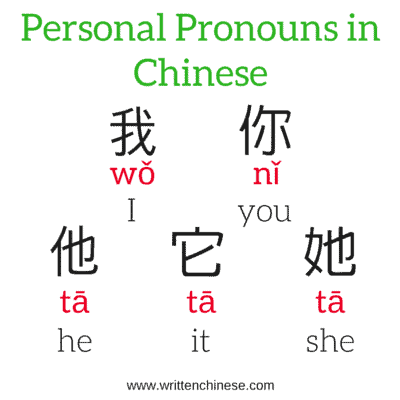
| Character | Meaning | Pinyin without tone | Initial | Final |
|---|---|---|---|---|
| 我 | I, me | wo | none | uo |
| 你 | you | ni | n | i |
| 他 | he | ta | t | a |
| 她 | she | ta | t | a |
For wo, begin with rounded lips and make one smooth movement through the uo final. Avoid treating the written w as an English-style consonant followed by a separate “oh.”
For ni, use a clear n and an ordinary i vowel, roughly “nee” without stretching it artificially.
For ta, Pinyin t is noticeably aspirated: a small burst of air accompanies the release. Put your hand about a fist’s distance in front of your mouth and compare ta with ba. You should feel more air on ta than on ba. This is a useful physical cue, not a reason to exaggerate the sound.
How to articulate the new components
Rather than trying to master all Pinyin sounds at once, concentrate on the components that recur in today’s fourteen syllables.
Initials
- b in ba: made without the strong breath burst expected in English “b.” It may initially sound between English b and p.
- t in ta: an aspirated t. Release it with audible air, but do not add a separate vowel afterward.
- n and l in ni and liu: close enough to familiar English n and l to serve as starting points.
- s in san and si: a narrow, hissing s. Keep it distinct from sh.
- sh in shi: a single Pinyin initial. Raise the tongue slightly farther back than for English sh; it has a more retroflex, hushed quality.
- j in jiu: a front-of-mouth affricate with little air release.
- q in qi: made in a similar front-of-mouth region as j, but with a stronger puff of air. The tongue tip stays low, near the lower teeth, rather than moving as it often does for English “ch.”
Do not try to pronounce Pinyin letter names. The Pinyin initial q is a sound, not the English letter name “cue”; j is a sound, not “jay.”
Finals
- a in ba, ta: open the jaw and use a clear, open vowel.
- an in san: say the open vowel and finish with an n closure. Keep it one syllable.
- i in yi, ni, qi: a high front vowel, approximately “ee.”
- i in si, shi: a special context-dependent final. Do not force an “ee” after s or sh. Let the consonant continue with a vowel-like resonance.
- u in wu: round the lips, as for “oo.”
- uo in wo: move from a rounded u-like beginning into o as one connected final.
- iu in liu, jiu: glide quickly through the final. If it feels like two syllables, make the transition smaller and faster.
- er in er: a special rhotic final. Treat it as one unit, not e followed by a separately pronounced r.
A reliable production rule is: prepare the initial, release it into the final, and stop. Do not insert an English filler vowel between them.
A short retrieval routine
Keep this Mandarin session compact but active: about 12–15 minutes after watching the video. If you prefer, split it into two shorter sittings.
First sitting: analyze before speaking
Write the fourteen characters on one side of small cards:
- 一、二、三、四、五、六、七、八、九、十
- 我、你、他、她
On the other side, write only the tone-less Pinyin. Then add the structural breakdown in smaller writing:
- san: s + an
- liu: l + iu
- wo: zero initial + uo
- shi: sh + i
As you review, state the structure aloud before saying the syllable. This makes recall a comprehension task rather than a simple visual association.
Second sitting: group by shared components
Say each group at a steady, comfortable pitch:
| Focus | Syllables |
|---|---|
| Zero initial | yi, er, wu, wo |
| Ordinary i | yi, ni, qi |
| Special written i | si, shi |
| Open a | ba, ta |
| Final iu | liu, jiu |
| Nasal ending | san |
Then shuffle the cards. When a character appears, use this sequence:
- Recall its tone-less Pinyin.
- Name its initial and final.
- Say the consonant and final as a connected syllable.
- Check the back of the card only after responding.
For now, leave the tone-marked form visible only as a reminder that tones exist. Do not let the marks pull attention away from the segmental shape you are building.
Key takeaways
Pinyin syllables are built from an optional initial, a required final, and a tone. Today you worked only on initials and finals.
The central spelling insight is that y and w can be writing conventions for zero-initial syllables. Thus:
- yi is zero initial plus i
- wu is zero initial plus u
- wo is zero initial plus uo
- er is zero initial plus er
You also identified recurring patterns: liu and jiu share iu; ta represents both 他 and 她; and the written i in si and shi does not sound like the i in ni or qi.
Next, the course returns to bass: you will map and play a movable one-octave major scale from E- and A-string roots. The next Mandarin lesson will add the pitch contours that make these syllables distinct words: the four lexical tones.
Can't find a good explanation? Sign up and we'll make it for you
Sign up