
Welcome back. In the last lesson, you matched entry conditions to order types: a stop entry for a price-through breakout, a limit for a pullback, and a market order when the condition is already true. That tells the platform when to enter. This lesson deals with a separate question: how much market exposure are you controlling once you enter?
For a gold breakout setup, leverage can make a trade look cheap because the required deposit is small. But the chart has not become safer, and the setup has not become better. By the end of this lesson, you should be able to distinguish margin from risk, explain why position size drives the monetary loss, and recognize why a valid setup can still be far too large for the account.
Margin is collateral; exposure is what moves your profit and loss
A margin requirement is the amount the broker requires you to set aside to open and maintain a leveraged CFD position. It is collateral, not the full value of the position and not a maximum-loss promise.
Leverage is the relationship between the relatively small margin deposit and the larger position you control.
For example, at leverage, a position worth dollars may require dollars of margin. At leverage, that same -dollar position may require dollars of margin.
The position is still worth dollars in both cases. Therefore, the dollar profit or loss from a given price move is also the same in both cases.
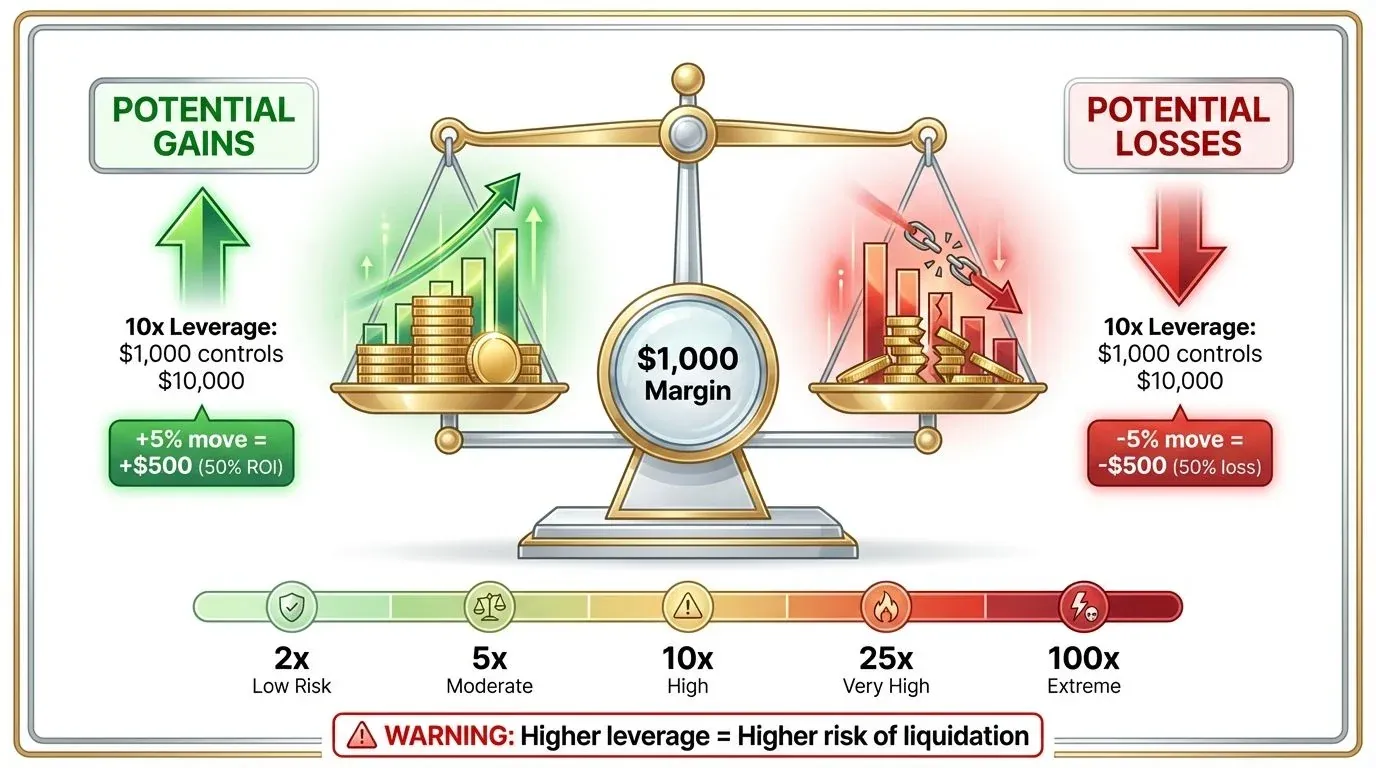
The picture is useful, but notice the possible mental trap: the center label says “ margin,” while the gain or loss comes from the -dollar exposure. Margin merely made that much exposure possible with less cash committed up front.
What is margin trading and how do you trade on margin?
Read IG’s guide for a clear distinction between the deposit you post, the leverage ratio, and the full position exposure. Its broker-specific figures are only examples; your TradeLocker broker’s gold-symbol requirements may differ.
First, in the section “What is margin trading?”, read the opening definition. Then go to “What’s the difference between margin and leverage?” and read the comparison and examples. Finish with “Benefits and risks of margin,” focusing on why losses use full exposure, not merely the margin deposit.
Three quantities must stay separate in your thinking:
| Quantity | Meaning | What it does not tell you |
|---|---|---|
| Position exposure | The total market value your CFD position represents | Whether the entry setup is good |
| Margin required | The collateral your broker locks to support that position | Your planned maximum loss |
| Risk to stop | The loss if price reaches your protective stop, including normal execution costs | Whether you have enough margin to open it |
At a high level:
When a simple fixed margin rate applies:
So a 10% margin rate corresponds to leverage, while a 5% margin rate corresponds to leverage.
For gold, your exact exposure depends on the broker’s XAUUSD contract size, the number of lots or units, and the current price. You have already seen why those specifications must be checked on the actual symbol rather than guessed from another trader’s platform.
The same setup can create very different losses
Imagine you have marked the same gold resistance boundary, chosen the same breakout entry, and placed the same structural stop below the breakout level. The chart setup is identical in every case below.
Assume the stop distance would create a loss equal to 1% of the position’s exposure. Ignore spread and slippage for the moment so that the comparison stays clear.
| Trade | Exposure controlled | Margin rate | Margin required | Loss if stop distance equals 1% of exposure |
|---|---|---|---|---|
| Small position | dollars | 10% | dollars | dollars |
| Larger position | dollars | 10% | dollars | dollars |
| Same small position, higher leverage | dollars | 5% | dollars | dollars |
The third row is crucial:
- Moving from a 10% margin rate to a 5% margin rate reduced the deposit needed from dollars to dollars.
- The position exposure remained dollars.
- The loss at the same stop remained dollars.
So higher permitted leverage does not automatically create a larger loss. Choosing a larger position does.
But high leverage makes it dangerously easy to choose a position that is too large because the required margin may look affordable. If a platform says you have enough margin to open a trade, it is saying only that you meet its collateral requirement at that moment. It is not saying the loss at your stop is sensible for your account.
A useful sentence to keep:
Margin answers “Can this position be opened?” Risk answers “Can this loss be accepted?”
Leverage cannot improve a breakout setup
Suppose a five-minute gold candle closes cleanly above a well-marked range high. Perhaps there is room to the next resistance, your planned stop is structurally placed, and the trade follows every rule you will later define in your playbook.
That may be a properly executed setup. Yet it can still lose. A breakout can fail, reverse, or be affected by a news-driven move. The trade’s technical quality does not guarantee its outcome.
Now compare two actions:
- You enter the planned position size.
- You enter five times the planned position size because the broker allows it and the margin number looks small.
Nothing about the second action changes:
- the marked breakout boundary;
- the candle close;
- the nearby resistance;
- the chance that the breakout succeeds;
- the correct invalidation point.
It only changes the financial consequences. A losing trade becomes five times as expensive, and a winning trade becomes five times as profitable. That is outcome magnification, not an improvement in edge.
This is especially important when trading feels urgent. A small account can create the thought, “I need more leverage to make this move worthwhile.” In practice, that reasoning often converts normal losing trades into losses that are hard to recover from emotionally or financially. A small account does not require a larger position. It requires a clear limit on what one failed idea is allowed to cost.
Margin stress can interfere with a valid trade plan
Your platform tracks more than just the initial margin. As an open trade loses money, your account equity falls. Depending on your broker’s rules, the platform may issue a margin warning or begin closing positions if there is not enough equity to support the open exposure.
This matters because a margin-related closure may occur for account-survival reasons, not because price reached your planned structural stop. In other words, a trade can be forcibly closed while your original chart thesis is technically still possible.
That does not mean the trade should have been held. It means the position was too large relative to the account and available margin.
Margin Trading | Trading Terms
Watch “Margin Trading | Trading Terms” by Trading 212 for a short visual explanation of how a small deposit controls a much larger position and why the deposit is not the ceiling on loss.
Watch the core idea, especially the example of a 10{,}000-dollar position supported by a 5% margin requirement. Then skip to the loss warning. Focus on the statement that total exposure, rather than initial margin, determines why losses can exceed the initial deposit.
A protective stop is still important because it defines where your trade idea is invalidated. But it is not a reason to take oversized exposure. In fast conditions, a stop order can also fill worse than its planned level, as you learned in the previous lesson. That makes spare account capacity important rather than optional.
A practical pre-click check for every gold trade
Before using any leverage in demo, separate the platform’s number from your own risk decision.
-
Read the position size and margin requirement.
Check the XAUUSD symbol specification and order ticket rather than assuming one lot means the same thing across brokers. -
Identify your structural stop first.
The stop belongs to the chart idea, not to the amount of margin currently available. -
Ask for the loss at that stop.
This is the amount that matters if the trade fails normally. The exact position-size calculation comes later in the course, but you should already refuse to treat the required margin as the answer. -
Check whether a normal losing trade leaves the account functional.
If a single routine loss would pressure you to add funds, widen the stop, take revenge entries, or abandon the plan, the exposure is too large. -
Use demo to observe the mechanics.
On a TradeLocker demo ticket, note how changing volume changes the required margin. Do not interpret the maximum volume the platform permits as a recommended volume.
The disciplined question is never “What is the largest position I can open?” It is “What is the smallest position that lets me execute this tested setup while keeping a normal loss contained?”
Key takeaways
- Margin is the collateral required to open and support a leveraged CFD position.
- Leverage allows a smaller margin deposit to control larger market exposure.
- Profit and loss are driven by the position exposure and the price movement, not by the initial margin alone.
- Reducing the margin rate for the same position does not change the dollar loss from a given move; increasing the position size does.
- A higher leverage setting does not improve a breakout, its probability, or its reward-to-risk structure.
- Margin availability is not a risk-management approval. A platform can allow a position that is far too large for the account.
- Oversized exposure can lead to margin stress or forced closure before a planned trade can play out.
Next, you will verify the broker behind a TradeLocker account: its legal entity, regulatory claims, fees, and withdrawal terms. Those details matter because contract conditions, margin rules, and protections are broker-specific.
Can't find a good explanation? Sign up and we'll make it for you
Sign up