
Good to see you again. Last time, you separated margin from risk: the platform may allow a position because enough collateral is available, but only your position size and stop distance determine whether the possible loss is acceptable. That distinction depends on the actual firm holding your account and setting the trading conditions.
Before treating TradeLocker as “your broker,” make one correction: TradeLocker is the platform interface. The broker, or sometimes a prop firm and its broker arrangement, is the party connected to deposits, quotes, execution, leverage, fees, and withdrawals. This lesson gives you a practical verification process before you fund any account or rely on its advertised conditions.
For a trader focused on short-term gold breakouts, this is not paperwork for its own sake. A narrow-looking XAUUSD spread, a fast breakout fill, and a “low minimum deposit” mean little if the entity behind the account is unclear or its withdrawal rules are vague.
TradeLocker is the screen; identify the firm behind it
The diagram below separates the roles. You interact with TradeLocker, but the broker or prop firm is the party between your account and the market connection. It supplies quotes, receives orders, manages the account, and handles money movement.
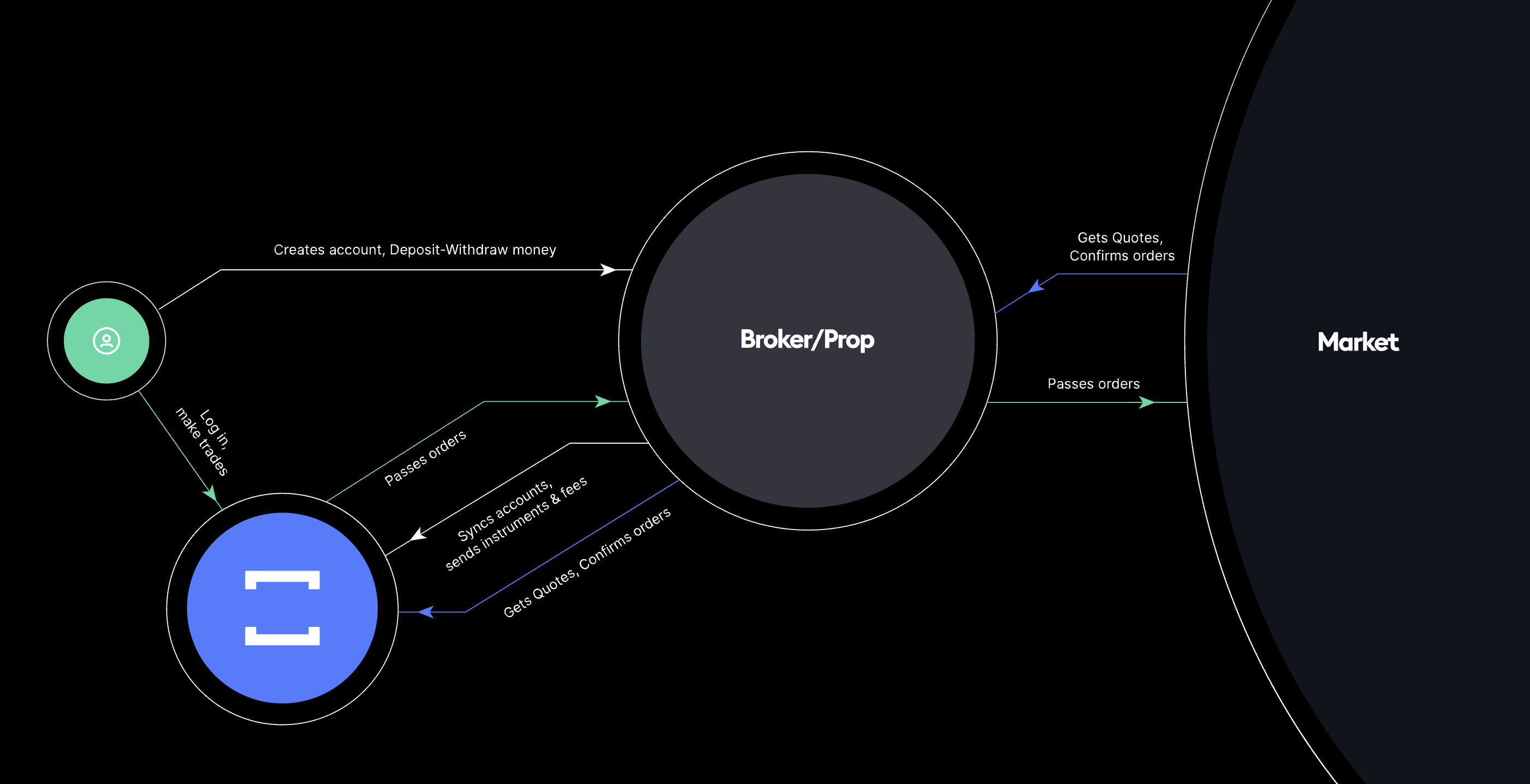
This distinction matters because a professional-looking TradeLocker login does not independently tell you:
- who legally holds your money;
- which firm executes or internalizes your gold CFD trade;
- whether that exact firm is regulated for clients in your location;
- what spread, commission, financing, or withdrawal fee applies;
- whether you are using a real brokerage account, a prop-firm evaluation, or a simulated account.
TradeLocker’s own terms make this separation explicit.
Read TradeLocker’s terms to establish the platform-versus-broker distinction. TradeLocker LTD’s terms are particularly useful because they state which responsibilities remain with the selected broker rather than the software provider.
In Section 2, “About Us and Our Services,” read from the platform description. Focus on the statement that TradeLocker transmits information through a bridge designated by the broker and is not itself the broker. Then go to Section 23, “General Reference to Broker Terms Responsibilities.” First read the responsibility boundary. Continue through the broker-responsibility list, beginning with the listed responsibilities. Notice that deposits, withdrawals, client money, quotes, fees, leverage, and account closure all sit with the broker.
The key conclusion is simple:
Do not verify “TradeLocker.” Verify the exact legal entity named in your broker account agreement.
TradeLocker LTD is a legal company providing technology, but it is not automatically the firm with which you have a trading contract. A broker may white-label the platform under its own brand, and a prop firm may use it for an evaluation or funded-account interface. Those are different relationships with different protections and rules.
Build an identity record before checking regulation
Start with documents, not social-media posts, influencer affiliate links, or a logo at the bottom of a website. Your goal is to locate the contracting legal entity: the precise company that your client agreement says you are dealing with.
Look in these places:
-
The broker’s Client Agreement or Terms and Conditions
Search for wording such as “this agreement is entered into between,” “contracting entity,” “we are,” or “governing law.” -
The broker’s legal, regulatory, or disclosure page
Record the company’s full legal name, registered address, country of incorporation, company-registration number, and claimed regulator or licence number. -
Your account-opening email and TradeLocker account details
Note the brand name, account type, account currency, and whether it says live, demo, evaluation, or funded. These labels are not interchangeable. -
The documents governing your exact account type
A broker can use different entities, leverage caps, protections, and products for residents of different countries. The firm named in a global website footer may not be the one assigned to a New York resident.
Make a record like this before depositing:
| Item | What you need to record | Why it matters |
|---|---|---|
| Brand name | The name used on the website and TradeLocker login | A brand can operate through multiple legal companies |
| Contracting entity | Exact legal company name in the agreement | This is the entity to verify |
| Country and address | Registered office and jurisdiction | Helps identify the relevant regulator and legal framework |
| Registration or licence number | Number stated in official broker documents | Lets you check the regulator’s own register |
| Account type | Demo, live CFD account, prop evaluation, or funded account | Determines whether deposits, payouts, and rules are comparable |
| Product | Exact XAUUSD or gold symbol available to you | Fees and trading conditions are symbol-specific |
| Date checked | The date and saved document version | Terms and conditions can change |
A common red flag is an account provider that displays only broad marketing language such as “regulated,” “secure,” or “institutional liquidity,” while making the actual contracting entity difficult to find. Another is a mismatch: the broker’s website names Company A, the client agreement names Company B, and the regulator record belongs to Company C. Do not assume related names mean the same legal protection.
For a prop firm, add two more questions:
- Is the account a simulated evaluation, a simulated funded account, or a live broker account?
- Who is contractually responsible for paying any “payout,” and what rulebook governs it?
A prop-firm payout is not automatically the same thing as withdrawing money from a regulated brokerage balance. Its rules may include consistency limits, news restrictions, prohibited strategies, drawdown rules, identity checks, or discretionary review clauses. Read those separately.
Regulation claims: verify the entity, not the badge
A regulation claim should be treated as something to check, not something to believe because it appears on a site.
The following short video provides a useful high-level checklist: oversight, segregation of client funds, negative-balance protection, and transparent trading costs. Use it to understand what to look for, but use an official regulator’s register as the evidence.
How To Pick A Good Broker In 2025
Watch “How To Pick A Good Broker In 2025” by Jason Graystone for a compact checklist of broker-verification topics. Treat it as a starting framework rather than proof that any particular broker is legitimate.
Watch regulatory oversight for the importance of checking the relevant supervisory authority. Then watch client protections for the discussion of separating client assets and negative-balance protection. Finish with cost transparency, focusing on published spreads, commissions, and overnight financing. Do not take an on-screen regulator name or a broker badge as verification; the next step is the official register.
A sound verification sequence is:
- Copy the exact entity name and licence number from the broker’s own agreement.
- Find the regulator named in that agreement.
- Use that regulator’s official public register.
- Search the exact legal entity or licence number.
- Compare the record with the broker documents. Check legal name, address, authorisation status, and whether the permitted activities fit what the firm offers you.
- Check disciplinary history, warnings, restrictions, and the client jurisdiction.
The U.S. Commodity Futures Trading Commission gives especially important guidance on this process. Its advisory is about over-the-counter forex dealers, so it does not by itself confirm that a particular gold CFD account is lawful or suitable. But its verification principle applies directly: research the dealer before sending money, and check official registration and disciplinary history rather than trusting promotion.
Eight Things You Should Know Before Trading Forex
Read this CFTC advisory for an official explanation of why dealer registration and disciplinary-history checks matter before an initial deposit. Its warning about withdrawal problems with unregistered offshore dealers is particularly relevant to a small account where every deposit matters.
At the start of the advisory, read the opening paragraph beginning the research directive. Continue through the paragraph explaining why registration matters and the warning about customers who were unable to withdraw funds from unregistered offshore dealers. Finish at the sentence directing readers to CFTC Check and the NFA BASIC system for registration and disciplinary-history searches. Focus on what official registration can establish, and on the warning that registration alone is not a guarantee against fraud.
Two important limits keep this process realistic:
- Registration is not a guarantee of safety or trading success. It can establish that an entity appears in a regulator’s records and is subject to particular rules; it does not make a high-risk trading strategy safe.
- A real licence belonging to another entity proves nothing about your account. The name, country, and account agreement must match. A group may have one regulated subsidiary and another offshore subsidiary serving a different set of clients.
Because you are in New York, take client eligibility especially seriously. Retail CFDs are generally not offered to U.S. retail clients through U.S.-regulated brokers. An offshore website allowing an application, or an influencer saying that a broker “works in the U.S.,” is not proof that the firm is authorized to offer you a retail gold CFD account. If the broker cannot clearly document the entity, your eligibility, and the regulatory basis for the account, treat that as a no-deposit condition until you have obtained reliable clarification.
Audit trading costs before judging a gold breakout setup
A breakout strategy can be reasonable on a chart and still be unsuitable for a specific account because costs consume too much of the available move.
For the exact XAUUSD symbol you plan to trade, collect the following from the broker’s published schedule, client agreement, or symbol specification:
| Cost or condition | What to verify | Why a gold scalper should care |
|---|---|---|
| Spread | Is it fixed or variable? What does “from” mean? What has the live spread looked like during your intended session? | You enter at the less favorable side of the quote; spread is an immediate hurdle |
| Commission | Is it charged per lot, per side, or round turn? Does the account type have a separate commission? | A “raw spread” account may have a meaningful commission instead |
| Swap or overnight financing | Long and short rates, rollover time, and any triple-swap day | Usually less central for short scalps, but essential if a trade remains open |
| Conversion charges | Whether profit, loss, commission, or withdrawal is converted between currencies | Small charges can accumulate if your account currency differs |
| Deposit and withdrawal charges | Broker fees, payment-provider fees, and currency-conversion costs | A small account should not lose a large percentage to movement of funds |
| Inactivity or administration fees | Trigger date, amount, and how to avoid it | Relevant if you pause trading while backtesting or practicing |
| Execution terms | Slippage policy, stop-order treatment, rejected orders, and market-hours changes | Breakouts often occur when price is moving quickly |
Do not be reassured by one headline such as “zero commission” or “spreads from 0.0.” Those phrases are incomplete without the exact account type, symbol, session, and other charges.
For now, you are auditing terms rather than calculating full trade cost; that comes shortly in the course. Still, write down each disclosed cost in one place. It will later prevent you from testing a breakout strategy using an unrealistic assumption of costless entry and exit.
For your preferred gold trading, compare costs during the actual windows you may trade: around 3:00 a.m. New York time and around 8:30–9:00 a.m. New York time. Do this on demo only at this stage. Record the displayed bid and ask for XAUUSD, but do not mistake one quiet snapshot for a guaranteed spread during news or a fast breakout.
Withdrawal terms are part of risk management
Withdrawal terms deserve the same attention as an entry rule. A platform can make depositing easy while making withdrawals slow, expensive, or subject to conditions that were not obvious at the start.
Read the broker’s withdrawal policy and record clear answers to these questions:
- What identity verification is required before a first withdrawal?
- Must withdrawals return to the original deposit method first?
- Which payment methods are available in your jurisdiction?
- What are the minimum and maximum withdrawal amounts?
- Does the broker charge a fee? Can a bank, card provider, or payment processor charge another fee?
- What processing time does the broker promise, and does that exclude third-party processing time?
- Are funds in open positions, pending orders, bonuses, or promotional credits unavailable to withdraw?
- What circumstances permit a withdrawal request to be delayed, rejected, or reversed?
- What contact channel and formal complaints process are available if there is a problem?
For a prop firm, replace “withdrawal” with payout policy as well. Check payout frequency, minimum payout amount, required trading days, prohibited behavior, rule-change authority, identity verification, and whether payout requests can be denied for rule violations. Do not rely on screenshots of payouts on social media as evidence that the written rules will apply to your specific account.
A responsible standard is:
If you cannot find, read, and save the withdrawal or payout terms before funding, you are not ready to fund.
A one-page broker verification decision
Create a dated note or spreadsheet called Broker Verification Record. Save a PDF or screenshot of every key document beside it; websites can change.
Use this decision structure:
| Area | Pass condition | Hold or reject condition |
|---|---|---|
| Legal entity | Exact contracting entity, address, and jurisdiction are clearly stated | Only a brand name is visible, or documents conflict |
| Regulation claim | Exact entity can be found in the claimed regulator’s official register and appears authorized for the relevant activity | No official record, wrong entity, warning, expired status, or unclear client eligibility |
| Account type | You know whether it is demo, live brokerage, prop evaluation, or funded program | Provider uses vague labels or blurs simulated and live conditions |
| XAUUSD costs | Spread, commission, financing, and key execution terms are disclosed for your account type | Costs are hidden, contradictory, or based only on marketing claims |
| Money movement | Deposit, withdrawal, or payout terms are written, specific, and workable for you | Terms are missing, unclear, unusually restrictive, or require unexplained extra payments |
| Evidence | Documents and official-register results are saved with date checked | Your conclusion relies mainly on a YouTuber, Discord, affiliate, or review site |
If any item falls into the right-hand column, pause. Do not let a good-looking breakout setup pressure you into rushing the account decision. Your chart skill and risk rules only matter after you know who is setting the conditions and handling the funds.
Key takeaways
- TradeLocker is a technology platform, not automatically the broker or firm holding your money.
- Verify the exact legal entity in your client agreement, not merely the platform, brand, or logo.
- Check regulatory claims in the relevant authority’s official register, matching legal name, licence number, address, status, permitted activity, and client jurisdiction.
- For a New York resident, an offshore firm accepting an application is not proof that it is authorized to offer a retail gold CFD account.
- Audit the full cost schedule for the exact XAUUSD account: spread, commission, financing, conversion, withdrawal, and execution terms.
- Read withdrawal or prop-firm payout rules before depositing. Vague terms are a reason to pause, not something to solve after making money.
- Save a dated verification record. “Cannot verify” is a valid and important no-trade, no-deposit decision.
Next, you will set up a TradeLocker demo chart and order ticket without enabling live execution. That will let you observe the platform and XAUUSD conditions while keeping the practice environment separate from real money.
Can't find a good explanation? Sign up and we'll make it for you
Sign up