
Hello again. In the last lesson, you practiced trimming filler and redundancy while preserving a sentence’s exact meaning. Concise writing helps readers see a sentence’s structure; today, you will use that clarity to repair two problems that can quietly distort meaning: unclear pronoun references and misplaced modifiers.
Both errors make a reader pause and ask, “Who or what does that word describe?” In an analytical essay, that pause can weaken an otherwise strong point. By the end of this lesson, you will be able to locate the intended target of a pronoun or modifier and revise the sentence so that target is unmistakable.
Pronouns need a clear antecedent
A pronoun is a word such as he, she, it, they, this, that, or which that stands in for a noun. The noun, noun phrase, or idea it represents is its antecedent.
For example:
When Maya challenges the principal’s decision, she risks losing her place in the program.
The antecedent of she is clearly Maya. A reader does not have to guess.
Pronouns are useful because repeating the same noun in every sentence produces stiff writing:
Maya challenges the principal’s decision because Maya believes the policy is unfair. Maya later explains Maya’s position to the school board.
A clearer version uses pronouns where the reference remains obvious:
Maya challenges the principal’s decision because she believes the policy is unfair. She later explains her position to the school board.
The goal is not to avoid pronouns. It is to use them only when the reader can identify their antecedents immediately.
Identifying and Addressing Unclear Pronouns & Antecedents - Writing Commons
Read “Identifying and Addressing Unclear Pronouns & Antecedents” from Writing Commons, by Julia L. McMillan. It establishes the key distinction between a pronoun and its antecedent, then shows practical ways to repair ambiguous references.
Begin in “What are pronouns and antecedents?” and read the basic explanation. Then, in “Unclear antecedents due to multiple possible antecedents,” follow the ambiguity examples. In “Practice: Solving unclear antecedents due to multiple possible antecedents,” read the two repair methods. Finally, in “Unclear antecedents due to unstated or assumed antecedents,” read from the explanation of undefined we and our. Notice that clarity depends on what a new reader can reasonably identify, not merely on what you meant while drafting.
Three common pronoun-reference problems
1. Two nouns compete for one pronoun
This is the most common problem. When two possible antecedents fit the pronoun, the reader cannot know which one you intend.
Unclear: After Lena interviewed Noor, she revised the article.
Did Lena revise the article, or did Noor? Both are possible.
The simplest repair is often to repeat the intended noun:
Clear: After Lena interviewed Noor, Lena revised the article.
Although writers are often told not to repeat words, repetition is preferable to ambiguity. You can also reorganize the sentence:
Clear: Lena revised the article after interviewing Noor.
This version is more direct because the subject and action appear early.
A pronoun does not become unclear simply because another noun appears between it and its antecedent. It becomes unclear when that other noun is a realistic competitor.
Clear: When Lena applied for the scholarship, she submitted her essay early.
The noun scholarship cannot submit an essay, so the reader naturally connects she with Lena.
2. The pronoun has no stated antecedent
Sometimes a writer assumes the reader will infer who they, we, or you means.
Unclear: They should provide students with more mental-health resources.
Who are they? Teachers, school administrators, legislators, or community organizations?
Clear: School administrators should provide students with more mental-health resources.
The same issue can appear with we and our, especially in persuasive writing:
Unclear: We need to reconsider our testing policies.
Clear: State education officials need to reconsider testing policies.
Using we can be appropriate when the group truly includes both writer and reader and has already been defined. Otherwise, name the group. This choice makes an argument more precise and avoids quietly excluding readers from an assumed “we.”
3. A broad pronoun hides the exact idea
Words such as this, that, and which can refer vaguely to an entire preceding sentence or paragraph.
Vague: The author repeats images of locked doors. This proves the narrator feels trapped.
What exactly does this mean: the repetition, the doors, the whole previous sentence, or something else?
Give the pronoun a noun:
Clear: The author repeats images of locked doors. This repetition suggests that the narrator feels trapped.
The revision does not merely correct grammar. It improves analysis by naming the evidence and choosing a careful interpretive verb, suggests, rather than claiming the imagery “proves” an interpretation.
A dependable editing principle is:
When a pronoun could refer to more than one noun, no noun, or a whole unclear idea, replace it with a specific noun or recast the sentence.
Modifiers must sit near their intended target
A modifier is a word, phrase, or clause that adds description or limits meaning. Adjectives, adverbs, prepositional phrases, and introductory participial phrases can all act as modifiers.
Consider the difference that placement makes:
The researcher analyzed the incomplete data.
The incomplete researcher analyzed the data.
The word incomplete changes meaning according to the noun it describes. In the first sentence, the data are incomplete. In the second, the researcher is incomplete, which is probably not the intended claim.
A misplaced modifier is positioned so that it appears to describe the wrong word. Readers generally connect a modifier with the closest logical target, so placement should make that relationship obvious.
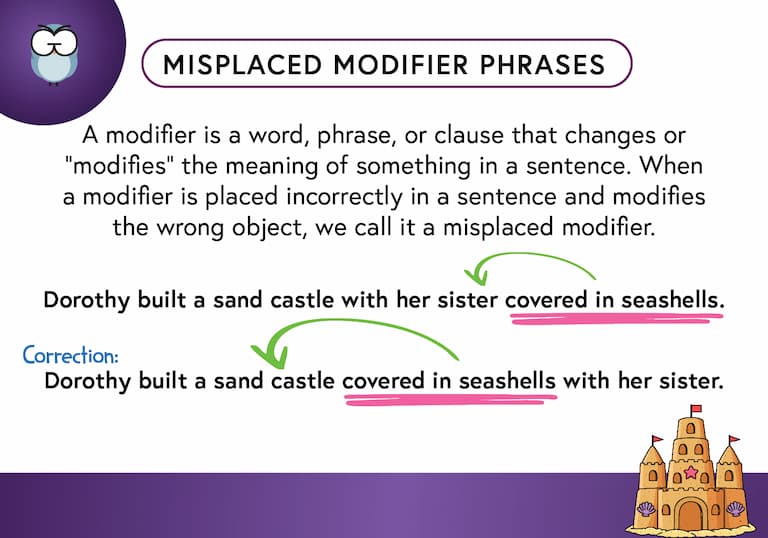
Compare:
Misplaced: Dorothy built a sand castle with her sister covered in seashells.
Clear: Dorothy built a sand castle covered in seashells with her sister.
The first version accidentally suggests that Dorothy’s sister is covered in seashells. The revised version places the descriptive phrase next to sand castle, its intended target.
How misused modifiers can hurt your writing - Emma Bryce
Watch “How misused modifiers can hurt your writing” from TED-Ed, presented by Emma Bryce. Its deliberately absurd examples make the central editing skill memorable: identify what a modifier appears to describe, then move or rewrite it so that it has one clear target.
Watch misplaced modifiers for the chocolate-bunny headline and its repair. Then watch dangling modifiers to see why an opening phrase needs a visible subject. Finish with squinting modifiers, focusing on how a word placed between two clauses can produce two possible meanings.
Repairing misplaced and dangling modifiers
Put descriptive phrases beside what they describe
Prepositional phrases beginning with words such as with, in, on, and after can create accidental meanings when placed carelessly.
Misplaced: The narrator describes a child in the abandoned house with torn clothes.
The phrase with torn clothes seems closest to house. Is the house wearing torn clothes? Of course not—but readers still have to untangle the sentence.
Clear: The narrator describes a child with torn clothes in the abandoned house.
Now with torn clothes sits directly after child. The setting phrase can follow because it describes the scene rather than competing with the description of the child.
Sometimes moving the modifier is not enough. Splitting one crowded sentence into two can be the clearest choice:
Clearer: In the abandoned house, the narrator describes a child whose clothes are torn.
This revision gives each detail a distinct place.
Make the subject after an opening phrase the logical actor
An opening phrase should modify the subject that follows it.
Dangling: After examining the survey, it is clear that the policy upset students.
The phrase After examining the survey implies that someone examined it. But the grammatical subject is it, which cannot examine anything. This is called a dangling modifier because the phrase has no clear noun to attach to.
Name the person or group performing the action:
Clear: After examining the survey, the reporter concluded that the policy had upset students.
Or make the action itself the subject:
Clear: An examination of the survey showed that the policy had upset students.
The first version is usually more vivid because it gives the sentence a clear actor and verb.
Place limiting words exactly where their meaning belongs
Some modifiers do not create absurd images; instead, they create uncertainty about which action they limit.
Unclear: Students who revise essays often improve.
Does often mean that students revise frequently, or that they improve frequently?
Choose a structure that states the intended meaning:
If revision is frequent: Students who revise essays regularly tend to improve.
If improvement is frequent: Students often improve when they revise essays.
This type of ambiguity is sometimes called a squinting modifier because the modifier seems to “look” in two directions. The label matters less than the revision: position the word so only one meaning is available.
A single editing method for both problems
Pronouns and modifiers are different grammatical tools, but they can be revised through the same habit: identify the target before trusting the sentence.
During a focused clarity pass, use this sequence:
-
Mark pronouns and modifiers. Circle pronouns such as it, they, this, which, and we. Underline descriptive phrases and limiting words such as only, almost, with, or after.
-
Name the target. For every marked item, silently complete the thought: “It means ___,” or “with torn clothes describes ___.”
-
Look for competitors or missing targets. If two nouns could fit, if no noun fits, or if the literal reading is absurd, revise.
-
Use the least disruptive repair.
- Repeat the intended noun.
- Replace this or that with this + a specific noun.
- Move the modifier beside its target.
- Put the logical actor after an introductory phrase.
- Recast or split the sentence when movement alone leaves it crowded.
-
Read as an unfamiliar reader. Do not rely on your knowledge of the topic. Read only what the sentence actually says.
Here is that process applied to a short draft:
Draft: After examining the survey, it was clear that the principal’s policy upset students. She explained the policy to parents that they considered unfair. This made them protest.
Several references are unstable:
- Who examined the survey?
- Who is she?
- Does that they considered unfair describe the parents or the policy?
- What does this mean?
- Who does them mean: parents or students?
A revised version can make each relationship explicit:
Revision: After examining the survey, the reporter concluded that the principal’s policy had upset students. At a meeting, the principal explained the policy to parents, who considered it unfair. Student frustration led to a protest.
The revision repeats the principal rather than using an unclear she. It places who considered it unfair directly after parents, and it replaces the vague This made them protest with the precise causal claim Student frustration led to a protest.
This is the kind of precision that makes prose feel mature. Readers can give their attention to your evidence and reasoning rather than decoding who did what.
A short clarity checklist
Before submitting an essay, scan for these patterns:
| Watch for | Revision move |
|---|---|
| he, she, it, or they with two possible antecedents | Repeat the intended noun or recast the sentence. |
| they with no named group | Name the people or institution responsible. |
| we or our with an undefined audience | Define the group or choose a specific noun. |
| this, that, or which referring vaguely to an idea | Add a noun: this pattern, this decision, this contrast. |
| An opening phrase followed by it, there, or an unrelated noun | Put the actual actor immediately after the phrase. |
| A descriptive phrase that seems attached to the wrong noun | Move it beside the noun it describes, or rewrite. |
| A word such as only, almost, or often between two possible targets | Reposition it or split the sentence. |
Clear pronouns let readers track people, objects, and ideas without confusion. Correctly placed modifiers ensure that descriptions attach to the nouns or actions you actually intend. In both cases, the strongest revision is usually not the fanciest one: it is the one that makes one meaning unavoidable.
Next, you will build on this clarity by varying sentence openings while preserving natural emphasis and flow.
Can't find a good explanation? Sign up and we'll make it for you
Sign up