
Hello again. In the previous lesson, you learned to make pronouns and modifiers point unmistakably to their targets. That work matters here: changing a sentence opening should improve its rhythm or emphasis, never make the reader wonder who is acting or what a phrase describes.
Writers often hear “vary your sentence openings” and conclude that every sentence must begin differently. That is not the goal. Strong essays still use many direct subject-first sentences because they are clear and efficient. The goal is deliberate variation: change an opening when it helps the reader see the relationship between ideas, enter the right context, or feel the intended emphasis.
By the end of this lesson, you will be able to spot repetitive openings and revise them using several natural patterns while keeping the main point clear.
Openings shape a reader’s expectations
English readers expect the common pattern:
Subject + verb + rest of sentence
The school board approved the proposal.
There is nothing weak about this structure. In fact, it is often the best choice when you want to state a claim plainly.
The problem appears when several nearby sentences begin in exactly the same way:
The author repeats images of darkness. The author uses those images to create tension. The author also suggests that the narrator feels isolated.
The issue is not merely that The author repeats. Every sentence gives the reader the same entrance: the same subject, in the same position, performing another action. The paragraph begins to sound like a list.
A useful revision preserves the ideas but changes the reader’s route into them:
Through repeated images of darkness, the author creates tension. As the imagery accumulates, it also suggests the narrator’s isolation.
The first sentence now foregrounds the method—the imagery—before arriving at the central effect, tension. The second begins with time and development: the reader learns that the interpretation depends on the imagery building over the passage.
Notice what did not happen: the writing did not become inflated just to sound sophisticated. The revision made the connections between ideas more visible.
[PDF] Varying Sentence Openers for Emphasis, Pace, and Cohesion
Read the San José State University Writing Center handout, “Varying Sentence Openers for Emphasis, Pace, and Cohesion.” It gives a useful framework: sentence openings can affect emphasis, reading pace, and cohesion—not simply make prose look more varied.
On pages 1–2, read the introduction and the models under “Sentence Openers.” Begin with the opening rationale, then study the examples of subordinate clauses, participial phrases, adjectives, appositives, prepositional phrases, and transitions. Do not try to memorize every category; focus on how moving material to the front changes what the reader notices first. On page 3, read the “Emphasis, Pace, and Cohesion” discussion, especially the explanation of emphasis. Keep this principle in mind: an opening is prominent, but the end of a main clause often carries the sentence’s strongest final weight.
Choose an opening for a reason
Before revising a repeated opening, ask one question:
What should the reader know before reaching this sentence’s main claim?
Your answer usually reveals the best kind of opener.
| If the reader needs… | A useful opener | Example |
|---|---|---|
| A cause, contrast, time, or condition | A dependent clause | Although the policy reduces costs, it may limit access. |
| A setting, time frame, or location | A prepositional phrase | During the first semester, attendance declined. |
| A method or accompanying action | A participial phrase | Drawing on survey data, the researchers identified a pattern. |
| A link to the previous sentence | A precise transition | However, the evidence does not support that conclusion. |
| A different focus altogether | A new subject | The survey results challenged the committee’s assumption. |
These choices do more than decorate a sentence. Each one tells the reader how to organize the information that follows.
Keep some subject-first openings
Do not force variation where directness is more important.
Clear: The court’s decision established a new precedent.
Trying to avoid a subject-first opening might create an awkward sentence:
Awkward: In a decision that established a new precedent, the court ruled.
The revision delays the important action, ruled, and makes the sentence heavier without adding a useful relationship. A reader does not need every sentence to surprise them. They need the prose to move naturally.
A good paragraph has a pattern of variation, not a rule that bans repeated structures.
The most useful academic sentence openers
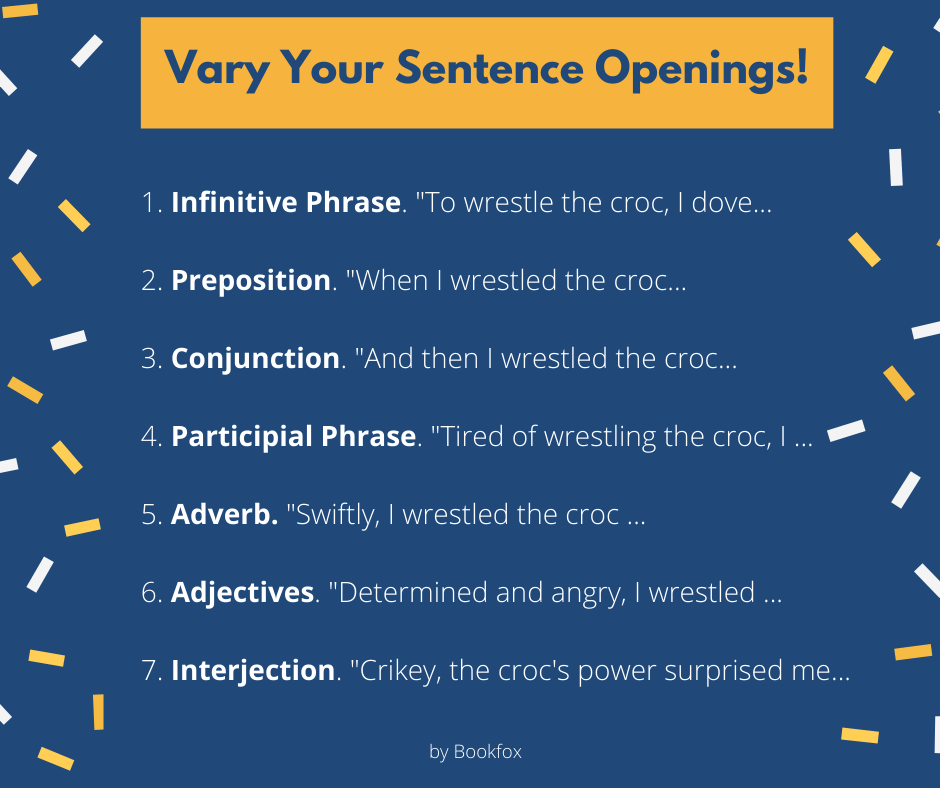
The image offers a useful menu of possibilities, but treat it as a source of options rather than a formula. One terminology note is important: its second example begins with when, which is not a preposition in that sentence; it introduces a subordinate clause. Accurate grammar helps you make accurate revisions.
1. Begin with a dependent clause to show a relationship
A dependent clause has a subject and verb but cannot stand alone. It often begins with words such as although, because, when, while, if, or since.
Subject first: Standardized tests can provide useful data, although they cannot measure every form of learning.
Dependent clause first: Although standardized tests can provide useful data, they cannot measure every form of learning.
Both sentences are correct, but they emphasize different ideas. In the second version, the concession comes first; the reader arrives at the main point—what the tests cannot do—at the end.
This pattern is especially useful in analytical and argumentative writing because essays often need to express contrast and qualification.
Because the narrator withholds key details, the reader shares the protagonist’s uncertainty.
When schools cut arts programs first, they signal a narrow definition of educational value.
If cities invest only in highways, public transportation may remain inaccessible.
Use a comma after an introductory dependent clause.
2. Begin with a prepositional phrase to establish context
A prepositional phrase often tells the reader where, when, under what conditions, or in relation to what something happens.
The narrator finally admits the truth in the final chapter.
In the final chapter, the narrator finally admits the truth.
The second version gives the reader a time frame first. This is helpful when the setting or stage of an argument matters.
In the novel’s opening scene, the empty house establishes an uneasy atmosphere.
During the economic downturn, many families postponed major purchases.
For students without reliable internet access, online homework can create an additional barrier.
Prepositional openers often create cohesion because they connect a new sentence to an already established context. They are particularly useful when you move from one part of a text, period, place, or group to another.
However, do not drag every phrase to the beginning merely because you can. Some moved phrases sound theatrical or unnatural:
Natural: After the meeting, the committee released its statement.
Unnatural for ordinary prose: Across the hallway ran the student.
The second structure can work in literary writing, but it is not the normal choice for an essay. Clarity comes first.
3. Begin with a participial phrase to foreground action or method
A participial phrase often begins with an or form. It adds information about the subject of the main clause.
Examining the data closely, the researchers noticed a sharp decline.
Frustrated by the delay, residents attended the council meeting.
Written in a restrained tone, the letter becomes more unsettling than an angry outburst would be.
This structure can make an essay feel more fluid because it connects two related actions within one sentence. Yet it carries an important rule from the previous lesson:
The subject immediately after the comma must be the person or thing the phrase describes.
Dangling: Examining the data closely, it became clear that attendance had fallen.
Clear: Examining the data closely, the researchers concluded that attendance had fallen.
The word it cannot examine data. The researchers can.
Likewise:
Unclear: Written in a restrained tone, the reader may find the letter unsettling.
Clear: Written in a restrained tone, the letter may unsettle the reader.
The letter is written in that tone, so it belongs immediately after the opening phrase.
4. Begin with a transition only when it states the real relationship
Transitions are not ornamental words sprinkled into a paragraph. They tell readers how one idea relates to the previous one.
The proposal would reduce short-term expenses. However, it could create greater costs later.
Here, however signals contrast. Other precise options include:
- therefore for result
- for example for illustration
- meanwhile for simultaneous developments
- similarly for comparison
- instead for replacement or correction
- consequently for a consequence
Avoid choosing a transition merely because it sounds formal. For example, do not use therefore when the second sentence is simply another detail rather than a result.
Weak connection: The author uses short sentences. Therefore, the setting is a hospital.
Clearer connection: The author uses short sentences. As a result, the narration feels abrupt and anxious.
The second version gives a genuine cause-and-effect relationship.
5. Change the sentence’s subject when the focus has changed
Sometimes the best way to avoid a repeated opening is not to move a phrase. It is to make a different, more meaningful noun the subject.
Repetitive: The narrator describes the hallway as narrow and dark. The narrator makes the hallway seem threatening.
Revised: The narrator describes the hallway as narrow and dark. This confined setting makes the space feel threatening.
The revision improves more than variety. It identifies the actual cause of the effect: not simply “the narrator,” but the confined setting the narrator creates.
This move is powerful in analysis. Instead of repeatedly writing the author shows, make the technique, image, contrast, or evidence do the grammatical work:
| Less precise subject | More focused subject |
|---|---|
| The author shows that the character is isolated. | The character’s unanswered messages reveal her isolation. |
| The writer uses repetition to create urgency. | The repeated commands create urgency. |
| The government made people concerned. | The policy’s sudden announcement caused public concern. |
The new subject must remain logical. Do not make an object perform an action it cannot reasonably perform simply to avoid repetition.
8 Tips for Starting Better Sentences (Writing Advice)
Watch Writer Brandon McNulty’s “8 Tips for Starting Better Sentences.” The selected sections demonstrate two practical revision moves: changing the subject to change focus, and moving meaningful phrases or clauses to the front.
Watch shifting focus to see how a different noun, action, or sensory detail can become the subject of a sentence. For essay writing, apply this by making evidence or a technique—such as an image, policy, pattern, or contrast—the subject when it is the true focus. Then watch phrases and clauses. Focus especially on the need for an introductory participial phrase to match the following subject, and on the natural use of time phrases and dependent clauses. The examples are largely narrative, but the structural choices transfer directly to analytical prose.
Emphasis: put setup first, put the main point where it can land
Sentence beginnings are noticeable, but endings often carry the strongest emphasis because they are the last words before a pause. You can use this fact to arrange a sentence around its main idea.
Compare these versions:
The novel exposes the damaging effects of isolation through recurring images of locked doors.
This sentence ends on the technique, locked doors. That is useful if your focus is the imagery.
Through recurring images of locked doors, the novel exposes the damaging effects of isolation.
Now the imagery provides the setup, while isolation receives the final emphasis. This is usually stronger if the paragraph’s main idea is the theme of isolation.
Neither version is universally better. Your paragraph’s purpose decides.
A practical rule:
- Put context, contrast, cause, or method near the beginning when readers need it to interpret the claim.
- Put the central consequence, judgment, or new insight near the end when you want it to land with force.
For example:
Although school uniforms may reduce visible economic differences, they cannot by themselves create a more inclusive school culture.
The opening fairly acknowledges a benefit. The end delivers the sentence’s larger claim: uniforms are not a complete solution.
A short revision demonstration
Consider this draft from an analytical paragraph:
The poet describes the city as silent. The poet repeats the word “empty.” The poet creates a feeling of abandonment. The poet later introduces the sound of a single train.
The ideas are sound, but three of four sentences begin with The poet. Here is a revision:
In the poem’s opening, the city appears silent. Through the repeated word “empty,” the poet creates a feeling of abandonment. Later, the sound of a single train interrupts that silence.
Look at the purpose of each opening:
- In the poem’s opening gives a time and textual location.
- Through the repeated word “empty” foregrounds the evidence before stating its effect.
- Later moves the reader through the poem’s development.
The revised paragraph still includes one straightforward subject-first main clause: the poet creates. That directness is useful. Variation works because it is balanced with clarity.
A practical scan for repeated openings
During revision, use this fast process on one paragraph at a time:
-
Underline the first meaningful unit of every sentence.
Mark not just the first word, but the actual opener: The author, In the final chapter, Although the policy, However. -
Look for a cluster, not a coincidence.
Two subject-first sentences in a row may be perfectly natural. Four sentences beginning The author probably need attention. -
Decide whether the subject should really stay first.
Keep it when directness matters. Revise only when another opening would show a useful relationship or a more accurate focus. -
Select an opener based on meaning.
Use time, place, contrast, cause, method, or a logical transition—not a random grammatical trick. -
Check clarity before keeping the revision.
- Does the opening phrase clearly modify the next subject?
- Does the transition name the actual relationship?
- Does the sentence still have a clear subject and specific verb?
- Does the ending contain the idea you want readers to remember?
-
Read the paragraph aloud.
Listen for mechanical repetition, but also for sentences that feel overly delayed. A varied paragraph should sound controlled, not constantly dramatic.
For a brief independent practice routine, take a paragraph from a current assignment and revise only two openings. Keep at least one direct subject-first sentence. This limitation is useful: it trains you to make purposeful changes instead of rewriting every line into a complicated structure.
Sentence variety is not a collection of impressive-looking starters. It is a way to guide attention. Dependent clauses can establish contrast or cause; prepositional phrases can supply context; participial phrases can connect actions; transitions can clarify logic; and new subjects can reveal the real focus of an idea.
Most importantly, preserve what you learned last time: every opener needs a clear grammatical target. When variation supports meaning rather than competing with it, your essays gain rhythm without losing precision.
Next, you will build on this fluency by combining closely related ideas with coordination, allowing you to avoid choppy prose while keeping each relationship clear.
Can't find a good explanation? Sign up and we'll make it for you
Sign up