
Hello! Welcome back to our module on the emotional and social drivers of choice.
In our last lesson, we explored how integral emotions like FOMO and anticipated regret can be powerful motivators. We saw that creating a sense of FOMO often depends on signals that other people are participating in or benefiting from something. This brings us directly to today's topic.
This lesson's learning outcome is to explain the principle of social proof and identify its use in testimonials, ratings, and user counts. We will explore the psychological basis for why we look to others to guide our actions, and then we'll break down the common ways this principle is applied in the digital products you design and use every day. This understanding is fundamental to creating experiences that build trust and reduce user uncertainty.
1. What Is Social Proof?
At its core, social proof is the idea that we look to the actions and behaviors of others to determine our own, especially in situations of uncertainty. It's a mental shortcut (a heuristic) that assumes if a lot of people are doing something, it must be the correct thing to do.
To kick things off, let's watch a short video from the Nielsen Norman Group that defines the concept with a simple, memorable real-world analogy before connecting it to UX design.
This video, 'Social Proof in UX,' provides a concise definition of social proof and quickly demonstrates its application in digital interfaces.
Please watch from the beginning until 01:43. Pay attention to the umbrella analogy and the initial examples of how social proof is used online, such as follower counts and reviews.
As the video explains, social proof is a powerful force for increasing credibility and persuading users. This isn't just a modern marketing gimmick; it's a deep-seated psychological principle identified by Dr. Robert Cialdini, one of the most respected figures in the psychology of influence.
Let's hear Cialdini explain the principle (which he also calls "consensus") and share a fascinating study that reveals its power compared to other types of appeals.
How to Influence Others | Robert Cialdini | Big Think
In this clip from a talk by Robert Cialdini, he discusses the principle of consensus, or social proof, and details a famous study that tested its effectiveness in a hotel setting.
Watch the segment from 02:08 to 03:40. Note how the message leveraging social proof was significantly more effective than the standard messages appealing to environmental responsibility.
The hotel towel experiment is a classic example. It demonstrates that appealing to our desire to conform to the group's behavior ("the majority of guests reuse their towels") can be more persuasive than appealing to logic or social responsibility. We're wired to follow the crowd.
For a more detailed look at the psychology and some classic examples, take a few minutes to read the following article.
Social Proof in the User Experience
This article from the Nielsen Norman Group, the same source as the first video, offers a foundational text on the topic.
Please read the introduction (up to the image of the Apple Store queue) and the section titled 'Background of the Social-Proof Principle.' Focus on how social proof plays on our insecurities and the observation that what users say doesn't always match what they do.
The key takeaway here is that social proof works by reducing uncertainty. When users are unsure which product to buy, which service to trust, or which action to take, they look for external cues—and the actions of others are one of the most potent cues available.
2. Common Types of Social Proof in Product Design
Now that we have a solid grasp of the principle, let's focus on identifying its most common implementations in digital products. Your work in product design involves constant decisions about what information to display to users; social proof is a powerful category of that information.
This excellent sketch note provides a great visual overview of the different facets of social proof in UX design.
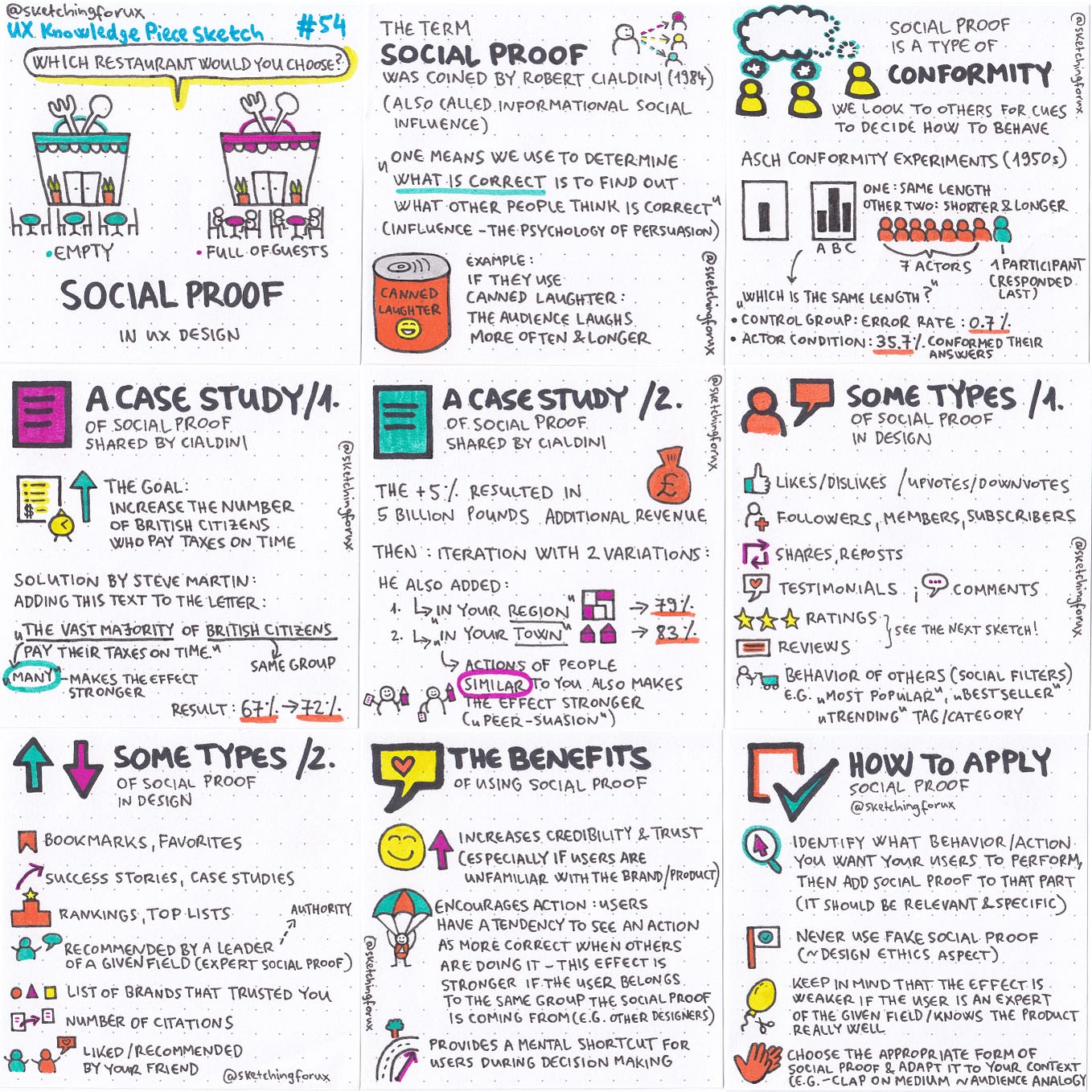
As the sketch note illustrates, social proof comes in many forms. We'll focus on the three mentioned in our learning outcome: testimonials, ratings, and user counts.
Social Proof: Definition, Types, Examples & How to Work With It
The article 'Social Proof: Definition, Types, Examples' from CXL provides an excellent, practical breakdown of the different ways social proof is used. It's packed with real examples relevant to your work.
Please read the section '6 types of social proof (with examples).' As you read, pay close attention to the descriptions and examples for Testimonials, Reviews, and Data/Numbers.
Let's unpack these three types with some specific examples.
A. Testimonials & Reviews
Testimonials (qualitative praise) and reviews (often a quantitative rating paired with qualitative feedback) are perhaps the most direct forms of social proof. They serve as "word-of-mouth" recommendations at scale.
-
Testimonials: As the CXL article highlights, these are short-form recommendations from happy customers. For a B2B product, this might be a quote from an industry leader. For a B2C service, it could be a customer success story. A key to their effectiveness, as you know from your design work, is their authenticity. A generic quote is weak; a quote with a name, photo, and company/role is strong because it's credible.
-
Ratings & Reviews: This is the bedrock of e-commerce and service platforms. They provide a quick quantitative summary (the star rating) and qualitative depth (the written reviews).
Look at this example of a product review interface.
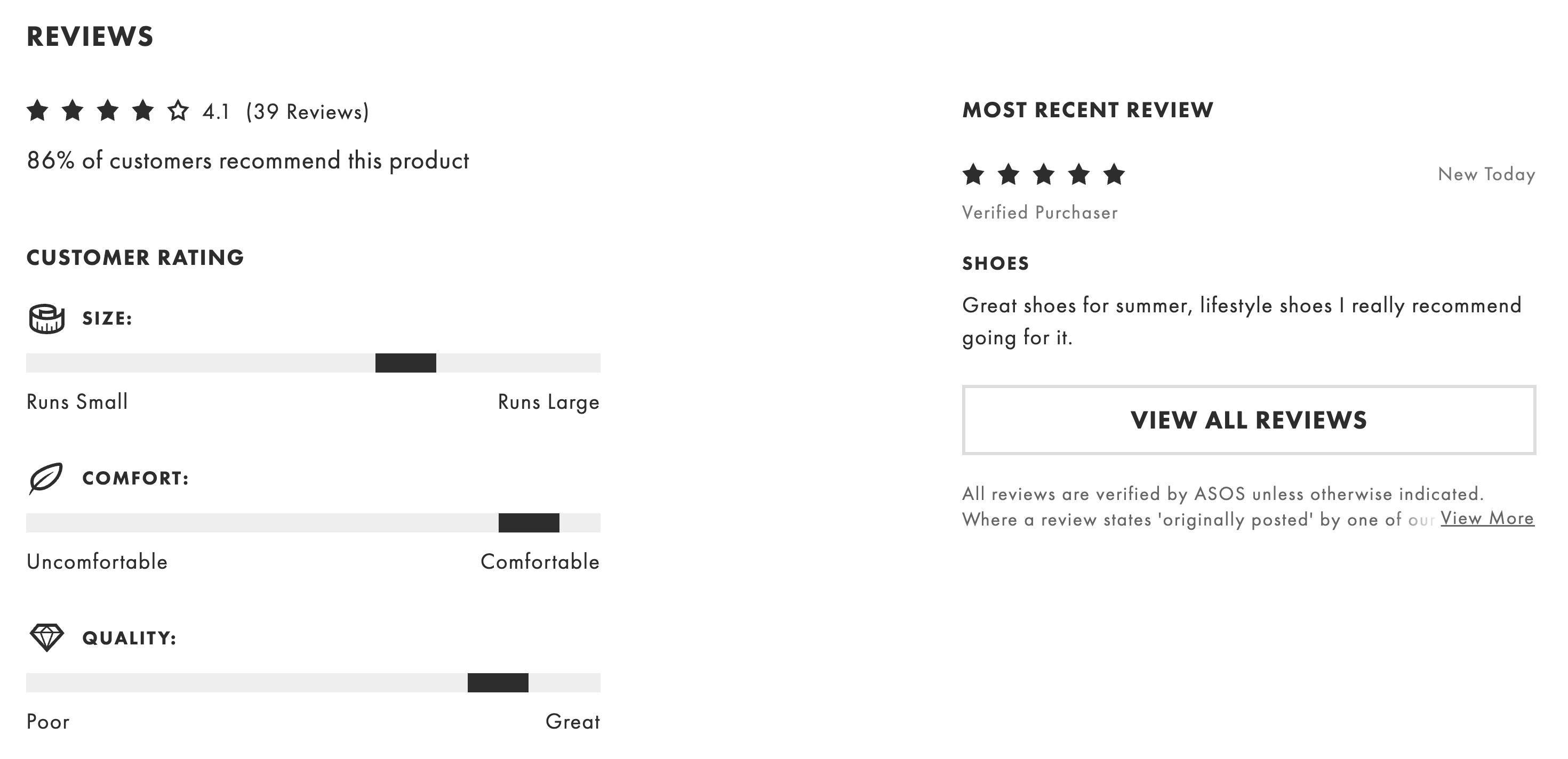
Each element in that image is designed to answer a different question an uncertain user might have, using the experiences of past customers as the evidence.
B. User Counts (Data/Numbers)
This form of social proof leverages quantity as a proxy for quality. The underlying assumption is, "If so many people are using this, it must be good."
You see this everywhere:
- Buffer: "Join 160,000+ small businesses..." (from the CXL article)
- Social Media: Follower, subscriber, and like counts.
- E-commerce: "Over 1 million sold," or "25 people have this in their cart right now."
- Newsletters: "Join 500,000 daily readers."
This tactic is effective because it's easily digestible and creates a sense of scale and authority.
3. Using Social Proof: Effectiveness and Ethics
Simply plastering testimonials on a page isn't a guaranteed win. The effectiveness of social proof depends heavily on its quality and context. For it to work, it must be credible and relevant.
- The "Negative Social Proof" Problem: Displaying social proof only works if the numbers are impressive. Showing "0 people bought this" or featuring a single, mediocre review can have the opposite effect, actively discouraging users.
- Relevance Matters: Social proof is most powerful when it comes from "similar others." Cialdini's hotel experiment was even more effective when the sign said, "The majority of guests who stayed in this room reused their towels." For your products, this means a testimonial from a user in a similar industry or role is more persuasive.
Finally, this brings us back to the ethical line between persuasion and manipulation. Cialdini makes a critical distinction:
- Ethical Influence: A designer acts like a "detective," finding genuine social proof that already exists (e.g., highlighting your most popular plan) and bringing it to the surface to help users make a good decision.
- Unethical Manipulation: A designer acts like a "smuggler," fabricating social proof or importing it where it doesn't naturally exist (e.g., using fake testimonials, creating a "bestseller" tag for a product that doesn't sell well).
This distinction is crucial. Using social proof ethically means honestly guiding users with real data. Manipulating them with false signals will ultimately destroy trust.
Conclusion
In this lesson, we've unpacked the principle of social proof and its central role in guiding user decisions.
Key Takeaways:
- Social proof is a psychological principle where people look to the actions of others to guide their own behavior, especially under uncertainty.
- It works by providing a mental shortcut that helps users feel more confident that they are making the "correct" choice.
- In product design, social proof is commonly implemented through:
- Testimonials: Qualitative endorsements from happy customers.
- Ratings & Reviews: Quantitative and qualitative feedback that builds trust.
- User Counts: Numbers and data that signal popularity and widespread adoption.
- The effectiveness of social proof depends on its credibility and relevance. Using it ethically involves highlighting genuine user behavior, not fabricating it.
Next Up
Social proof is often used in combination with another powerful psychological driver: scarcity. In our next lesson, we will explore how limited-time offers and low-stock warnings create a sense of urgency and compel users to act.
Can't find a good explanation? Sign up and we'll make it for you
Sign up