
Hello! Welcome to the first lesson in our module on the emotional and social drivers of choice.
In the previous module, we explored how the presentation of information—through framing, defaults, and decoys—can shape decisions. We capped it off with a crucial discussion on the ethics of these techniques. Now, we're shifting our focus from the "cold" cognitive aspects of decision-making to the "hot" drivers: our emotions.
Today's learning outcome is to explain how integral emotions (e.g., anticipated regret, FOMO) shape user choices within a product. You'll discover that feelings aren't just noise that gets in the way of rational choice; they are often the very engine of decision-making. For you as a product designer, understanding these emotional undercurrents is key to creating experiences that are not only usable but also resonant and compelling.
We'll start by defining what integral emotions are and then take a deep dive into two of the most powerful emotional forces in the digital world: the Fear of Missing Out (FOMO) and Anticipated Regret.
1. The Emotional Core of Decision-Making
We often like to think of ourselves as rational beings, weighing pros and cons to arrive at the best decision. However, research in neuroscience and psychology shows that emotions are not a bug in our decision-making software; they're a fundamental feature.
To understand this better, let's distinguish between two types of emotion that can affect our choices.
[PDF] Compendium of Persuasive User Experience Design Techniques
This section from a master's thesis on persuasive design provides a clear, academic distinction between incidental and integral emotions.
Please read the section '1.3 Emotions and decision-making process' (it's on page 5). Focus on the definitions of incidental and integral emotions and the key takeaway about which one designers can influence.
As the text explains:
- Incidental emotions are feelings you bring to a decision (like being in a bad mood after a tough meeting). They are unpredictable and mostly outside a designer's control.
- Integral emotions are feelings caused by the decision itself (like the anxiety of a high-stakes purchase or the excitement of a new opportunity). These are the emotions that product designers can and do influence.
This lesson focuses on these integral emotions. They are often the shortcuts our brains use to make quick, "good enough" judgments.
How Brands Use Design & Marketing to Control Your Mind
Let's watch a short clip that illustrates this point with some memorable, real-world examples. It shows how our choices are often driven by an emotional need rather than pure logic.
Watch the segment from 03:22 to 04:53. Notice how it reframes everyday actions like brushing your teeth or buying a car as being driven by the pursuit of feelings like confidence or status.
This idea—that we are often buying a feeling or a "better version of ourselves"—is central to understanding the power of emotional drivers in product design. Let's now explore one of the most potent of these: FOMO.
2. The Fear of Missing Out (FOMO)
FOMO, or the "Fear of Missing Out," is a pervasive anxiety that an exciting or interesting event may currently be happening elsewhere. In a product context, it’s the worry that you might miss out on a great opportunity, a special deal, or a valuable experience that others are enjoying.
To understand why FOMO is such a powerful motivator, let's look at its psychological and neurological roots.
The power of 'FOMO' in influencing consumer decision-making
This article from Hall & Partners, 'The power of ‘FOMO’ in influencing consumer decision-making,' breaks down the science behind FOMO and why it's so relevant for brands and products.
Please read the first three sections of the article, down to the heading 'Why should growing brands care about FOMO?'. Pay attention to how it connects FOMO to behavioral science principles and the role of dopamine.
As the article highlights, FOMO works because it taps into two core drivers:
- Emotion: It creates a sense of urgency and anxiety.
- Heuristics (Mental Shortcuts): It leverages social proof and scarcity. If others are doing it, it must be good. If it's scarce, it must be valuable.
The release of dopamine in anticipation of a reward creates what product designer Nir Eyal calls the "itch"—a stress of desire that motivates us to act.
Hooked: The Psychology of How Products Engage Us
In his talk 'Hooked: The Psychology of How Products Engage Us,' Nir Eyal explains this 'itch' and how habit-forming products use negative emotions as internal triggers.
Please watch the following clips: 02:42 - 05:12: Eyal introduces the concept of the 'itch' – the negative emotional state (anxiety, curiosity) that a product can trigger and then relieve. 08:49 - 11:19: This section explains how negative emotions like loneliness, boredom, and uncertainty act as powerful internal triggers that drive us to use products like Facebook or Google. 11:19 - 13:45: Here, he uses Instagram as a case study, showing how it initially addressed the 'fear of loss' and later evolved to trigger FOMO.
FOMO in Product Design
So, how does this manifest in the products you design and use every day? FOMO is often engineered through features that signal scarcity and social activity.
How Brands Use Design & Marketing to Control Your Mind
Let's return to the 'How Brands Use Design & Marketing to Control Your Mind' video. This section gives concrete examples of how scarcity is used to create FOMO.
Watch the clip from 18:54 to 22:41. Notice the Booking.com example, which is a classic digital product pattern, and the concept of 'artificial scarcity' used for product launches.
These techniques are widespread. This infographic provides a great visual summary of the common patterns used to generate FOMO.

3. Anticipated Regret
Closely related to FOMO is the concept of anticipated regret. This is the forward-looking emotion where we make a choice today to avoid feeling bad about it tomorrow. We are trying to minimize the potential for future regret.
The "Compendium" PDF you read earlier touches on a key insight here: "in the long term, we feel more regretful about missed opportunities or decisions that we did not make, while in the short term, we are more likely to regret decisions we have made."
This aversion to the regret of inaction is a powerful motivator that you can see across many products:
- Shopping Cart Abandonment: An email saying "Don't miss out!" or "Your items are waiting" is designed to trigger the anticipated regret of missing a good find.
- Free Trial Endings: A warning that "Your premium access ends in 3 days" prompts you to consider the regret you'll feel when you lose access to valuable features.
- Insurance Products: The entire value proposition of insurance is to sell you a way to avoid the catastrophic regret you would feel after an accident, theft, or illness.
While FOMO is often about what others are doing, anticipated regret can be more personal—it’s about a future version of yourself being disappointed in your present-day decision.
4. The Ethical Tightrope
Leveraging integral emotions like FOMO is undeniably effective. However, as we discussed in our last lesson, effectiveness is not the only measure. These techniques walk a fine line between persuasive design and unethical manipulation.
Pushing urgency too hard can create undue stress and pressure users into making decisions that aren't in their best interest. This might lead to a short-term gain for the business, but it can erode trust and harm long-term retention.
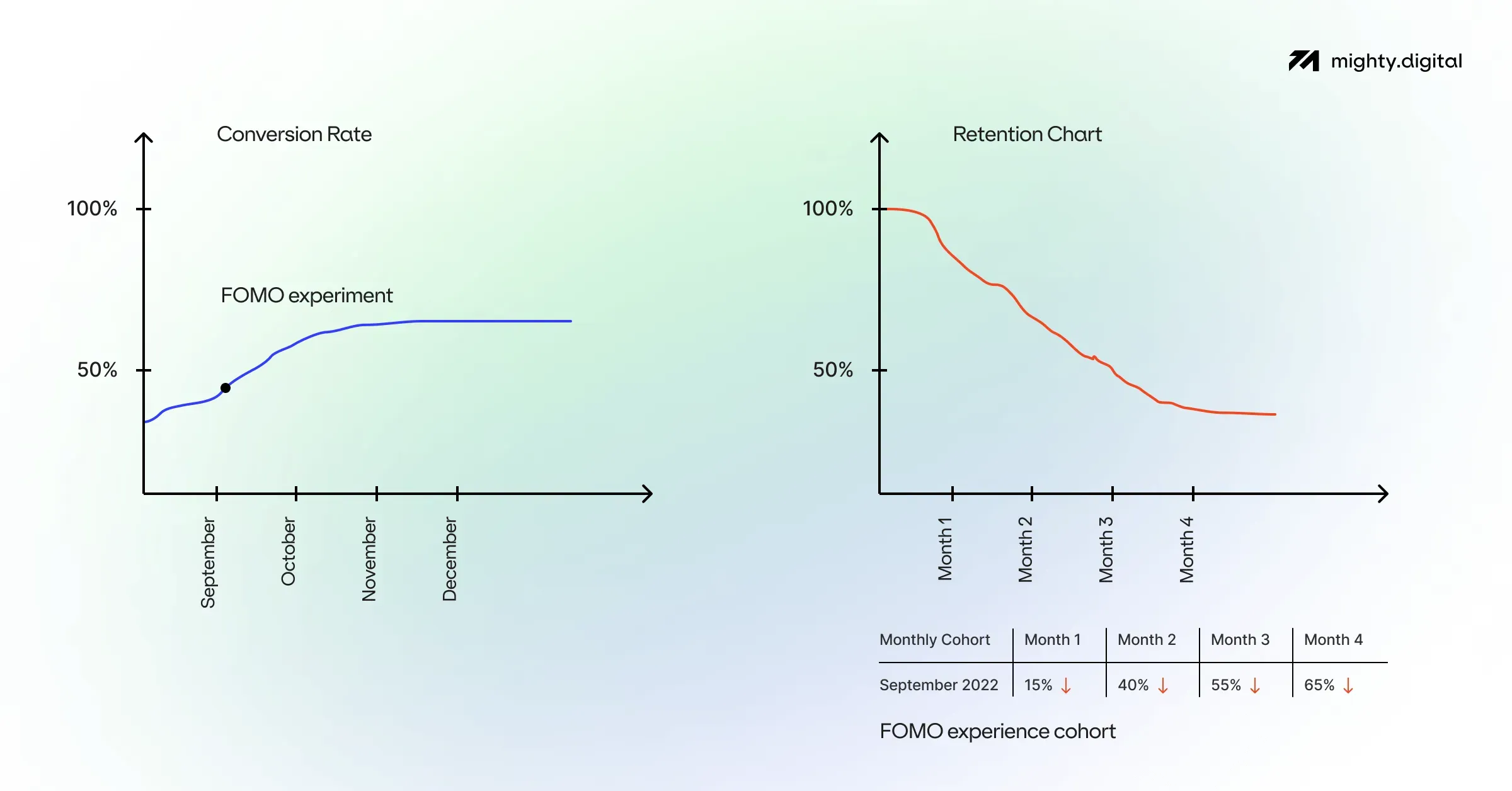
This data provides a compelling business case for ethical design. The "greatest good for the greatest number" (a utilitarian view) should include the long-term well-being and trust of your users, which ultimately aligns with the long-term health of the product.
Conclusion
Today, we've explored the powerful role of integral emotions in shaping user choices. You've seen that feelings are not random noise but are core to the decision-making process.
Key Takeaways:
- Integral emotions are feelings caused by a decision itself, and they are a key area where designers can influence user behavior.
- Fear of Missing Out (FOMO) is a potent driver rooted in social anxiety and amplified by design patterns that signal scarcity and social proof. It creates an "itch" or "stress of desire" that motivates action.
- Anticipated Regret is a forward-looking emotion that guides our choices as we try to avoid future disappointment, particularly the regret of inaction.
- Using these emotional drivers is a double-edged sword. While effective for engagement and conversion, overuse or unethical application can create user anxiety, damage trust, and harm long-term retention.
As a product designer, your goal is to understand these emotional drivers not to exploit them, but to create more empathetic and compelling experiences that genuinely serve your users' needs and feelings.
Next Up
One of the key ingredients needed to create FOMO is social proof. In our next lesson, we will dive deeper into this principle, exploring how testimonials, ratings, and user counts act as powerful social signals that guide our decisions.
Can't find a good explanation? Sign up and we'll make it for you
Sign up