
Hello! Welcome to the next lesson in our module on the emotional and social drivers of choice.
In our last lesson, we examined social proof and saw how the actions of others can powerfully influence our decisions. We noted that social proof is often combined with another potent psychological principle to create an even stronger effect. That principle is our focus today.
This lesson is designed to help you describe how perceived scarcity (e.g., limited time offers, low stock warnings) affects the urgency of user decisions. We will explore why scarcity is such a powerful motivator by looking at its psychological and neurological roots. We'll then identify the common ways it's implemented in digital products and discuss how you, as a product designer, can use this principle effectively and ethically.
1. The Power of "Limited Availability"
Why do people rush to buy the last item on a shelf, even if they were hesitant just moments before? The answer lies in the scarcity principle.
The scarcity principle states that we assign a higher value to things we perceive as being rare or in limited supply. When an opportunity or item becomes less available, our desire for it often increases.
To see this principle in a dramatic, real-world context, let's start with a story.
How Brands Use Design & Marketing to Control Your Mind
This video from Design Theory begins with a fascinating story about one of Elvis Presley's cars. It perfectly illustrates how scarcity can transform an ordinary object's perceived value.
Please watch the segment from 00:18:54 to 00:20:13. Notice how the car's unique story and non-reproducible 'features' (the bullet holes) create extreme scarcity and, therefore, extreme value.
This story shows scarcity in its most elemental form. But why does it have such a strong grip on our decision-making? The effect is rooted in two deep-seated psychological concepts: loss aversion and our brain's primal threat-detection system.
The Psychology Behind Scarcity
You may recall from a previous module that we discussed loss aversion, the principle discovered by Daniel Kahneman and Amos Tversky. It posits that the pain of losing something is psychologically about twice as powerful as the pleasure of gaining something of equal value. Scarcity directly triggers this bias. The thought of a limited-time offer expiring or an item going out of stock frames the decision not as a potential gain, but as an impending loss.
Scarcity Principle: Making Users Click RIGHT NOW or Lose Out
This article from the Nielsen Norman Group provides an excellent explanation of the psychological background of scarcity, explicitly connecting it to Robert Cialdini's work and the concept of loss aversion.
Please read the section titled 'Background of the Scarcity Principle.' Focus on the connection between scarcity and loss aversion.
Beyond the psychology of loss aversion, scarcity also activates primal parts of our brain. Given your interest in human behaviour, you might find the neuroscience behind this fascinating. When faced with scarcity, our brain's threat and reward centers light up, pushing us from slow, analytical thinking (System 2) toward fast, instinctive action (System 1).
The Scarcity Effect: How Limited Offers Activate the Brain's Urgency ...
This article from Braintrust Growth provides a clear, accessible overview of the neuroscience behind scarcity, which helps explain its urgency-inducing effect.
Read the section 'The Neuroscience of Urgency and Scarcity.' It breaks down the roles of the amygdala (threat detector) and the dopamine system (reward anticipation), which are key to understanding why scarcity feels so compelling.
In short, scarcity works by creating a powerful cocktail of emotions: the fear of losing out, the anticipation of a unique reward, and a sense of urgency that short-circuits our more deliberate decision-making processes.
2. Types of Scarcity in Product Design
As a product designer, you've likely encountered and perhaps even implemented scarcity tactics. Let's formalize this by categorizing the most common types used in digital interfaces to drive user action. These cues are designed to signal that an opportunity is fleeting.
For a quick visual summary, here are the most common tactics you'll see.
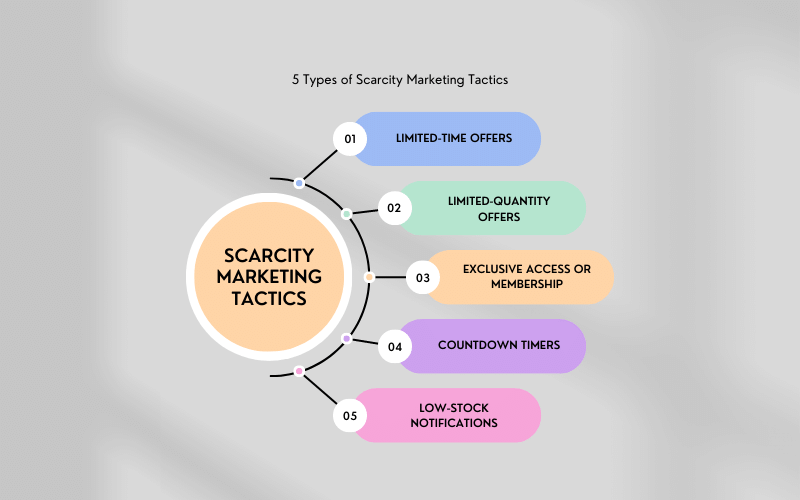
The article from Braintrust Growth provides a slightly more strategic categorization that's useful for design thinking.
The Scarcity Effect: How Limited Offers Activate the Brain's Urgency ...
Let's return to the Braintrust Growth article to explore its excellent categorization of scarcity cues.
Read the section 'Types of Scarcity Cues (and When to Use Them).' It details four key types: Time-Based, Quantity-Based, Access-Based, and Contextual Scarcity.
Let's look at these types in action in the digital world.
The Scarcity Principle in UX: Don't Miss Out!
This short video from the Nielsen Norman Group provides clear, practical examples of how time-based and quantity-based scarcity are used in UX design.
Watch from the beginning to 01:35. Pay attention to the examples like flash sales, limited quantity indicators on e-commerce sites, and exclusive access for newsletter subscribers.
As the video shows, these tactics are everywhere:
- Time-Based Scarcity: This is about deadlines. "Flash sale ends at midnight," "Offer expires in 02:35:19," "Order in the next 3 hours for same-day shipping." These are all designed to prevent procrastination.
- Quantity-Based Scarcity: This is about limited supply. E-commerce sites like Amazon use "Only 2 left in stock." Event platforms like Eventbrite show "8 tickets remaining." Travel sites like Booking.com famously use "Only 1 room left at this price."
- Access-Based Scarcity: This creates exclusivity. "Available only to members," "Get early access by signing up," "An exclusive offer for our newsletter subscribers." This tactic not only uses scarcity but also plays on our desire for status and belonging.
These types of scarcity are often manufactured to create what is known as artificial scarcity.
How Brands Use Design & Marketing to Control Your Mind
Let's go back to the Design Theory video, which explains the concept of artificial scarcity using major brands as examples.
Watch the segment from 00:20:13 to 00:22:25. It discusses Booking.com's use of scarcity and how brands like Nike and Apple intentionally limit supply to create a 'feeding frenzy' and increase perceived value.
3. Using Scarcity Effectively and Ethically
Leveraging scarcity can be a double-edged sword. When used authentically, it can help users overcome indecision and act on a good opportunity. When used deceptively, it erodes trust and can be classified as a 'dark pattern'.
Effectiveness
For scarcity to be effective, users must believe it. If your site perpetually runs a "24-hour" sale that resets every day, users will quickly learn to ignore it. The NNgroup video offers key advice: use it sparingly and test its impact.
Given your background, you know the importance of data-driven design. When implementing scarcity, you should measure its effects.
- A/B Testing: Does a "low stock" warning increase conversion compared to a page without it?
- Analytics: Does a countdown timer reduce the average time-to-purchase?
- User Research: In usability tests, do users perceive the scarcity cues as helpful information or stressful manipulation? Does it impact their trust in the brand?
Ethics
The line between persuasive design and manipulation is critical. False scarcity—like a countdown timer that does nothing or a "limited stock" warning on a digital product—is unethical and will ultimately damage your product's credibility.
The Scarcity Effect: How Limited Offers Activate the Brain's Urgency ...
The Braintrust Growth article offers clear guidelines for applying scarcity ethically.
Please read the section 'How to Ethically Use the Scarcity Effect.' The four principles it outlines—Be Authentic, Pair Scarcity with Value, Reinforce with Social Proof, and Provide Clarity—are an excellent framework for your design practice.
The most important rule is authenticity. Ethical scarcity involves highlighting a genuine limitation (real inventory, a true deadline, limited seats) to help users make an informed and timely decision.
Conclusion
In this lesson, we've explored how perceived scarcity creates urgency and drives user decisions.
Key Takeaways:
- The scarcity principle causes us to place a higher value on things that are rare or limited.
- It is effective because it triggers powerful psychological biases like loss aversion and activates primal brain systems related to threat and reward, pushing us toward quick, intuitive action.
- In product design, scarcity is commonly applied through:
- Time-based cues (e.g., flash sales, countdown timers).
- Quantity-based cues (e.g., "low stock" warnings).
- Access-based cues (e.g., exclusive offers for members).
- Using scarcity ethically is paramount. It should be based on authentic limitations to guide users, not deceive them with false urgency. The impact of scarcity should always be tested to ensure it doesn't harm user trust.
Next Up
Now that we've covered social proof and scarcity, we will turn to another of Cialdini's principles of influence in our next lesson: commitment and consistency. We'll explore how getting a user to make a small, initial commitment can make them much more likely to follow through on larger requests, a key principle in designing effective multi-step processes like sign-up flows and checkouts.
Can't find a good explanation? Sign up and we'll make it for you
Sign up