Hello! Welcome back to our module on Top-of-Funnel Copy.
In our last lesson, we focused on writing LinkedIn ads. The key challenge there was interrupting someone scrolling through their feed and grabbing their attention. We learned to craft a message for a specific persona who wasn't necessarily looking for a solution at that exact moment.
Today, we shift gears to a completely different, and arguably more powerful, scenario. Our learning outcome is to write a Google Search ad for a B2B product that matches high-intent buyer search queries. Instead of interrupting, our job is to capture the attention of someone who is actively looking for a solution. This is a fundamental skill in B2B copywriting, as it allows you to meet the buyer at their point of highest need.
1. From Interruption to Intent: The B2B Search Mindset
The first step in writing a great search ad is understanding the buyer's state of mind. Unlike someone on LinkedIn, a person on Google is on a mission. They have a problem and are actively searching for an answer. Your ad's job is to be the best possible answer to their specific question.
To do this effectively, we need to understand the different levels of purchase intent, which often map to the sales funnel.
The Best B2B Google Ads That Worked for 300+ Clients
The article 'The Best B2B Google Ads That Worked for 300+ Clients' from KlientBoost provides an excellent breakdown of how to think about buyer intent in stages.
First, read section 1, 'Embrace the sales cycle,' focusing on the keywords for Top-of-Funnel, Mid-Funnel, and Bottom-of-Funnel. Then, review the section 'Low-intent keyword strategy' under 'Top 3 B2B Google Ads mistakes.' This will help you see which keywords signal a buyer is ready to act versus just researching.
As you can see, our goal for this lesson is to target the Bottom-of-Funnel (BOFU) buyer. These are people using "high-intent" keywords that include terms like "software," "tool," "pricing," "demo," or "alternative." They've done their research and are now evaluating options to make a purchase decision.
The KlientBoost article also introduces a more refined B2B concept: In-Market Keywords. These fall into two buckets:
- Category Keywords: Describe the what for the who (e.g., "HR software for SaaS companies").
- Capability Keywords: Describe the what with the with (e.g., "project management tool with Gantt charts").
When you write an ad for these keywords, you're not trying to create demand; you're fulfilling it.
2. The Anatomy of a High-Intent Search Ad
Now that we know who we're targeting and what they're searching for, let's build the ad itself. A modern Google Search Ad is "responsive," meaning you provide multiple headlines and descriptions, and Google's AI mixes and matches them to find the best-performing combination.
Our job is to provide Google with high-quality ingredients that work together seamlessly.
10 High-Converting Ad Copy Examples to Drive B2B Growth in 2025
The article '10 High-Converting Ad Copy Examples' from Unkoa gives a fantastic, simple framework for writing the components of a high-intent search ad. It's a formula you can use every time.
Read the section 'Google Ads Search Campaign - High-Intent Keyword Copy.' Pay close attention to the three-part headline formula and the role of the description.
Based on that reading, here is our core ad structure:
- Headline 1 (Keyword Match): This is the most important part. Your first headline should mirror the user's search query as closely as possible. If they search for "B2B sales software," your headline should say "B2B Sales Software." This provides instant confirmation that they've come to the right place.
- Headline 2 (Benefit/Outcome): Now that you have their attention, state a specific, tangible outcome. Use numbers whenever possible. Instead of "Improve Sales," use "Close Deals 40% Faster."
- Headline 3 (Social Proof/Credibility): Reduce the buyer's risk by showing that others trust you. This could be "Rated 4.9 Stars on G2," "Used by 5,000+ Founders," or "Trusted by [Major Brand]."
- Description: This is where you have more space (90 characters per description) to elaborate on the problem you solve and end with a clear, low-friction call-to-action (CTA) like "Get Your Free Demo Today" or "Start Your 14-Day Trial."
Let's see this in action. The ad on the right, labeled 'Expert', clearly follows this formula by highlighting capabilities and specific numbers.

To see how these pieces come together in the actual Google Ads platform, this next clip is very helpful.
Google Ads Beginners Tutorial for 2026 (Step By Step)
The 'Google Ads Beginners Tutorial' from Grow My Ads gives a clear walkthrough of the ad creation interface. Watching this will help you visualize where your headlines and descriptions go.
Watch from 25:50 to 28:50. The presenter explains how to write headlines using different 'angles' (intent match, USP, offer, CTA), which directly corresponds to the framework we just learned.
Your Turn: Write a Google Search Ad
Let's apply this framework. You'll be writing an ad for the same company from our last lesson, FlowState.
Scenario:
- Product: "FlowState," a project management tool designed specifically for creative agencies.
- High-Intent Search Query: "project management software for creative agencies"
- The Goal: Get the searcher to click through to the landing page and request a demo.
Your Task (10 minutes):
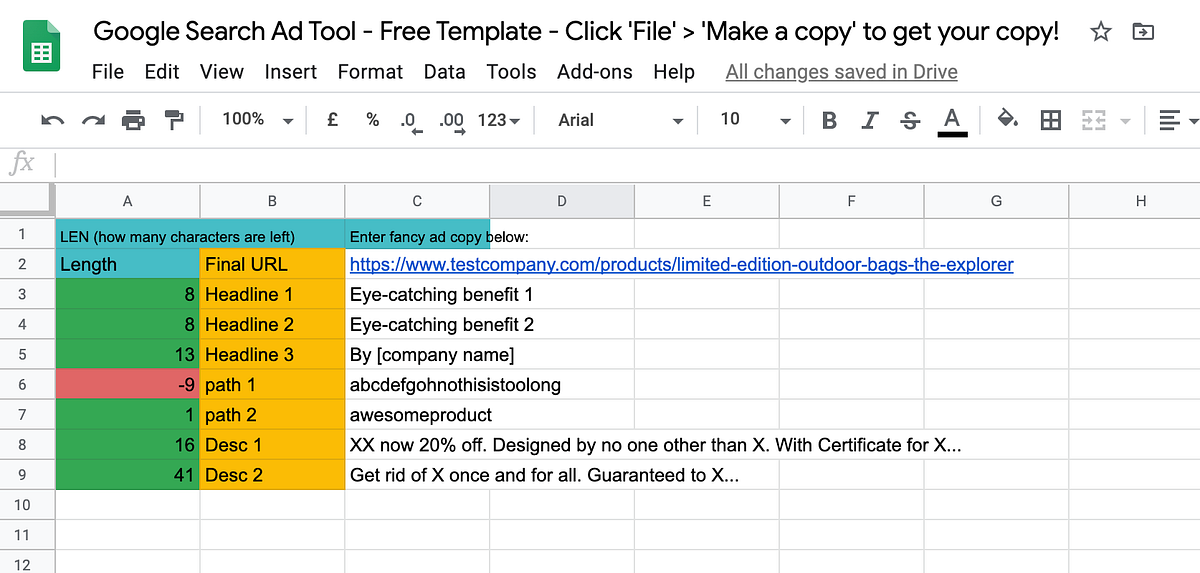
Using the structure we've discussed, write the copy for a responsive search ad. Use the template image below as a guide for character counts.
- Headline 1 (Keyword Match): Mirror the search query.
- Headline 2 (Benefit/Outcome): State a specific, quantifiable result.
- Headline 3 (Social Proof/Credibility): Build trust.
- Description 1: Elaborate on the problem FlowState solves for agencies.
- Description 2: Provide a clear call-to-action.
Conclusion
Excellent work. You've now created a search ad designed to capture a buyer at the precise moment they are looking for a solution.
Key Takeaways:
- Capture, Don't Interrupt: The strategy for Google Search Ads is fundamentally different from social media ads. Your goal is to be the most relevant answer to a user's active search query.
- Focus on High-Intent Keywords: Target BOFU (Bottom-of-Funnel) buyers by focusing on "in-market" keywords that signal a readiness to buy (e.g., category and capability terms).
- The High-Intent Ad Formula: A powerful ad structure is Headline 1 (Intent Match) + Headline 2 (Quantifiable Benefit) + Headline 3 (Social Proof).
- Clarity and Specificity Win: Vague promises don't work in B2B. Use specific numbers and clear language to build credibility and drive clicks.
In our next lesson, we will shift back to LinkedIn, but with a different focus. We will learn how to craft a short-form LinkedIn post that builds authority and generates engagement from B2B buyers, moving from paid acquisition to organic thought leadership.