Hello! Welcome to the first lesson in our new module on Top-of-Funnel Copy.
In our last session, we honed in on the critical first few lines of your copy, learning how to write opening hooks that establish immediate relevance for a B2B buyer. We saw how a hook's job is to earn the reader's attention by aligning with their specific stage of awareness.
Today, we'll put that skill to work in a very practical context. We're moving from the hook to the whole package: a complete advertisement. Specifically, our goal is to write a LinkedIn ad that targets a specific B2B buyer persona and drives a defined action. This is where your skills in writing headlines and hooks come together to persuade a potential customer to take their first step with a brand.
1. The Anatomy of a LinkedIn Ad
Before we write, we need to understand the structure of a LinkedIn ad and, more importantly, how users interact with it. A standard single-image ad has three main copy components, but people don't read them from top to bottom.
To understand this user behavior, let's watch a short video.
The video 'LinkedIn Ads Best Practices' from Paid Media Pros clearly explains the order in which users typically read the elements of an ad. Understanding this is key to structuring your message for maximum impact.
Watch from 03:32 to 05:45. Pay close attention to the sequence he describes: Creative -> Headline -> Introductory Text.
As you just saw, the user journey within the ad itself is:
- The Creative (Image/Video): This is the scroll-stopper. Its visual appeal and core message are the first things a person registers.
- The Headline: After the image catches their eye, they glance down at the bold headline to quickly understand the ad's main point or offer.
- The Introductory Text: If they are still interested, they will finally move up to read the text above the image for more context and details. This is where your hook from the last lesson lives.
This sequence means all three parts must work together as a cohesive unit, but with the understanding that the visual and headline do the initial heavy lifting.
2. Targeting: Speaking to a Specific Persona
The power of LinkedIn advertising lies in its precise targeting. This means we aren't just writing an ad; we're writing an ad for someone. As we've discussed, B2B buying committees involve multiple roles (e.g., the CFO cares about ROI, the IT manager cares about integration). Your copy must adapt to the specific concerns of the person you're targeting.
Let's return to the 'LinkedIn Ads Best Practices' video to see a practical example of how ad copy should change for different buyer personas within the same company.
Watch the segment from 08:20 to 09:27. Notice how the messaging is tailored to the distinct motivations of the CEO, CFO, Manager, and end-user.
This is why the buyer persona work we've covered is so crucial. To write an effective ad, you must first have a crystal-clear picture of who you're talking to—their job title, their frustrations, and what they hope to achieve.
3. Crafting the Three-Part Message
Now, let's assemble the ad, piece by piece, keeping our target persona in mind. We'll use some excellent advice from the article "10 B2B SaaS Copywriting Tips for Better Ad Performance."
10 B2B SaaS Copywriting Tips for Better Ad Performance
This article from AdConversion offers several powerful copywriting principles. We'll focus on a few that are essential for writing compelling ad copy.
Please read Tip #1 'Sell The Click, Not The Product,' Tip #8 'Clear Before Clever,' Tip #9 'Tie Benefits Back to Something Realistic,' and Tip #10 'Make Sure Your Copy Passes the “So What” Test.' These tips provide a great mental checklist for writing effective ad copy.
With those principles in mind, here’s how to approach each component:
-
Creative (The Scroll-Stopper): While you're a copywriter, your copy and the visual are a team. The creative needs to be eye-catching and instantly communicate the ad's core idea. Best practices suggest using bright colors (to stand out from LinkedIn's blue and white), large bold text with a single focus, and a square (1:1) format to take up more screen space. Your copy should complement this visual promise.
-
Headline (The Core Value): This should be short (under 70 characters is best) and crystal clear. It reinforces the creative's message and states the primary benefit or offer. This is the place for a specific, tangible outcome, not vague marketing fluff. Think "Free IT Software Audit Checklist," not "Optimize Your Business."
-
Introductory Text (The Hook & Context): This is where you deploy your hook. The first 150 characters are critical because anything longer will be hidden behind a "see more" link. Use this space to call out a problem, present a surprising statistic, or ask a provocative question that speaks directly to your persona's pain points. The rest of the text can then elaborate and guide the reader to the call-to-action. A pro tip is to also include the destination link at the end of this text for an extra click opportunity.
-
Call-to-Action (The "Defined Action"): The CTA button must match the promise of your ad. If your ad offers a guide, the button should say "Download." If it promotes a webinar, it should say "Register" or "Save your seat." This is the final step, and any mismatch between the ad's promise and the CTA will kill your conversion rate.
Your Turn: Write a LinkedIn Ad
It's time to put this all together.
Scenario:
- Product: A project management tool called "FlowState" designed specifically for creative agencies.
- Target Persona: Selena Daniels, the CEO/Founder of a startup project management firm. Her detailed persona is below.
- The Offer: A free webinar titled "Beyond Spreadsheets: How Agency Owners Can Reclaim 10+ Hours a Week."
- The Goal (Defined Action): Get Selena to register for the webinar.
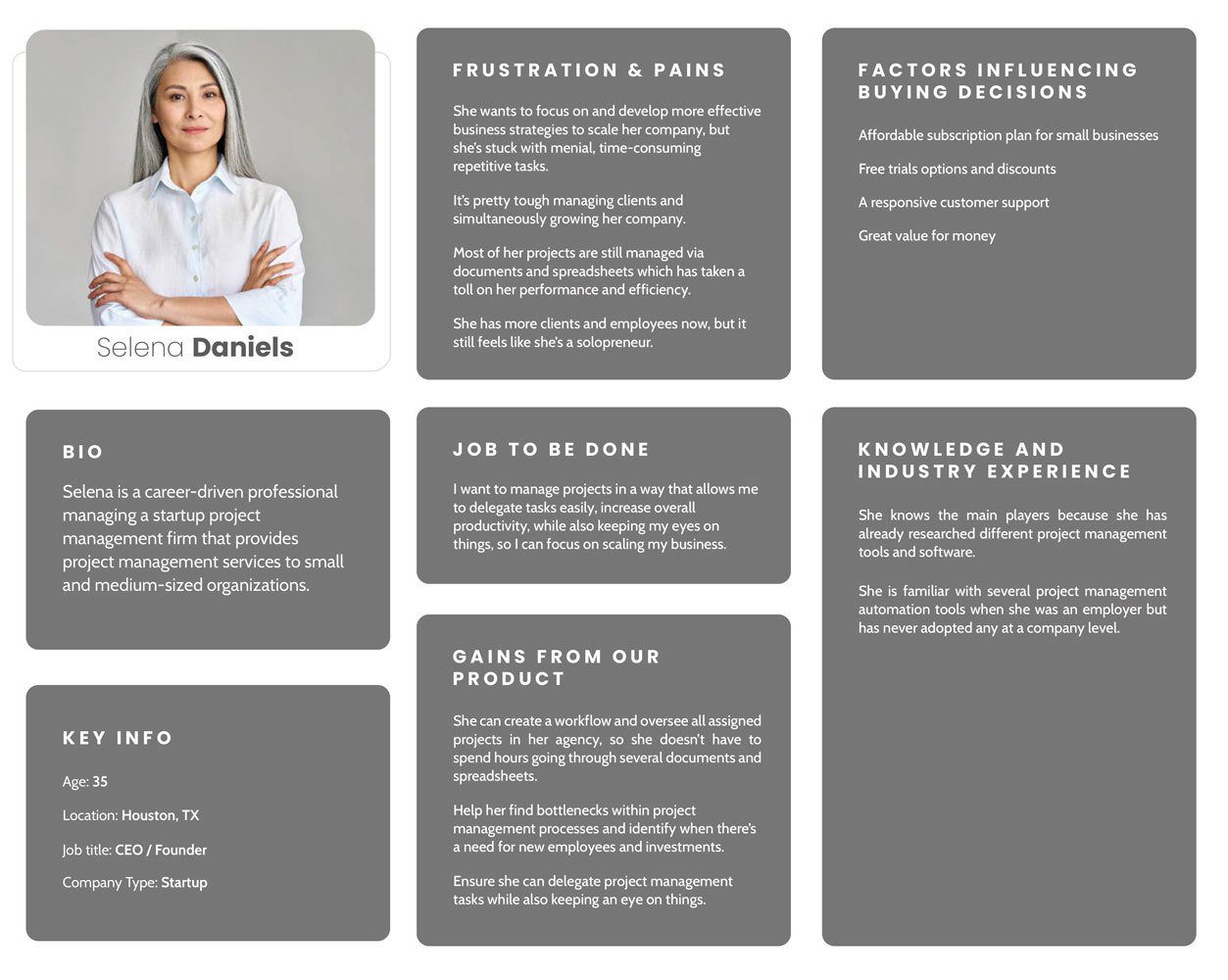
Your Task (10 minutes):
Based on the scenario and Selena's persona, write the three core components for a LinkedIn ad.
- Introductory Text: Write a compelling hook and body text. Remember to make the first ~150 characters count.
- Headline: Write a clear, concise headline (max 70 characters).
- Creative Brief: In 1-2 sentences, describe the visual you would want a designer to create for this ad. What should it show to grab Selena's attention?
Conclusion
Great work! You've just constructed a complete B2B LinkedIn ad, moving from strategy and persona research to the final execution of copy.
Key Takeaways:
- Write for the User's Eye Path: Structure your ad knowing that the Creative grabs attention, the Headline clarifies value, and the Intro Text provides the convincing details.
- Persona-First Copy: The most effective ads speak directly to a specific person's problems and aspirations. Every word should be written with your target persona (like Selena) in mind.
- The Ad is a System: All components—the creative, headline, intro text, and CTA—must work together seamlessly to guide the buyer toward the defined action.
- Clarity Over Cleverness: In the fast-scrolling world of social media, a clear, specific, and tangible promise will always outperform a vague or overly clever one.
In our next lesson, we will tackle another crucial top-of-funnel channel: Google Search. We'll explore how to write a Google Search ad that matches high-intent buyer search queries. This will be a fascinating contrast, as we shift from interrupting a user's feed (like on LinkedIn) to capturing their active, expressed intent.