Hello! Welcome back to our course.
In our last lesson, we focused on capturing high-intent buyers with Google Search Ads. The goal was to be the best answer for someone actively looking for a solution. Today, we're shifting our focus from capturing existing demand to creating it through organic content.
Our learning outcome is to craft a short-form LinkedIn post that builds authority and generates engagement from B2B buyers. This is about moving from paid interruption to organic thought leadership, building a brand (either for yourself or a client) that draws buyers in over time.
1. The Strategy: What Should You Post About?
Effective LinkedIn content isn't random; it follows a strategy. The goal for a B2B professional isn't just to get likes, but to be seen as a credible, authoritative voice in their industry. A great way to structure this is the "Authority First" framework.
This framework suggests that your content should be a strategic mix designed to build trust first, then connect on a personal level, and finally, present offers.
LinkedIn Content Strategy Framework 2025 - How to Get Started
To understand this strategy, let's watch a few clips from the video 'LinkedIn Content Strategy Framework 2025' by Pierre Herubel. He breaks down his 'Authority First' framework into three content pillars.
Please watch from 03:01 to 03:38 to understand the core concept, then watch from 03:38 to 04:43 for the 'Industry Content' pillar, 04:43 to 06:31 for the 'Personal Stories' pillar, and finally 06:40 to 10:09 for the 'Conversion Content' pillar and the summary.
To summarize the framework you just watched:
- 70% Authority Content: The bulk of your posts. This is where you share your expertise—industry insights, analysis, how-tos, and unique opinions. This content proves you know what you're talking about.
- 15% Personal Stories: Content that humanizes you or your brand. These are stories related to your career, lessons learned, or behind-the-scenes content that helps your audience connect with you as a person.
- 15% Conversion Content: Posts that are designed to drive an action, like signing up for a newsletter, downloading a resource, or requesting a demo. This works best after you've established authority and connection.
For today's lesson, we are focusing squarely on that first, most important pillar: Authority Content.
2. The Anatomy of an Authoritative Post
Now that we have a strategy for what to post, let's break down how to write a single, effective post. An authoritative post isn't just about sharing information; it's about making that information easy to consume and engaging to discuss.
Every great LinkedIn post has a few key components.
How I write LinkedIn Posts that get 100,000+ views
Let's turn to another video from Pierre Herubel, 'How I write LinkedIn Posts that get 100,000+ views.' He provides a simple, five-step process for crafting a post.
Pay close attention to these segments: Step 1 & 2 (01:16 - 03:03): Finding a unique insight and a single idea. Step 4 (04:24 - 07:03): The crucial role of the hook. Step 5 (07:03 - 07:51): Writing the body and the call to action.
Let's break down that structure:
- The Hook (The First 2 Lines): This is the most critical part of your post. Its only job is to make someone stop scrolling and click "...see more". A strong hook states a problem, shares a surprising fact, or makes a bold claim.
- The Body: This is the main part of your post where you deliver on the promise of your hook. The key to a good body is readability. Use short sentences, single-line paragraphs, and bullet points or numbered lists. People skim on LinkedIn, so make your post easy to scan.
- The Call-to-Action (CTA): Unlike an ad, the CTA in an organic post is usually a question. The goal is to start a conversation in the comments. This engagement signals to the LinkedIn algorithm that your post is valuable, showing it to more people.
3. Post Formats That Build Authority
You now have a strategic framework (Authority First) and a tactical structure (Hook, Body, CTA). To make this even more practical, let's look at a few proven post formats you can use as templates for your authority content.
10 Powerful LinkedIn Posts Examples to Boost Your Engagement
The article '10 Powerful LinkedIn Posts Examples' from Postiv.ai offers an excellent playbook of different post types. We'll focus on a few that are perfect for building authority.
Please read the sections for these three post types: 'The Problem-Solution Post' 'The 'Hot Take' or Contrarian Opinion Post' 'The Quick Tips or Actionable Advice Post' For each one, pay attention to the 'Why It Works' section and the provided template.
These formats give you a repeatable structure for sharing your expertise. For example, a "Hot Take" or "Contrarian Opinion" post is a fantastic way to showcase your unique perspective and generate discussion.
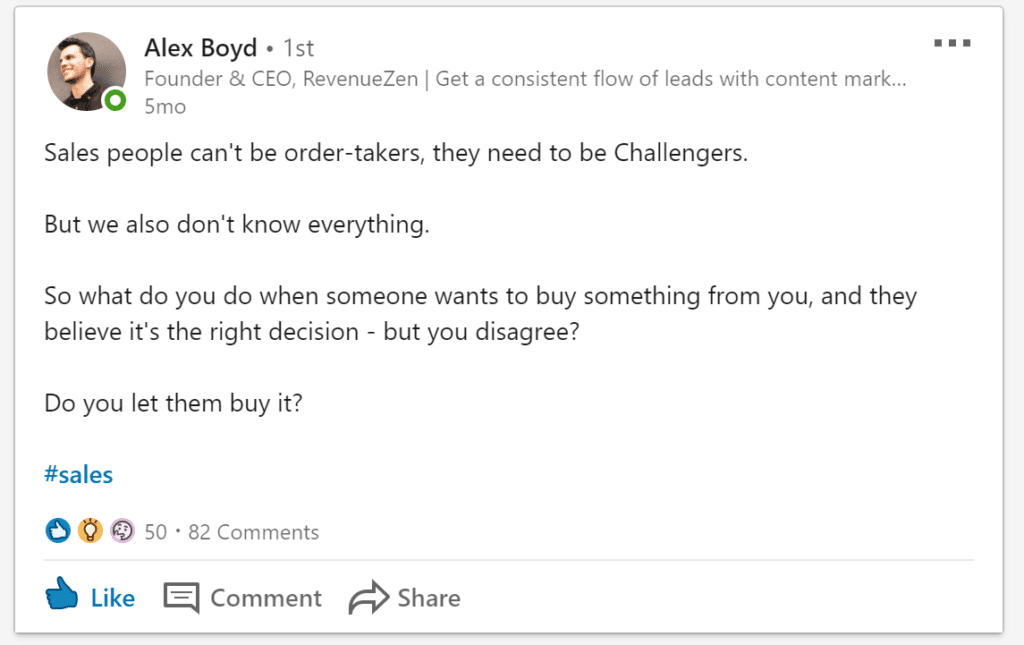
Here is a real-world example of a post that uses a combination of the "Contrarian Opinion" and "Question Starter" formats.
Your Turn: Write an Authoritative LinkedIn Post
Now it's time to put this into practice.
Scenario:
You are a B2B copywriter building your personal brand on LinkedIn. Your target audience is marketing managers at B2B SaaS companies.
Task (7 minutes):
Write a short-form LinkedIn post using the "Contrarian Opinion" format. Your goal is to challenge a common piece of advice in the B2B marketing world and spark a debate.
Choose one of these "hot takes" (or create your own):
- "Blogging is a waste of time for most early-stage startups."
- "Your obsession with creating 'buyer personas' is killing your copy."
- "Gated content (like white papers) does more harm than good."
Follow this structure:
- Hook (1-2 lines): State your contrarian opinion clearly.
- Body (3-5 short sentences): Briefly explain why you believe this. Back up your take with a short piece of reasoning. Remember to keep sentences short and use white space.
- CTA (1 line): End with a question to encourage debate (e.g., "What's your take?", "Am I wrong here?", "What has your experience been?").
Conclusion
Great job! You've just crafted a piece of copy designed not just to sell, but to build authority, start conversations, and establish expertise—all crucial skills for a B2B copywriter.
Key Takeaways:
- Follow the Authority First Framework: Dedicate most of your content (70%) to sharing expertise to build credibility with B2B buyers.
- The Hook is Everything: The first two lines determine if your post gets read. Make them count by being bold, specific, or questioning.
- Structure for Skimming: Use short sentences, white space, and lists to make your posts easy to read on a mobile feed.
- Engage with a Question: Your goal is to start a conversation. End your authority posts with a question to invite comments.
In our next lesson, we'll revisit a concept mentioned in passing today. We will take a deep dive into one of the most powerful copywriting formulas and apply the problem-agitate-solution framework to a B2B awareness-stage ad.