Hello! Welcome back.
In our last lesson, we focused on building authority and starting conversations with organic LinkedIn posts. Today, we're shifting gears to a foundational direct-response copywriting formula that is essential for writing compelling ads: Problem-Agitate-Solution (PAS).
Our learning outcome is to apply the problem-agitate-solution framework to a B2B awareness-stage ad. While our last lesson was about earning attention through thought leadership, this lesson is about grabbing attention by tapping directly into a buyer's pain points to create urgency. This is one of the most versatile and powerful formulas in your copywriting toolkit.
1. Deconstructing the PAS Framework
At its core, the Problem-Agitate-Solution framework is a simple, three-step narrative structure designed to persuade a reader to take action.
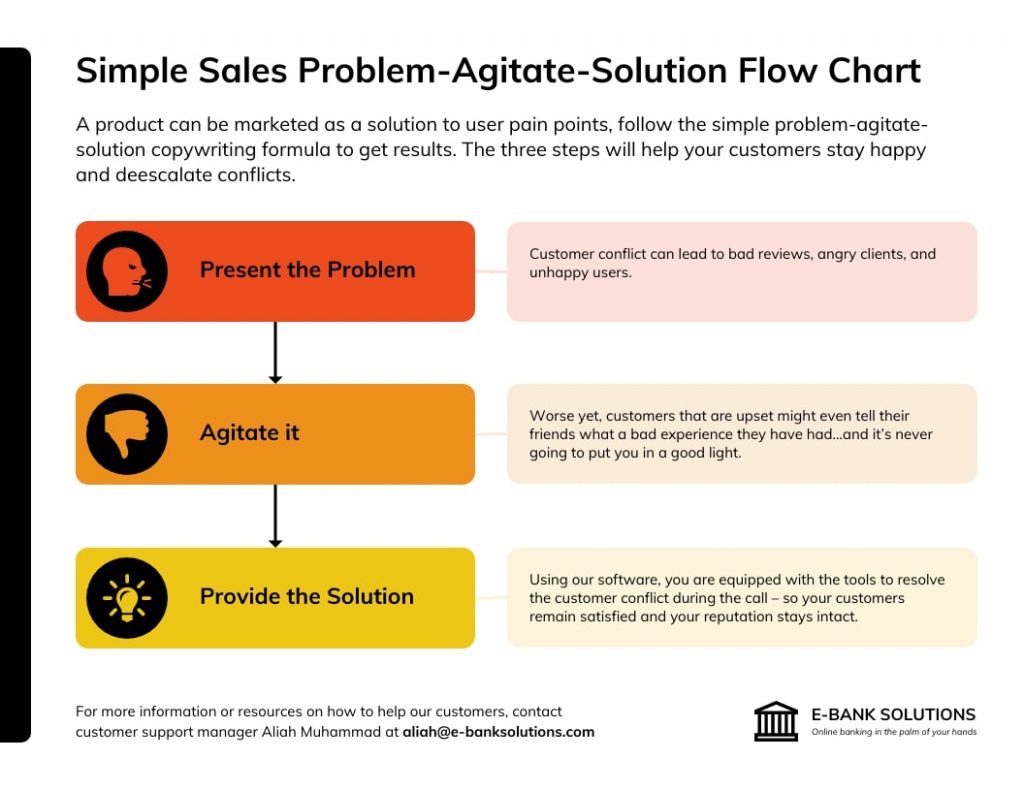
Let's get a more detailed definition of each part.
Mastering the PAS Framework: Problem, Agitation, Solution
To understand the role of each component, please read the breakdown in the article 'Mastering the PAS Framework' from Pageblock.
Please read the 'Detailed Breakdown' sections for 'Problem', 'Agitation', and 'Solution'. As you read, focus on the specific purpose and key elements of each stage. Notice how each step logically flows into the next.
To summarize what you've just read:
- Problem: You identify and state a specific, relevant pain point your reader is experiencing. This shows empathy and grabs their attention.
- Agitate: You intensify the problem. You explore the negative consequences, frustrations, and costs of not solving it. This is where you create urgency.
- Solution: You present your product or service as the clear and logical answer to the agitated problem, providing relief.
The Agitation stage is the most critical and often the most challenging to write well. It’s what separates weak copy from copy that compels action. Effective agitation isn't about fearmongering; it's about demonstrating a deep understanding of the buyer's world—the core theme of this course.
2. The Art of Agitation
Good agitation goes beyond the surface-level problem. It digs into the real-world consequences—the wasted time, the financial costs, the damage to professional reputation, the team frustration. To do this well, you need to think like your buyer and ask the right questions.
How to Use the PAS Formula - Copyhackers
Copywriting expert Joanna Wiebe has an excellent process for brainstorming powerful agitation points. In this clip from her video 'How to Use the PAS Formula,' she shares a set of questions to uncover the true cost of a problem.
Please watch from 00:52 to 04:05. Pay close attention to the questions she asks about how the problem manifests (in their work, mind, community, bank account) and what it's costing them. These questions are a goldmine for generating potent copy.
The key takeaway here is to move from a general problem to specific, tangible consequences. The questions from the video provide a great framework for your own research and brainstorming:
- How does this problem manifest in their work? In their mind?
- What is it costing them in time, money, or reputation?
- Why does this problem even exist for them?
- What are the common misconceptions they have about it?
Answering these questions gives you the raw material to make the problem feel real and urgent to your reader.
3. Applying PAS to a B2B Awareness Ad
Now, let's connect this framework to a practical application: a B2B awareness-stage ad. In the confined space of an ad, the PAS flow needs to be concise and impactful. The carousel ad format is particularly well-suited for this narrative structure.
10 High-Converting Ad Copy Examples to Drive B2B Growth in 2025
Let's see how this looks in a real-world ad format. The article '10 High-Converting Ad Copy Examples' from Unkoa breaks down how a Facebook carousel ad can perfectly execute the PAS framework.
Please read section 4, 'Facebook/Instagram Carousel Ad - Problem-Solution-Social Proof Sequence.' Focus on the 'Why This Ad Copy Works' part and how the narrative is broken down across the different cards.
As the article highlights, each card in the carousel has a single job, guiding the user through a mini-funnel: problem, agitation, and then solution.
Your Turn: Write a PAS-Based Ad
It's time to put this powerful framework into practice.
Scenario:
You are writing an ad for "SyncFlow," a B2B SaaS product. SyncFlow is a project management tool specifically designed for remote marketing teams.
Target Audience:
Marketing Managers who lead these remote teams.
Task (7 minutes):
Using the PAS framework, write the copy for a three-card carousel ad. Be concise for each card.
- Card 1 (Problem): State a clear problem that marketing managers of remote teams face. (e.g., related to communication, project visibility, missed deadlines).
- Card 2 (Agitation): Agitate that problem. What are the negative business consequences? (e.g., "This leads to...", "Which means...", "You risk...").
- Card 3 (Solution): Introduce SyncFlow as the solution. Focus on the primary benefit that resolves the agitated pain point.
Conclusion
Well done. You've just used one of copywriting's most enduring formulas to structure a B2B ad. By starting with the buyer's problem and demonstrating you understand its consequences, you make your solution feel less like a sales pitch and more like welcome relief.
Key Takeaways:
- PAS is a Persuasive Narrative: It guides the reader from a state of pain (Problem), to a state of urgency (Agitation), to a state of relief (Solution).
- Agitation Creates Urgency: This is the engine of the formula. By exploring the true costs of a problem, you motivate the buyer to act.
- PAS is Adaptable: The framework can be applied to many formats, from long-form sales pages to concise ad formats like carousels.
In our next lesson, we will continue our work on top-of-funnel ads. You will learn how to evaluate and rewrite an underperforming B2B ad by diagnosing the mismatch between its message and audience. This will involve spotting weaknesses in frameworks like PAS and sharpening the copy to better connect with the buyer.