
Good to see you again. Last lesson established how to read a structure for formal charge, polar bonds, hydrogen-bond donors and acceptors, and nonpolar surface. We now add the aqueous environment—the fact that biomolecules do not interact in empty space, but while surrounded by water.
This lesson explains two related ideas that organize much of biochemistry: hydrogen bonding makes water an unusually interactive solvent, while the hydrophobic effect drives nonpolar surfaces to become less exposed to it. Together, these principles help explain why ions and sugars dissolve, why proteins fold, why lipids assemble into membranes, and why polar and nonpolar groups occupy different locations in biomolecular structures.
Water is an active participant, not just a background solvent
Water is polar because oxygen attracts shared electrons more strongly than hydrogen does. Oxygen therefore has a partial negative charge, while the hydrogen atoms have partial positive charges. This charge distribution allows one water molecule’s hydrogen to interact with another water molecule’s oxygen through a hydrogen bond.
A hydrogen bond is weaker than a covalent bond and continually breaks and reforms in liquid water. But water molecules form so many of these transient interactions that, collectively, they strongly shape the behavior of dissolved molecules.
The Chemical Components of a Cell - Molecular Biology of the Cell - NCBI Bookshelf
Read “The Chemical Components of a Cell” from Molecular Biology of the Cell on NCBI Bookshelf. It provides the central physical picture for this lesson: a dynamic hydrogen-bond network in water, the distinction between hydrophilic and hydrophobic substances, and the solvent-driven basis of the hydrophobic effect.
Under “Water Is the Most Abundant Substance in Cells,” read the paragraph beginning “The two bonds are highly” through water's network. Focus on why individual weak hydrogen bonds can collectively give water distinctive properties. Then read the following paragraph beginning “Molecules, such as alcohols, that contain” through hydrophilic and hydrophobic molecules. Notice that ions interact favorably with water as well as molecules that can hydrogen-bond. Finally, in the later discussion of weak noncovalent bonds, read the paragraph beginning “This bond represents a special form of” through directional bonding, followed by the paragraph beginning “The fourth effect that can play an important part” through the hydrophobic effect. Keep the distinction clear: hydrogen bonds are specific, directional interactions; the hydrophobic effect is a collective consequence of water’s behavior around nonpolar surfaces.
Recall the structural requirements for a typical biochemical hydrogen bond:
- A donor contains a hydrogen attached to an electronegative atom, usually O or N.
- An acceptor has an available lone pair, commonly on O or N.
- The interaction is strongest when donor, hydrogen, and acceptor are aligned approximately linearly.
For example, an alcohol group can both donate and accept hydrogen bonds. A carbonyl oxygen can accept but cannot donate. A protonated amine, such as , can donate through its bonds but generally cannot accept because its lone pair is unavailable.
Solvation: what water does to polar and charged groups
When a polar or charged biomolecule enters water, surrounding water molecules orient themselves to make favorable interactions. This is solvation or, specifically for water, hydration.
- Water’s oxygen atoms orient toward a cation, such as or a protonated amino group.
- Water’s hydrogen atoms orient toward an anion, such as , a carboxylate, or phosphate.
- Polar groups such as hydroxyls, carbonyls, and amides can form hydrogen bonds with nearby water molecules.
This is why sugars, nucleic-acid phosphates, and many protein surface groups are compatible with an aqueous environment. They either carry charge or present hydrogen-bonding sites that water can satisfy.
An important consequence follows: water competes for hydrogen bonds. If a protein donor and acceptor form a hydrogen bond with each other on the protein surface, they often replace hydrogen bonds each could already form with water. Therefore, a protein hydrogen bond is not automatically strongly stabilizing merely because it exists. Its benefit depends on the full comparison between the folded and unfolded situations.
Hydrophilic, hydrophobic, and amphipathic behavior
A molecule or region is hydrophilic when it interacts favorably with water. Charged groups are especially hydrophilic because they make strong ion–dipole interactions with water. Polar uncharged groups are also hydrophilic when they can form hydrogen bonds.
A molecule or region is hydrophobic when it is nonpolar and cannot make favorable hydrogen bonds with water. Hydrocarbon chains and the faces of many aromatic rings are typical examples. “Hydrophobic” does not mean that the molecules literally repel water by a new, special repulsive bond. It describes an unfavorable situation for the surrounding water network.
When isolated nonpolar molecules are dispersed in water, each presents surface area that water must accommodate. Nearby water molecules become more restricted in their orientations than water in the bulk liquid. If the nonpolar molecules cluster, their total exposed surface area decreases. Fewer water molecules must remain in these constrained arrangements.
The result is a favorable increase in the freedom of the surrounding water molecules. This solvent-driven tendency for nonpolar surfaces to associate is the hydrophobic effect.
Thermodynamically, a process is favorable when its Gibbs free-energy change is negative:
For hydrophobic association, the increase in entropy of water often provides an important favorable contribution. The nonpolar molecules themselves become more organized when they aggregate, but the surrounding water becomes sufficiently less constrained that the overall process can be favorable.
It is therefore more accurate to say:
Nonpolar groups associate in water because doing so reduces nonpolar surface exposed to water.
It is less accurate to say that nonpolar groups “attract each other because they are hydrophobic.” They do make direct dispersion contacts when packed closely, but the defining driver of the hydrophobic effect is water.
009-Hydrophobic Effect & Its Consequences
Watch “009-Hydrophobic Effect & Its Consequences” from Fundamentals of Biochemistry for a concise visual account of how ordered water around nonpolar surfaces leads to aggregation and to lipid self-assembly.
Start with solvation cost, which contrasts mobile bulk water with the more constrained water around a nonpolar group. Continue with aggregation to see why clustering nonpolar molecules reduces the amount of ordered water. Then watch assembly shapes, focusing on how molecular shape helps amphipathic molecules form micelles or bilayers.
An amphipathic biomolecule contains both hydrophilic and hydrophobic regions. A fatty acid illustrates this well: its carboxylate-containing head is polar or charged, whereas its hydrocarbon tail is nonpolar. In water, many such molecules can arrange with their polar heads facing water and their nonpolar tails packed together away from it.
Single-tailed amphipathic molecules can form micelles, with tails hidden in a nonpolar interior. Many double-tailed phospholipids instead form bilayers, the structural basis of cell membranes. The details of membrane structure come later; for now, the essential principle is that water-facing surfaces tend to be polar, while water-excluded regions tend to be nonpolar.
Protein folding: a balance of burial, exposure, and precise contacts
A newly synthesized protein is initially an extended chain whose side chains are exposed to water. Its sequence contains a mixture of polar, charged, and nonpolar groups. Folding reorganizes those groups into a three-dimensional structure that better fits the aqueous environment.
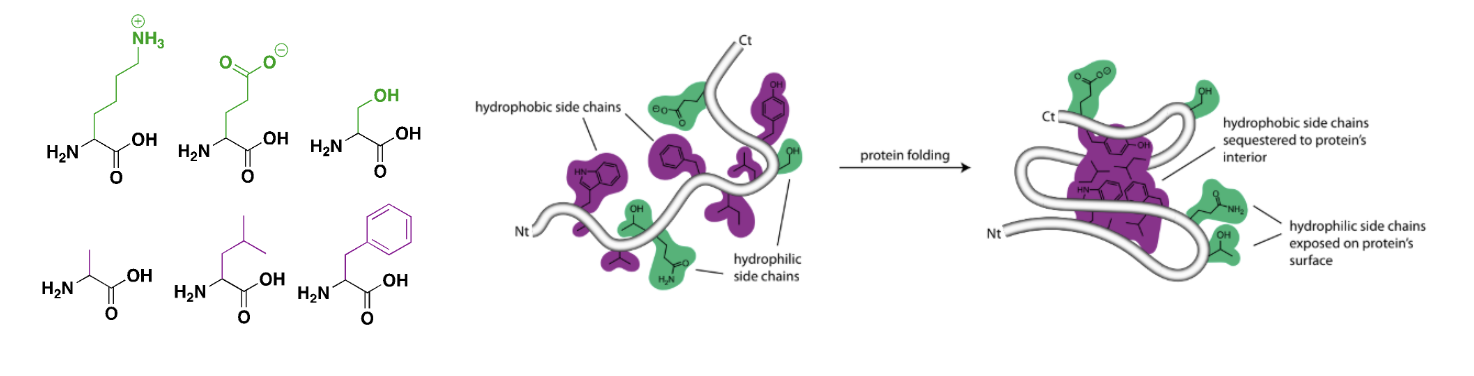
The illustration captures the broad pattern seen in many soluble proteins:
- Hydrophobic side chains are commonly buried in the protein core, where they pack tightly against one another.
- Polar and charged side chains are commonly exposed on the surface, where they can hydrogen-bond with water or make ion–dipole interactions.
- Backbone polar groups that become buried generally need to form hydrogen bonds with other protein groups; burying an unsatisfied donor or acceptor is unfavorable.
The protein interior is not held together by a single interaction type. The hydrophobic effect encourages nonpolar residues to become buried, while close packing provides many dispersion interactions. Hydrogen bonds can stabilize specific helices, sheets, turns, and buried polar networks. Oppositely charged groups can form salt bridges when their geometry and surroundings favor them.
The key idea is cooperation. A folded protein is stable when many interactions work together and the folded state has lower free energy than the unfolded alternatives.
There are useful exceptions to the simple “nonpolar inside, polar outside” rule:
- Buried polar groups can occur if they make well-positioned hydrogen bonds or participate in a functional site.
- Surface hydrophobic patches can occur when a protein must bind another protein, a membrane, or a nonpolar ligand.
- Membrane proteins differ from soluble proteins. Their outer surfaces often contain nonpolar residues that contact the hydrophobic interior of the lipid bilayer.
Thus, use the rule as a strong first prediction, not as an absolute law.
Hydrogen bonds and hydrophobic effects in other biomolecules
These same principles apply beyond proteins.
Nucleic acids
DNA and RNA have negatively charged phosphate groups that are strongly hydrated and typically face the aqueous environment. Their bases contain both hydrogen-bonding groups and relatively nonpolar aromatic surfaces.
In a double helix, complementary bases form specific hydrogen bonds, but base pairing is not explained by hydrogen bonds alone. The bases also stack, reducing their exposure to water and creating favorable close contacts. Thus, hydrogen bonding provides specific recognition, while hydrophobic and stacking effects contribute importantly to structural stability.
Small-molecule binding
An enzyme can bind a substrate by placing complementary chemical groups close together. A charged substrate group may form an electrostatic interaction; an alcohol might form a hydrogen bond; a nonpolar portion may fit into a hydrophobic pocket.
However, the relevant comparison remains the full aqueous environment. When a ligand enters a binding pocket, some water molecules are displaced. Binding is favored when the new protein–ligand contacts, changes in water organization, and changes in molecular flexibility together lower the total free energy.
A practical prediction routine
When asked how a biomolecule will behave in water, work through this sequence:
- Identify charged groups. Predict strong hydration and ion–dipole interactions.
- Identify hydrogen-bond donors and acceptors. Predict possible hydrogen bonds with water and with complementary biomolecular groups.
- Locate nonpolar surface. Predict poor water compatibility, dispersion contacts, and a tendency to become buried or clustered.
- Look for amphipathic architecture. Predict organized assemblies that expose polar regions to water and shield nonpolar regions.
- Account for competition from water. A proposed intramolecular or intermolecular hydrogen bond must be considered relative to the hydrogen bonds that water already provides.
Key takeaways
Water is polar and forms a dynamic hydrogen-bond network. Charged and polar biomolecular groups are usually hydrated because they can make ion–dipole interactions or hydrogen bonds with water.
Hydrogen bonds are directional and chemically specific. In aqueous solution, they must be evaluated in context because water can hydrogen-bond with the same donors and acceptors.
The hydrophobic effect is a solvent-driven tendency for nonpolar surface area to become less exposed to water. By clustering nonpolar groups, water becomes less constrained overall. This effect helps drive lipid assembly, protein folding, base stacking, and many molecular-binding events.
In soluble proteins, hydrophobic side chains are often buried and polar or charged groups are often water-exposed. The full folded structure is stabilized by the combined effects of hydrophobic burial, close packing, hydrogen bonds, and electrostatic interactions.
Next, you will shift from qualitative aqueous chemistry to quantitative acid–base behavior by calculating pH or pOH for simple strong-acid and strong-base solutions.
Can't find a good explanation? Sign up and we'll make it for you
Sign up