
Good to see you again. In the previous lesson, you learned to assign formal charges from the structure as drawn: for example, recognizing , , and negatively charged phosphate oxygens. Those full charges are one essential part of molecular behavior, but they are not the whole story. Neutral atoms can carry partial charges because electrons are shared unequally, and the three-dimensional arrangement of those partial charges determines whether a whole molecule is polar.
This lesson develops a practical structure-reading skill: starting from a chemical drawing, identify its charged, polar, and nonpolar regions, then predict the noncovalent interactions those regions can plausibly make. This is the chemical language behind protein folding, enzyme binding, membranes, and nucleic-acid structure.
From bonds to molecular polarity
Begin by separating three ideas that are often blurred together:
| Idea | What it describes | Example |
|---|---|---|
| Formal charge | Integer charge assigned by electron bookkeeping | , |
| Bond polarity | Unequal sharing of electrons in one covalent bond | The oxygen end of an bond is partially negative |
| Molecular polarity | Net separation of partial charge across the entire molecule | Water has a partially negative oxygen side and a partially positive hydrogen side |
A polar covalent bond occurs when one atom attracts shared electrons more strongly than the other. This tendency is called electronegativity. In biomolecules, oxygen and nitrogen commonly pull electron density away from carbon or hydrogen:
- , , and bonds are substantially polar.
- and many bonds are polar.
- bonds are polar, and phosphate groups often also carry formal negative charge.
- and, for most biochemical purposes, bonds are treated as nonpolar.
The more electronegative atom is the partially negative end, written ; the other end is partially positive, written . These are not formal charges. For example, the oxygen in a neutral alcohol is formally uncharged, but it is still electron-rich and partially negative.
For a small molecule, the next question is whether all its bond polarities cancel in three-dimensional space. A molecule is polar only if it has polar bonds arranged so that there is a remaining net separation of charge.
7.6 Molecular Structure and Polarity - Chemistry 2e | OpenStax
Read the “Molecular Polarity and Dipole Moment” subsection from OpenStax Chemistry 2e. It gives the central rule for this lesson: bond polarity must be combined with molecular geometry.
In the subsection “Molecular Polarity and Dipole Moment,” start with the definition of a molecular dipole. Then read the carbon dioxide and water comparison, beginning at the role of geometry. Finish the subsection through the two-point summary of the conditions required for molecular polarity. Focus on why polar bonds alone are insufficient.
The water, methane, and carbon dioxide comparison below captures the logic.
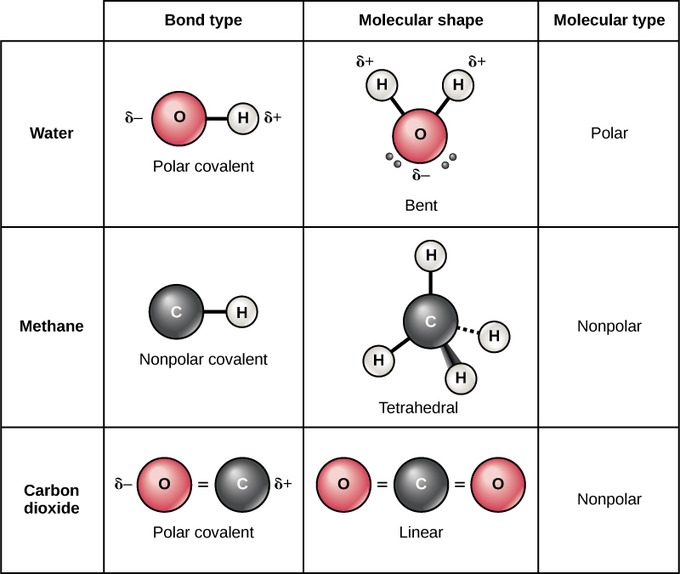
- Water, , contains polar bonds. Its bent shape prevents the bond polarities from cancelling, so water is polar.
- Carbon dioxide, , also contains polar bonds. But it is linear, with identical oxygens on opposite sides. The two bond polarities cancel, so is nonpolar overall.
- Methane, , is tetrahedral and contains only effectively nonpolar bonds. It is nonpolar.
For exam problems involving simple molecules, use VSEPR geometry when deciding whether bond polarities cancel. Highly symmetric arrangements with identical outer atoms, such as linear or tetrahedral , are commonly nonpolar. Replacing one of those outer atoms with a different group often breaks the symmetry and produces a polar molecule.
For large biomolecules, asking whether the entire molecule is polar is sometimes less useful than identifying polar patches and nonpolar patches. A fatty acid, for instance, has a polar or charged carboxyl-containing head and a long nonpolar hydrocarbon region. A molecule with both types of region is amphipathic.
Geometry is the deciding step
A skeletal structure is two-dimensional, but molecular interactions occur in three dimensions. When you see a structure, make this short sequence routine:
- Locate polar bonds and formal charges. Look first for O, N, S, P, halogens, and any explicit charge.
- Determine the relevant local geometry. For a small molecule, use VSEPR around the central atom. A double bond counts as one electron-density region.
- Check symmetry. Ask whether equal bond polarities point in geometrically balanced directions.
- Describe the result at the appropriate scale. Use “polar” or “nonpolar” for small molecules; use “polar region,” “nonpolar region,” or “amphipathic” for larger ones.
A useful contrast is a carbonyl-containing molecule versus a hydrocarbon. In a carbonyl, , oxygen creates a strongly electron-rich region. That local polarity remains chemically important even if the rest of a larger molecule is mostly hydrocarbon. Conversely, a long chain of and bonds makes a broad nonpolar surface.
Molecular polarity | Chemistry | Khan Academy
Watch “Molecular polarity” from Khan Academy for a compact visual treatment of bond-polarity cancellation. The examples directly reinforce the distinction between polar bonds and polar molecules.
Watch carbon dioxide to see why two polar bonds can yield a nonpolar molecule when the structure is linear. Then watch water geometry, focusing on how oxygen lone pairs create a bent shape and prevent cancellation.
One caveat matters in biomolecules: net charge zero does not mean nonpolar. Consider a zwitterion such as glycine drawn as
Its total formal charge is zero, but it contains a positively charged ammonium group and a negatively charged carboxylate group. It has strong local electrostatic interactions with water and other charged groups. Treating it as “uncharged” would be a serious mistake.
What interactions can the structure make?
Once you have identified charge and polarity, you can predict the main noncovalent interactions. “Likely” is important: an interaction also requires close approach, a favorable orientation, and an appropriate environment. Water can compete strongly for charged and polar groups, while pH can change the protonation state of acid-base groups.

1. Interactions involving full formal charges
A positively charged group and a negatively charged group can make an ion–ion electrostatic interaction. In proteins, an interaction between a lysine-like group and an aspartate-like group is often called a salt bridge.
An ion can also interact strongly with a polar molecule through an ion–dipole interaction. Water solvates ions this way:
- The partially negative oxygen end of water faces cations such as .
- The partially positive hydrogen side of water faces anions such as .
Ion–dipole interactions are why charged biomolecular groups are often strongly hydrated in water.
2. Hydrogen bonds
A hydrogen bond requires two roles:
- A hydrogen-bond donor provides a hydrogen covalently attached to an electronegative atom, usually O or N in biomolecules.
- A hydrogen-bond acceptor provides an available lone pair, usually on O or N.
The attractive contact is between the partially positive donor hydrogen and the electron-rich acceptor atom. Hydrogen bonds are directional: the donor, hydrogen, and acceptor must adopt a suitable geometry.
Common functional-group behavior is worth memorizing:
| Structural feature | Donor? | Acceptor? | Reasoning |
|---|---|---|---|
| Alcohol hydroxyl, | Yes | Yes | It has an bond and oxygen lone pairs |
| Carbonyl oxygen, | No | Yes | It has lone pairs but no attached hydrogen |
| Neutral amine with | Yes | Yes | Nitrogen has an bond and an available lone pair |
| Protonated amine, | Yes | No | It can donate an hydrogen, but its lone pair is no longer available |
| Carboxylate, | No | Yes | The oxygens are electron-rich but have no bond |
| Carboxylic acid, | Yes | Carbonyl O only | The hydroxyl donates; the carbonyl oxygen accepts |
| Amide nitrogen, | Often yes | No | Its lone pair is delocalized into the carbonyl group |
| Phosphate oxygen | Protonation-dependent | Usually yes | Oxygen lone pairs can accept; an form can donate |
A common error is to label every nitrogen an acceptor. Amide nitrogen is not a normal hydrogen-bond acceptor, and a fully protonated amine is not an acceptor either.
3. Dipole–dipole interactions
Two neutral polar groups can align so that a partially positive region lies near a partially negative region. This is a dipole–dipole interaction. Carbonyl groups, hydroxyl groups, neutral amines, and many amide groups can all participate in such interactions.
Hydrogen bonding is a particularly important, more specific kind of dipolar interaction. Do not call every attraction involving oxygen or nitrogen a hydrogen bond; first check that there is a donor hydrogen attached to O or N.
4. Dispersion forces
London dispersion forces, often included under the broad term van der Waals interactions, occur between all atoms and molecules. At any moment, an electron cloud can become slightly uneven, creating a temporary dipole that induces a complementary temporary dipole nearby.
These interactions are individually weak, but they become significant when many atoms fit closely together. They are especially important for:
- close packing of hydrocarbon chains in lipids;
- contacts between nonpolar amino-acid side chains;
- packing in the interior of a folded protein.
Nonpolar groups cannot hydrogen bond or form ordinary dipole–dipole interactions, but they are not interaction-free. Their principal direct attractions are dispersion forces.
5. Induced dipoles and aromatic interactions
A full charge or permanent dipole can distort the electron distribution of a nearby nonpolar group, giving ion-induced dipole or dipole-induced dipole attractions. The figure shows these as separate categories. In introductory biochemistry, you will often group them conceptually with electrostatic and dispersion contributions rather than calculate them separately.
Aromatic rings also have delocalized electrons. When aromatic rings lie close and suitably oriented, they can make pi interactions, commonly described as aromatic stacking. Positively charged groups can also interact with the electron-rich face of an aromatic ring. These interactions are context-dependent, so predict them only when you can identify aromatic rings and a plausible close-contact arrangement.
Intermolecular Forces and Boiling Points
Watch the selected portions of “Intermolecular Forces and Boiling Points” by Professor Dave Explains. It connects molecular features to ion–dipole, hydrogen-bonding, dipole–dipole, and dispersion interactions.
Watch the interaction types for the physical basis of ion–dipole interactions, hydrogen bonding, and dispersion forces. Then watch structure prediction, which models the exact exam habit you need: infer possible interactions from charges, polar bonds, and geometry. Treat the relative-strength discussion as a broad trend; in aqueous biology, solvent, distance, and orientation can substantially change the effective interaction.
A structure-reading workflow for biomolecules
Use this method whenever you are given a molecular structure.
-
Read the protonation state exactly as drawn. Circle every explicit formal charge. A carboxylate and carboxylic acid do not make the same interactions; neither do a neutral amine and a protonated amine.
-
Mark electron-rich atoms. Carbonyl oxygens, alcohol oxygens, carboxylate oxygens, phosphate oxygens, and many neutral amine nitrogens are likely partial-negative or fully negative sites.
-
Mark donor hydrogens. Look specifically for and bonds. A hydrogen attached to carbon is generally not a hydrogen-bond donor in this context.
-
Identify nonpolar surface. Regions made mostly of , , and hydrocarbon rings are nonpolar and can form close-packing dispersion contacts.
-
Consider geometry and symmetry. For a small molecule, decide whether bond dipoles cancel. For a large molecule, identify polar, charged, and nonpolar regions rather than relying only on a single overall polarity label.
-
State interactions as compatible pairs. For example: “The carboxylate can make ion–ion interactions with a cation, ion–dipole interactions with water, and hydrogen bonds as an acceptor.”
Here are three concise examples of that reasoning.
| Structure | Polarity diagnosis | Likely interactions |
|---|---|---|
| Ethanol, | Polar because of its hydroxyl group; its hydrocarbon portion is nonpolar | Hydroxyl can donate and accept hydrogen bonds; molecule can make dipole–dipole interactions; hydrocarbon portion makes dispersion contacts |
| Acetate, | Formally negative and strongly polar | Ion–ion attraction to cations; ion–dipole interactions with water; carboxylate oxygens accept hydrogen bonds; methyl group contributes dispersion contacts |
| Glycine zwitterion, | Net charge , but strongly charge-separated | Ion–ion interactions with oppositely charged groups; strong hydration; ammonium donates hydrogen bonds but does not accept; carboxylate accepts hydrogen bonds |
Notice the difference between having an interaction available and forming it at every moment. A carboxylate oxygen may be hydrogen-bonded to water, coordinated to a metal ion, or paired with a nearby positive group depending on its surroundings. Chemical structures reveal the interaction possibilities; the molecular environment selects among them.
Key takeaways
Molecular polarity is not determined by one bond alone. First identify polar bonds from electronegativity differences, then consider their three-dimensional arrangement. Symmetric molecules such as can contain polar bonds yet be nonpolar overall, whereas bent water is polar.
When predicting noncovalent interactions from structure:
- Formal charges predict ion–ion and ion–dipole interactions.
- Hydrogen-bond donors usually contain or bonds.
- Hydrogen-bond acceptors usually have available lone pairs, but protonated amines and amide nitrogens are important exceptions.
- Neutral polar groups can make dipole–dipole interactions.
- Nonpolar surfaces make dispersion contacts and are important in molecular packing.
- Large biomolecules are best described in terms of charged, polar, and nonpolar regions, rather than a single label alone.
Next, you will build on these interaction types to explain how hydrogen bonding and the hydrophobic effect govern the behavior of biomolecules in water.
Can't find a good explanation? Sign up and we'll make it for you
Sign up