
Hello. In the previous lesson, we examined how water hydrates charged and polar groups and why nonpolar groups tend to minimize their exposure to water. Acid–base chemistry now makes that aqueous setting quantitative: the concentration of hydronium ions determines pH, while hydroxide ions determine pOH.
This lesson focuses on the simplest, high-yield cases for introductory biochemistry and general chemistry: strong acids and strong bases, which dissociate essentially completely in water. By the end, you will be able to turn a stated molarity into pH or pOH, account for hydroxide stoichiometry in compounds such as calcium hydroxide, and recognize when the shortcut is appropriate.
pH and pOH: logarithmic labels for ion concentration
In water, the acidic ion is more accurately written as hydronium, , rather than a bare proton. For the concentration-based calculations used here, pH is defined as:
Similarly:
The brackets mean molar concentration. Strictly, pH is defined using activity rather than concentration, but in the dilute solutions in this lesson, molarity is the standard and sufficiently accurate approximation.
The negative logarithm makes a very broad range of ion concentrations manageable. For instance:
corresponds to:
while a tenfold lower hydronium concentration gives pH 3.00. Thus, a one-unit increase in pH means a tenfold decrease in hydronium concentration.
At , water obeys:
Taking the negative logarithm of this relationship gives the convenient result:
So, once you know either pH or pOH, you can obtain the other by subtraction. At this temperature:
| Solution type | Relative ion concentrations | pH |
|---|---|---|
| Acidic | less than 7.00 | |
| Neutral | 7.00 | |
| Basic | greater than 7.00 |
A useful calculator pattern is:
where . For example, is , or .
8.5: pH of Strong Acids and Strong Bases - Chemistry LibreTexts
Read Chemistry LibreTexts’ “pH of Strong Acids and Strong Bases” to see the direct connection between complete dissociation, ion concentration, and the logarithmic pH or pOH calculation.
In the “Strong Acids” section, read from the opening explanation of complete ionization through Example PageIndex 1. Start at the ionization explanation, then follow the HCl example and note its rounding rule. Next, in “Strong Bases,” read through the NaOH and calcium hydroxide examples to the Summary. Focus on the dissociation and stoichiometry discussion: the formula unit concentration is not always the hydroxide concentration.
Strong acids: determine hydronium first
A strong acid dissociates essentially completely in water. For a simple monoprotic strong acid such as HCl, one formula unit produces one hydronium ion:
Therefore, for an ordinary dilute solution of HCl:
The approximation sign matters conceptually: pure water already contains a very small concentration of hydronium. But when the acid concentration is far larger than , the acid’s contribution dominates and the water contribution can be neglected.
Worked example: hydrochloric acid
Find the pH of HCl at .
1. Establish the ion concentration. HCl is a strong, monoprotic acid, so:
2. Apply the pH definition.
3. Round appropriately. The given concentration has two significant figures, so report two digits after the decimal in the logarithmic answer:
If the question also asks for pOH:
The important chemistry is not the logarithm alone. It is the prior conclusion that complete dissociation makes the stated HCl concentration equal to the hydronium concentration.
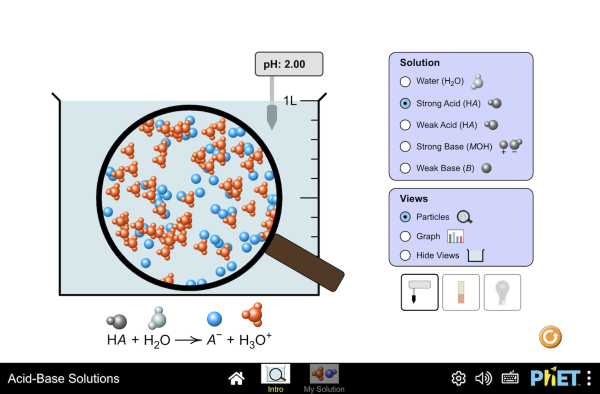
The screenshot represents a solution with a relatively large hydronium concentration compared with neutral water. A pH of 2.00 corresponds approximately to:
Strong bases: determine hydroxide first
A strong base dissociates completely to yield hydroxide ions. For a metal hydroxide with one hydroxide per formula unit, such as sodium hydroxide or potassium hydroxide:
Thus, for NaOH:
You calculate pOH directly, then use pH plus pOH equals 14.00:
The base calculation differs from the acid calculation mainly in its final step: hydroxide concentration yields pOH, not pH.
Stoichiometry matters: bases with more than one hydroxide
Before taking a logarithm, inspect the chemical formula and balanced dissociation equation. Calcium hydroxide has two hydroxide ions per formula unit:
Consequently:
Worked example: calcium hydroxide
Calculate the pOH and pH of at .
1. Use the dissociation stoichiometry.
2. Calculate pOH.
3. Convert to pH.
The most common mistake here is to insert directly into the pOH formula. That would ignore that every unit of calcium hydroxide produces two hydroxide ions.
pH Calculations | Strong Acids & Bases | 16.4 General Chemistry
Watch Chad’s Prep’s “pH Calculations | Strong Acids & Bases | 16.4 General Chemistry” for a compact visual walk-through of the acid and base procedures, including hydroxide stoichiometry.
Watch strong acids for the direct acid-concentration-to-pH method. Then watch strong bases for the pOH-first approach, followed immediately by two hydroxides for why group-two hydroxides require a stoichiometric multiplier before calculating pOH.
A dependable calculation routine
For the standard exam-style problem, follow this order:
- Identify the solute as a strong acid or strong base. Complete dissociation is the key assumption.
- Write the dissociation equation or inspect the formula. Determine how many or ions arise per formula unit.
- Calculate the relevant ion concentration. For HCl, the multiplier is one; for , the hydroxide multiplier is two.
- Use the matching logarithmic formula. Hydronium gives pH; hydroxide gives pOH.
- Use the complementary value if required. At , subtract from 14.00.
- Check chemical sense. Strong-acid solutions should have pH below 7, while strong-base solutions should have pH above 7.
This compact table summarizes the decision:
| Given solute | First concentration to determine | First calculation | If the other scale is needed |
|---|---|---|---|
| Strong monoprotic acid, such as HCl | |||
| Strong base, such as NaOH | |||
| Strong hydroxide with multiple , such as | , after stoichiometry |
Precision and boundaries of the shortcut
For logarithms, significant figures in a concentration become decimal places in pH or pOH. For example, has three significant figures, so its pH should be reported to three decimal places.
Also keep the scope clear:
- The direct concentration shortcut applies to strong acids and bases, not weak acids or weak bases.
- The approximation that the solute alone controls the ion concentration becomes unreliable for extremely dilute acid or base solutions near , where water’s autoionization matters.
- A pH below 0 or above 14 can occur in sufficiently concentrated idealized solutions; the familiar 0–14 scale is a useful convention, not an absolute physical limit.
Key takeaways
For simple strong-acid and strong-base solutions, complete dissociation converts a chemical-formula problem into an ion-concentration problem.
- For a monoprotic strong acid, the acid molarity gives , then calculate pH.
- For a strong base, determine , calculate pOH, then obtain pH from at .
- Always account for stoichiometry before taking the logarithm. , for example, produces twice as much hydroxide as its formula-unit concentration.
- A one-unit pH change represents a tenfold change in hydronium concentration.
Next, the course moves from complete dissociation to buffers. You will use the Henderson–Hasselbalch equation to connect pH with the relative amounts of a weak acid and its conjugate base.
Can't find a good explanation? Sign up and we'll make it for you
Sign up