
Good to see you again. Last lesson established the structural patterns of the functional groups that recur in biomolecules: carboxyl, amino, phosphate, hydroxyl, amide, and others. This lesson adds the accounting system that lets you label which atoms actually carry charge in a particular drawn structure.
The key constraint is “at a specified protonation state.” Do not guess what form is most common at a given pH unless the question asks you to do that. Instead, use the hydrogens, bonds, lone pairs, and any explicitly stated charges in the structure you are given. By the end, you should be able to assign formal charges atom by atom and verify the molecule’s total charge.
Formal charge is electron bookkeeping
A formal charge is a charge assigned to an individual atom in a Lewis structure by pretending that electrons in each covalent bond are shared equally. It is an accounting convention, not a literal map of where electron density sits in a real molecule.
For formal-charge purposes, an atom “owns”:
- all of its nonbonding electrons, meaning its lone-pair electrons;
- one electron from each single bond;
- two electrons from each double bond;
- three electrons from each triple bond.
The general equation is:
where:
- is the number of valence electrons in the neutral isolated atom;
- is the number of nonbonding electrons;
- is the total number of bonding electrons.
A faster equivalent form for line-bond structures is:
In this shortcut, a single bond contributes 1, a double bond contributes 2, and a triple bond contributes 3.
For the atoms you will encounter most often:
| Atom | Valence electrons |
|---|---|
| C | 4 |
| N | 5 |
| O | 6 |
| P | 5 |
| S | 6 |
| H | 1 |
A hydrogen drawn with one bond has formal charge , so most biochemistry problems require you to focus chiefly on nitrogen, oxygen, sulfur, phosphorus, and occasionally an unusual carbon.
Watch “Formal Charge” by The Organic Chemistry Tutor for a compact demonstration of the electron-counting method. It is particularly useful for seeing why the same rule identifies negatively charged oxygen, positively charged carbon, and positively charged nitrogen.
Watch the basic formula to establish the counting convention. Then watch oxygen example, carbon example, and nitrogen example. For each, pause briefly before the calculation and count bonds and lone-pair electrons yourself.
Recognize the common charge patterns first
You can always calculate formal charge from the equation, but common patterns become fast to recognize. In the table below, “bond-order total” means the sum of single, double, and triple bonds around that atom.
| Atom and pattern | Lone-pair electrons | Bond-order total | Formal charge |
|---|---|---|---|
| Carbon with four bonds | 0 | 4 | |
| Carbon with three bonds and no lone pair | 0 | 3 | |
| Nitrogen with three bonds and one lone pair | 2 | 3 | |
| Nitrogen with four bonds and no lone pair | 0 | 4 | |
| Oxygen with two bonds and two lone pairs | 4 | 2 | |
| Oxygen with one bond and three lone pairs | 6 | 1 | |
| Oxygen with three bonds and one lone pair | 2 | 3 | |
| Sulfur with two bonds and two lone pairs | 4 | 2 | |
| Sulfur with one bond and three lone pairs | 6 | 1 |
The patterns most important for biomolecules are these:
- A single-bonded oxygen with three lone pairs is usually .
- An oxygen in , with two bonds and two lone pairs, is neutral.
- A neutral amine nitrogen usually has three bonds and one lone pair, such as .
- A protonated amine nitrogen has four bonds and no lone pair, such as .
- A normal carbonyl oxygen has a double bond and two lone pairs, so it is formally neutral.
Consider a carboxylate group:
The singly bonded oxygen has six nonbonding electrons and one bond:
The double-bonded oxygen has four nonbonding electrons and a double bond:
So the carboxylate group contributes one negative formal charge overall. By contrast, in the protonated carboxylic-acid form, , both oxygens are formally neutral.
A useful warning: a polar bond is not automatically a formal charge. The oxygen of a neutral alcohol is electron-rich relative to hydrogen, but its formal charge is still . Formal charge depends on the full count of bonds and lone-pair electrons.
2.3: Formal Charges - Chemistry LibreTexts
Read this short treatment from Chemistry LibreTexts to reinforce the bookkeeping definition and see it applied to atoms with unfamiliar bonding patterns. Its methyl phosphate example will connect directly to a major biomolecular functional group.
In the discussion following the dimethyl sulfoxide example, follow the sulfur and oxygen count. Then read the paragraph beginning the general rule and inspect Table PageIndex 1 as a reference for C, N, O, S, and P. Finally, locate Exercise PageIndex 2, “Organic phosphate groups occur commonly in biological molecules,” and use its methyl phosphate structure to check that you can identify the two negatively charged oxygens.
Protonation changes formal charge in predictable ways
A protonation state specifies whether a functional group has gained or lost a proton, . It therefore changes the number of bonds and lone pairs at the atom that gains or loses that proton.
When a neutral amine is protonated, its nitrogen uses its lone pair to form a bond to :
For the protonated nitrogen:
The protonated amine has one more positive charge than the neutral amine.
Carboxyl groups follow the complementary pattern:
During deprotonation, the bond electrons remain with oxygen. That gives the oxygen an additional lone pair and changes its formal charge from to .
A phosphate group can likewise appear in several protonation states. Each terminal oxygen drawn as is usually neutral; each terminal oxygen drawn as has a formal charge of .
This gives a compact rule for the most common acid-base functional groups:
| Functional group as drawn | Charge contributed by that group |
|---|---|
| Carboxylic acid, | |
| Carboxylate, | |
| Neutral amine, or | |
| Protonated amine, or | |
| Phosphate oxygen, | |
| Phosphate oxygen, | |
| Thiol, | |
| Thiolate, |
An amide nitrogen deserves special attention. In a peptide-like group,
the nitrogen has three bonds and a lone pair, so it is formally neutral. It is also much less readily protonated than a simple amine, but the formal-charge calculation itself is still the same.
Amino acids: local charges can sum to zero
An amino acid makes the difference between formal charge and net molecular charge especially clear. Its amino group and carboxyl group can carry opposite charges simultaneously.
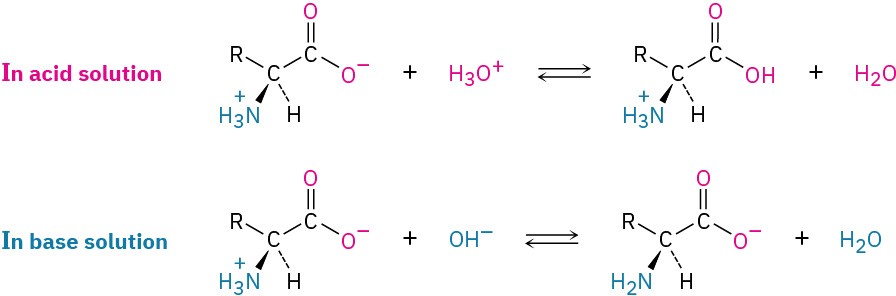
The middle structure in the figure is a zwitterion. It contains both a positive and a negative formal charge:
Thus, a zwitterion has net charge zero, but it is not an uncharged structure in the local sense. Its nitrogen remains formally positive and one carboxyl oxygen remains formally negative. This distinction matters because those local charges still strongly affect water solubility, binding, and interactions with other molecules.
26.1 Structures of Amino Acids - Organic Chemistry | OpenStax
Read the opening of this OpenStax section for a concise explanation of why amino acids commonly appear as zwitterions and how acidic versus basic conditions alter their drawn charge states.
In Section 26.1, read the opening discussion before Table 26.1. Follow the amino acid forms. Focus on the two local changes: carboxylate becoming a neutral carboxylic acid in acid, and ammonium becoming a neutral amine in base.
Phosphate: calculate each oxygen separately
Phosphate-containing groups are common in nucleic acids, ATP, phospholipids, and phosphorylated metabolic intermediates. They are a frequent source of errors because several oxygens surround a central phosphorus, and not all the oxygens have the same formal charge in one particular Lewis structure.
For the methyl phosphate dianion shown:
- The double-bonded oxygen has two lone pairs and a bond-order total of 2, giving formal charge .
- The oxygen connecting phosphorus to the methyl group has two single bonds and two lone pairs, giving formal charge .
- Each singly bonded terminal oxygen has three lone pairs and one bond, giving formal charge .
- The phosphorus has a bond-order total of 5 and no lone-pair electrons in this drawing, giving formal charge .
Adding the individual formal charges gives:
The charge locations in phosphate can be represented by more than one valid resonance drawing. For this course, assign the charges from the specific structure shown, then verify that all atom-level charges add to the bracketed or stated overall charge.
A reliable exam workflow
When faced with an unfamiliar biomolecular structure, use the same method every time.
-
Read the protonation state exactly as drawn. Locate explicit hydrogens on oxygen, nitrogen, sulfur, or phosphate oxygens. Do not add or remove a proton merely because a group “usually” has a certain charge.
-
Complete the local Lewis information. If lone pairs are omitted in a skeletal structure, infer the usual ones from the number of bonds and any displayed charge.
-
Calculate the likely charge-bearing atoms. Start with O, N, S, and P. Check carbon only if it has an unusual number of bonds or a lone pair.
-
Use the formal-charge equation rather than intuition when a pattern is unfamiliar.
-
Add all formal charges. The sum must match the stated overall molecular charge. If the molecule is not bracketed, the sum tells you its net charge.
A fast internal check is to compare the drawn form to the common patterns:
- should have on nitrogen.
- should have one oxygen with in the Lewis structure shown.
- is usually neutral.
- has one bond and three lone pairs.
- The number of negative phosphate oxygens usually determines much of the group’s net negative charge.
Key takeaways
Formal charge is a bond-and-lone-pair accounting system, not the same thing as partial charge or molecular polarity.
- Use to assign an atom’s formal charge.
- Neutral amine nitrogen is typically ; protonated amine nitrogen, , has formal charge .
- A carboxylic acid, , is neutral, whereas a carboxylate, , contributes .
- Each phosphate oxygen drawn as contributes ; each oxygen is neutral.
- A molecule can have net charge while still containing local formal charges, as in an amino-acid zwitterion.
- Always sum individual formal charges as a final consistency check.
Next, you will use these local charges and functional groups to predict molecular polarity and the noncovalent interactions a biomolecule is likely to make.
Can't find a good explanation? Sign up and we'll make it for you
Sign up