
Hello! Welcome to our next lesson in your journey to master sleep.
In our last session, we meticulously crafted the ideal physical "stage" for sleep by optimizing temperature, light, and sound. However, even on a perfect stage, the "actor"—your mind—might refuse to follow the script. Many people find that despite having a dark, cool, quiet room, the moment their head hits the pillow, their mind becomes a busy intersection of thoughts, worries, and frustrations.
Today, we address this directly. Our goal is to apply stimulus control techniques for better sleep onset. This is a cornerstone of Cognitive Behavioral Therapy for Insomnia (CBT-I) and is one of the most powerful non-pharmacological methods for treating difficulty falling asleep. We will learn how to systematically retrain your brain, breaking the frustrating association between your bed and wakefulness, and rebuilding a powerful, automatic connection between your bed and sleep.
This technique is a foundational step in gaining conscious influence over the automatic processes of the mind, a theme that will become central when we later explore the contemplative practices of Jainism.
1. The Problem: A Learned Frustration
For a good sleeper, the bed and bedroom are powerful cues (or stimuli) that trigger sleepiness. Over time, however, if you experience many nights of tossing and turning, your brain can learn a new, unhelpful association. The bed, instead of signaling rest, begins to signal anxiety, frustration, and mental arousal. It becomes a conditioned stimulus for wakefulness.
The goal of Stimulus Control Therapy (SCT) is to reverse this conditioning and re-establish the bed as a strong cue for sleep.
Cognitive Behavioral Therapy for Insomnia in Day-To-Day Practice: S2-Ep3
To begin, let's watch this excellent explanation from a Mayo Clinic expert on the psychological basis of stimulus control. It clearly explains how the bed can become associated with frustration and how the therapy aims to reverse this.
Please watch from 03:34 to 06:34. Focus on the concept of learned associations and the core instruction to leave the bedroom when unable to sleep.
As the video explained, the process is about systematically removing the negative association and replacing it with a positive one. You are actively teaching your brain that the bedroom is a place for sleep, and only for sleep.
2. The Rules of Stimulus Control
To achieve this re-association, we follow a set of clear, specific rules. At first, they may seem strict or even counterintuitive, but they are based on decades of research into learning theory and have proven highly effective.
Sleep Scheduling and Stimulus Control Techniques
This document from the University of Massachusetts Medical School provides a clear, step-by-step guide to the core principles of stimulus control.
Please read the section 'Lesson 2: Stimulus Control Techniques,' starting from 'Poor sleepers have lain awake...' and ending after 'Step 4'. This will introduce the common behaviors that weaken the bed-sleep link and outline the four primary steps to fix it.
Let's synthesize and expand upon these rules to create a definitive set of instructions. A second resource provides a slightly more detailed list and rationale, which we will draw upon.
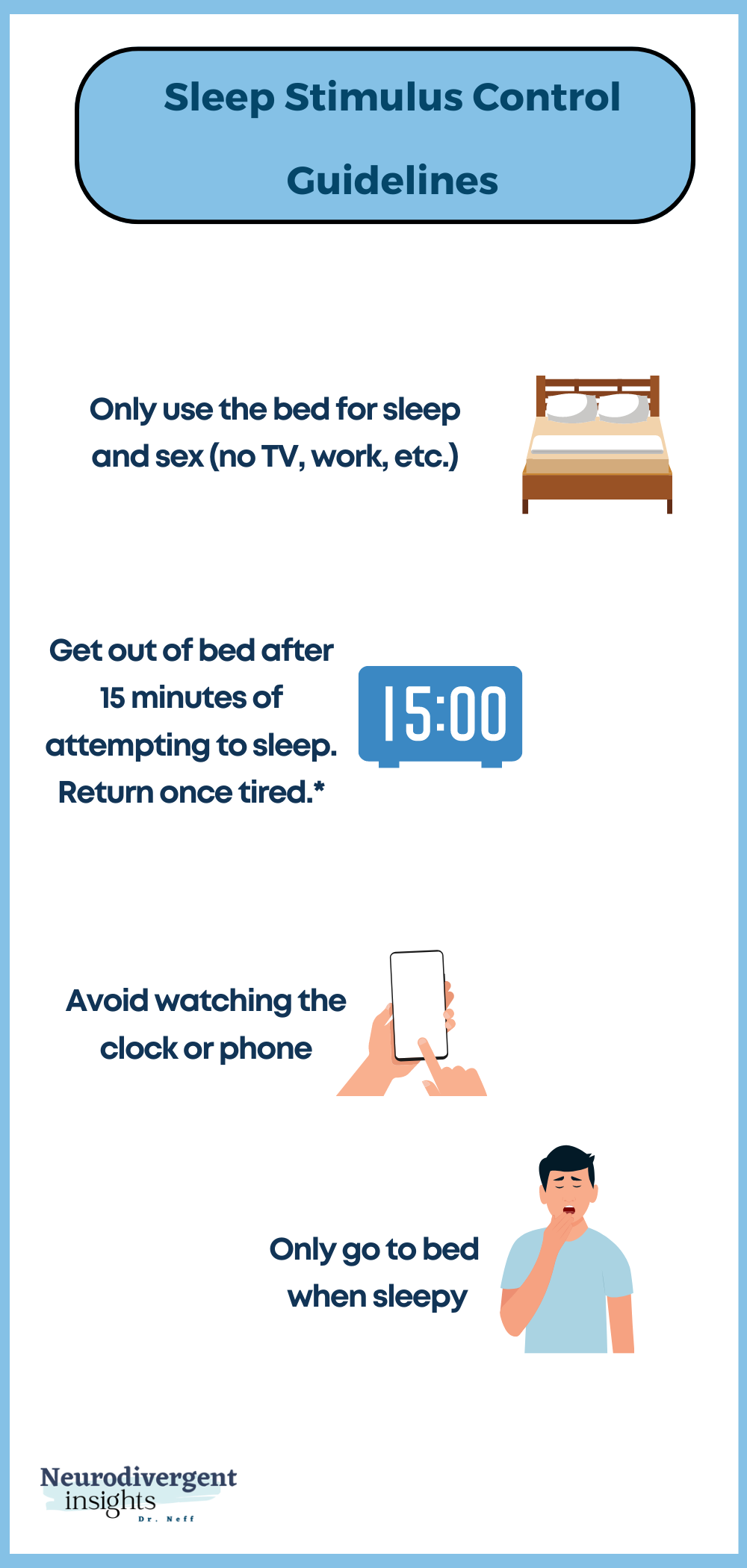
Here are the six fundamental rules of Stimulus Control Therapy:
-
Go to bed only when you are sleepy.
- This means listening to your body's internal cues (heavy eyelids, head nodding, feeling drowsy) rather than external cues like the time on the clock or your partner going to bed. There is a difference between being "tired" and being "sleepy." You want to go to bed when you are sleepy.
-
Use your bed for sleep and sexual activity only.
- This is the heart of stimulus control. Do not read, watch TV, eat, check your phone, work, or worry in bed. All these activities teach your brain that the bed is a place for wakefulness and arousal. Moving these activities out of the bedroom strengthens the bed-sleep association.
-
If you can't sleep, get out of bed.
- If you lie down and do not fall asleep within about 20-30 minutes (this is an estimate—do not watch the clock!), get out of bed and go to another room. The goal is to avoid associating your bed with the frustrating experience of being awake.
-
Do something quiet and relaxing until you feel sleepy again.
- In the other room, engage in a quiet, non-stimulating activity under dim light. Reading a dull book or magazine, listening to calm music, or doing simple stretches are good options. Avoid screens (TV, phone, computer), work, and bright lights. Return to bed only when you feel sleepy again.
-
If you still can't sleep, repeat the process.
- If you return to bed and still don't fall asleep, repeat steps 3 and 4. Do this as many times as necessary throughout the night. It may feel like a "yo-yo" effect for the first few nights, but this consistency is crucial for retraining your brain.
-
Maintain a consistent wake-up time, every day.
- Set an alarm and get up at the same time every morning, regardless of how much you slept. This includes weekends. This helps anchor your body's internal clock (circadian rhythm) and builds a strong sleep drive for the following night, making the whole process more effective.
3. Understanding the "Why": Rationale and Practical Tips
Following these rules can be challenging. Understanding the rationale behind each one can help you stay motivated.
This document from the University of Pennsylvania, written by one of the pioneers of this therapy, provides a fantastic, in-depth look at the 'why' behind each rule and gives practical tips for implementation.
First, read the dialogue in the 'Introduce the Exercise' section (from 'Therapist: I’m going to suggest...' to '...at least bearable for the next week or two.'). This conversational example beautifully illustrates the logic of stimulus control. Then, read the section 'Rationale for the Specific SCT Instructions' to understand the purpose behind each of the six rules.
Let's summarize the key practical takeaways from these readings:
- Prepare Your "Out of Bed" Zone: Don't wait until 2 AM to decide what you'll do. Have a comfortable chair in another room with a dim lamp and a boring book or magazine ready to go. This makes following the rule much easier.
- Focus on Frustration, Not the Clock: The "20-minute" rule can create anxiety if you start watching the clock. A better guideline is to get up when you feel yourself becoming alert, frustrated, or anxious about not sleeping.
- Embrace the Discomfort (Temporarily): The first week can be difficult. You might get less sleep initially. Remind yourself that this is a short-term investment for a long-term solution. As the therapist in the reading said, "It's a trade off... You'll be a yo-yo for a few days, at worst a couple of weeks, and then you can expect to be better."
- Don't Sleep on the Couch: When you get sleepy in your "out of bed" zone, you must return to your bed. Sleeping on the couch teaches your brain to associate the couch with sleep, which undermines the entire process.
Test your understanding!
A person is struggling to sleep. At 11 PM, they get into bed and start scrolling through news on their phone to "wind down." After 45 minutes, they are still wide awake and feeling anxious. Frustrated, they turn on the TV in the bedroom to distract themselves. They finally doze off around 1 AM with the TV still on.
Based on the rules of Stimulus Control Therapy, identify at least three specific mistakes this person made and describe what they should have done instead for each mistake.
Show answer
-
Mistake: Using their phone in bed. The bed should be for sleep only. The light from the phone also suppresses melatonin.
- Correction: They should have put their phone away and only gotten into bed when they felt genuinely sleepy. If they wanted to wind down, they should have done so in another room with a non-screen activity, like reading a paper book.
-
Mistake: Staying in bed for 45 minutes while wide awake and anxious. This reinforces the association between the bed and frustration.
- Correction: After about 20 minutes (or as soon as they felt frustrated), they should have gotten out of bed and gone to another room.
-
Mistake: Turning on the TV in the bedroom. This is another wakeful activity in the sleep environment, and the light and stimulating content are counterproductive to sleep.
- Correction: When they got out of bed, they should have gone to another room and engaged in a quiet, relaxing activity under dim light, like reading a dull book, until they felt sleepy enough to return to bed.
Conclusion
You now have a clear, actionable protocol for breaking a negative sleep cycle. Stimulus control is not a quick fix, but a powerful retraining program for your brain. By consistently applying these rules, you change your conditioned responses and restore your bed to its proper role: a sanctuary for fast, peaceful sleep.
Key Takeaways:
- The Problem is a Learned Association: Your brain may have learned to associate your bed with wakefulness and frustration.
- The Goal is Re-Association: Stimulus control systematically weakens the bed-wakefulness link and strengthens the bed-sleep link.
- The Core Rules: Use the bed only for sleep; get out of bed if you are awake and frustrated; only go to bed when sleepy; and maintain a consistent wake-up time.
- Consistency is Key: Adherence to the rules, especially in the first couple of weeks, is critical for success, even if it feels difficult at first.
Preview of the Next Lesson:
We have now covered how to create the right physical environment and how to train your psychological response to that environment. The final piece of the behavioral puzzle is timing. In our next lesson, we will explore the concept of chronotype—your innate biological preference for being a "morning lark" or a "night owl"—and learn how to align your sleep schedule with your unique internal clock for optimal results.