
Hello! Welcome to our next lesson.
In our last session, we explored how internal factors—substances like caffeine, alcohol, and nicotine—can systematically disrupt your natural sleep architecture. Today, we shift our focus from the inside out. Your ability to fall asleep and stay asleep is also profoundly influenced by your external surroundings.
Our goal in this lesson is to describe optimal sleep environment conditions. We will focus on the three primary levers you can control: temperature, light, and sound. By the end of our time together, you'll have a practical, science-backed blueprint for transforming your bedroom into a "sleep sanctuary"—an environment engineered to promote deep, restorative rest. Mastering these foundational, physiological aspects of sleep is the necessary groundwork for the more advanced contemplative practices we aim to explore later in the course.
1. Temperature: The Cool Imperative
You've likely noticed that it's much harder to sleep in a room that's too hot than one that's too cold. This isn't just a matter of comfort; it's a physiological necessity. To initiate and maintain sleep, your brain and body need to drop their core temperature by about 1-2°C (or 2-3°F). This temperature drop is a critical signal that gates the transition into sleep.
To learn the basics of temperature's role, please start by reading the first section of this article and watching a short explanatory video.
The UK's Sleep Charity provides an excellent summary of why temperature matters and gives the ideal range. It also includes practical tips for managing your bedroom temperature in different seasons.
Please read the section titled 'Temperature'.
6 tips for better sleep | Sleeping with Science, a TED series
Now, let's watch a brief clip from the TED series 'Sleeping with Science,' where Dr. Matt Walker reinforces this principle.
Please watch from 00:56 to 01:34.
As you've just learned, the ideal bedroom temperature is surprisingly cool: around 16-18°C (60-65°F).
Now, let's explore some more advanced ways to leverage temperature to your advantage. Dr. Andrew Huberman, a neuroscientist at Stanford, explains a few powerful techniques.
Sleep Toolkit: Tools for Optimizing Sleep & Sleep-Wake Timing
In this video, Dr. Huberman explains how you can use a hot bath or shower to trigger a drop in body temperature. He also discusses the body's natural 'thermal portals' and how to use them to regulate temperature during the night.
Please watch the segment from 01:04:38 to 01:08:19. Focus on the mechanism behind taking a hot bath to cool down and the role of your hands and feet in releasing heat.
Let's consolidate the key takeaways on temperature:
- Set Your Thermostat: Aim for a room temperature of 16-18°C (60-65°F). Use a fan or open a window if you don't have air conditioning.
- Use Heat to Get Cold: Taking a hot bath or shower 60-90 minutes before bed causes vasodilation (widening of blood vessels) in your skin. When you get out, this allows your core body heat to escape rapidly, causing a compensatory drop in core temperature that helps initiate sleep.
- Keep Your Extremities Free: Your hands, feet, and face have special vascular structures (glabrous skin) that are excellent at radiating heat. Keeping the room cool and allowing a foot or hand to stick out from under the covers is an effective way for your body to self-regulate its temperature during the night. This is why wearing socks to bed can be counterproductive for people who tend to wake up feeling too warm.
2. Light: The Power of Darkness
Light is arguably the most powerful environmental signal for regulating your sleep-wake cycle. In a previous lesson on circadian rhythms, we learned that light exposure in the morning helps wake you up. The inverse is just as crucial: darkness in the evening is the primary cue for your brain to release melatonin, the hormone that facilitates sleep.
Modern society is, as Dr. Matt Walker calls it, "dark-deprived." Exposure to artificial light in the evening, especially from overhead lights and screens, tricks our brain into thinking it's still daytime, suppressing melatonin and making it harder to sleep.
6 tips for better sleep | Sleeping with Science, a TED series
This next segment from 'Sleeping with Science' explains the importance of darkness for melatonin release.
Please watch from 01:34 to 02:30.
The key isn't just to turn off the lights when you get into bed. It's about creating a "dim light" environment in the 1-2 hours before bedtime. Dr. Huberman provides a detailed explanation of why even small amounts of light at night are so disruptive, and why the location of the light matters.
Sleep Toolkit: Tools for Optimizing Sleep & Sleep-Wake Timing
Let's return to Dr. Huberman's 'Sleep Toolkit.' He explains the critical period for avoiding light and a fascinating detail about why overhead lights are particularly problematic at night.
Please watch the segment from 00:56:42 to 01:03:36. Pay close attention to the recommendation to avoid bright lights between 10 PM and 4 AM, and the reason why low-placed lights are better than overhead lights in the evening.
This brings us to some very specific, actionable strategies for managing light:
- Total Darkness for Sleep: Your bedroom should be as dark as possible. Use blackout curtains or blinds. Cover or remove any electronics with standby lights. Even a tiny amount of light can be detected through your eyelids and disrupt sleep. An eye mask can be a great tool, but as Dr. Huberman notes, ensure your room is cool enough, as masks can trap heat around the face.
- Dim Down Before Bed: In the 1-2 hours before sleep, avoid bright overhead lights. Use dim, low-placed lamps (desk lamps, floor lamps) instead. The neurons in your retina that signal daytime are located primarily in the bottom half of your eye and are most sensitive to light coming from your upper visual field (i.e., overhead).
- Warm Tones are Better: If you must use light, warmer tones (yellow, orange, red) are less disruptive to melatonin than cooler tones (blue, white). You can use "night mode" on your electronic devices or even use red-light bulbs for evening lighting.
- Embrace Ancient Light: For tasks like reading, candlelight or moonlight are excellent options as they are far less intense than artificial lighting.
3. Sound: Creating a Quiet Haven
Sudden or inconsistent noise is an obvious sleep disruptor. Even if a noise doesn't fully wake you, it can pull you out of deep, restorative sleep and into a lighter stage, compromising the quality of your rest.
The Sleep Charity article provides a good overview of how noise impacts sleep and some common-sense solutions.
Please read the section titled 'Noise'.
While a quiet room is ideal, it's not always possible, especially in a city. In these cases, the solution isn't silence, but a consistent, soothing soundscape. This is where "colored noise" can be incredibly helpful. These are steady, ambient sounds that mask jarring noises like traffic or a neighbor's door slamming.
You have likely heard of white noise, but other "colors" like pink and brown noise may be even more effective for sleep.
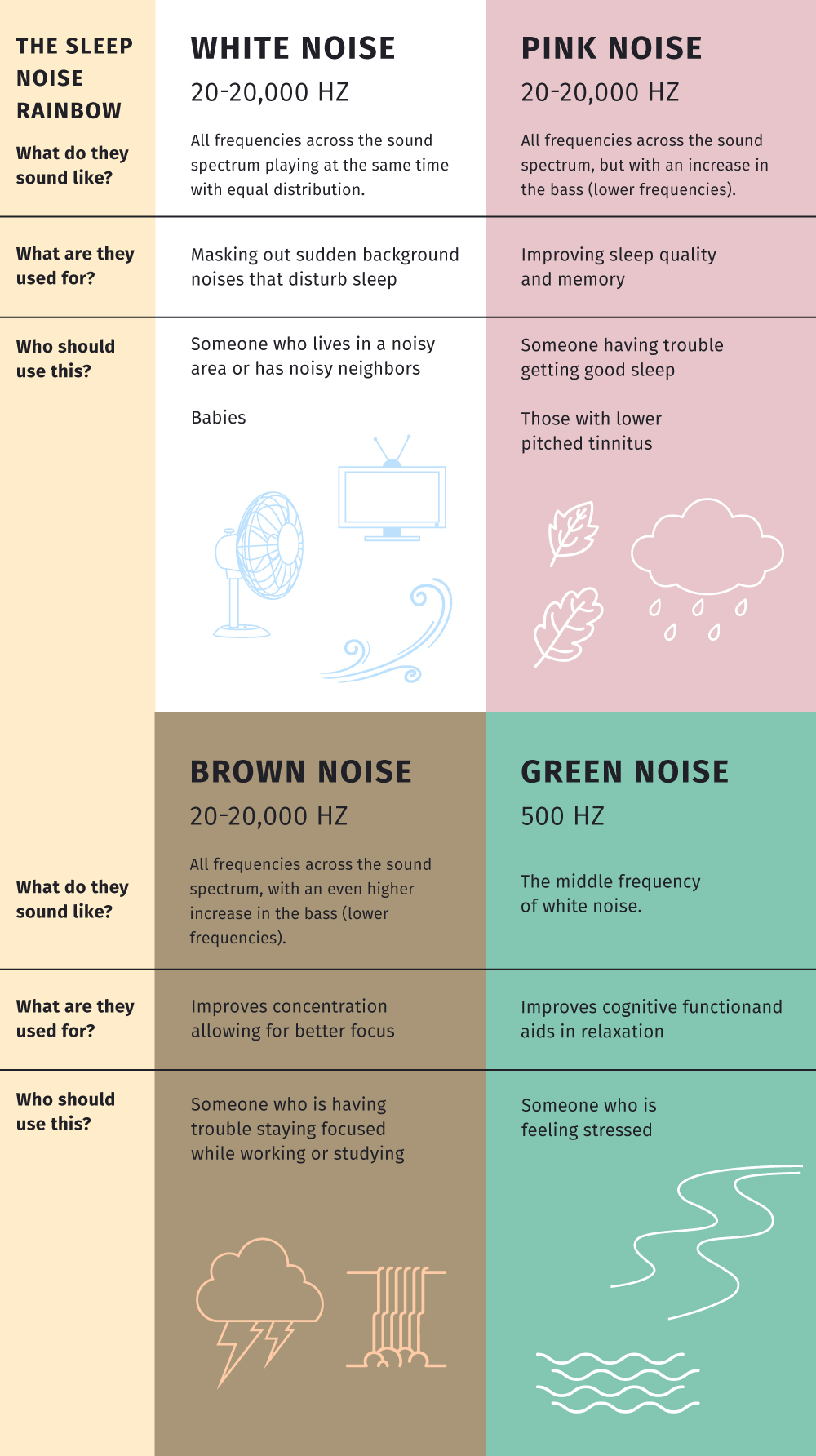
- White Noise: Good for masking high-pitched, sudden noises. A fan or an air conditioner can produce a form of white noise.
- Pink Noise: Many people find this more pleasant than white noise. Studies suggest it can help improve deep sleep. Sounds like steady rainfall or wind are examples of pink noise.
- Brown Noise: Deeper and more "rumbly." Can be very effective for blocking out low-frequency background noise.
You can find hours-long recordings of these sounds on YouTube or through various apps. Using earplugs is another option, though as Dr. Huberman mentioned (in the video segment on temperature), some people find them distracting as they can make internal sounds like your own heartbeat more noticeable. It's a matter of personal preference.
Test your understanding!
Imagine you are designing a "sleep sanctuary" for someone living in a noisy city apartment. The bedroom faces a street with bright lights, and the building's heating system makes the room uncomfortably warm at night.
List three specific changes you would make to the environment, one for each category (temperature, light, sound), and briefly explain the scientific reason why each change would improve sleep.
Show answer
- Temperature: I would advise them to turn down the thermostat to 18°C (65°F) or, if that's not possible, to use a fan to circulate air. Reason: The body's core temperature must drop by 1-2°C to initiate and maintain sleep. A cooler room facilitates this natural process.
- Light: I would install blackout curtains to completely block the streetlights. Reason: Darkness is the primary environmental cue for the brain to produce melatonin, the hormone that promotes sleepiness. Blocking external light prevents melatonin suppression and reinforces the body's natural circadian rhythm.
- Sound: I would suggest using a pink noise machine or app. Reason: Instead of attempting to achieve impossible silence, pink noise provides a consistent, soothing soundscape that masks sudden, jarring noises from the street (like car horns or sirens), preventing them from pulling the person out of deep sleep stages.
Conclusion
You now have a complete toolkit for optimizing your physical sleep environment. By consciously managing these three external factors, you can create conditions that work with your biology, not against it.
Key Takeaways:
- Keep it Cool: Your bedroom should be cool, around 16-18°C (60-65°F), to allow your core body temperature to drop, which is essential for falling and staying asleep.
- Make it Dark: Your sleeping environment should be as dark as possible to allow for maximal melatonin release. Dim the lights and use low-placed, warm-toned lighting in the hours before bed.
- Keep it Quiet (or Consistently Noisy): Block out jarring, intermittent noises. If you can't achieve silence, use a consistent masking sound like pink or brown noise.
These are not trivial adjustments; they are powerful, evidence-based practices that can significantly improve the quality and restorativeness of your sleep, starting tonight.
Preview of the Next Lesson:
We've now prepared the perfect "stage" for sleep by optimizing the environment. But what happens if the "actor"—your mind—still races when you get into bed? In our next lesson, we will address this directly by learning how to apply stimulus control techniques, a powerful psychological method to retrain your brain to associate your bed with fast, peaceful sleep.