Hello! Welcome back to our sessions on B2B copywriting.
In our last lesson, we built the blueprint for a high-conversion B2B landing page using the Problem-Solution-Proof-Action (PSPA) framework. You learned how to structure the page to guide a buyer's thinking logically from their problem to your solution.
Today, we're zooming in on the heart of that structure: the 'Solution' section. Our goal is to learn how to write scannable body copy that presents the solution by connecting features to specific business outcomes. This is the skill that turns a technical product description into a compelling argument for why a business should care.
For a busy B2B buyer, time is their most valuable asset. They won't read a wall of text to figure out what your product does. They scan for value. This lesson will give you the tools to make that value immediately obvious.
1. The Core Principle: Benefits, Not Features
As a copywriter, you're likely familiar with the classic distinction between features and benefits. In the B2B world, this distinction is not just important—it's everything.
- A feature is what your product is or does (e.g., "AI-powered analytics").
- A benefit is what your customer can achieve because of that feature (e.g., "Predict market trends 6 months ahead of your competitors").
B2B buyers are purchasing outcomes—less risk, more revenue, lower costs, saved time. Your job is to translate every feature into a meaningful business outcome.
Let's watch a video that breaks down this concept and provides a brilliantly simple technique to get you started.
Copywriting tips: Features vs. Benefits - The Critical Key to Selling More
In his video 'Copywriting tips: Features vs. Benefits', Jon Benson explains the critical difference and offers a simple trick for turning a boring feature into a compelling benefit. This will be our foundation.
Please watch these two clips: Defining the Terms (01:08 - 04:21): Pay attention to how he defines features as 'the stuff' and benefits as the 'emotional and logical drivers' that explain how a prospect's life will change. The 'So You Can' Formula (05:41 - 07:15): This is the key takeaway. Watch how adding the words 'so you can' forces you to bridge the gap between a feature and its benefit.
The "so you can..." bridge is a fantastic starting point. It forces you to think from the customer's perspective.
2. A Framework for Translation
The "so you can" trick is great for quick translations. For a more systematic approach, you can use the "So What?" framework. This involves repeatedly asking "So what?" until you arrive at a core business outcome.
This article provides an excellent breakdown of this method.
10 Tips and Tricks to Write B2B SaaS Website Copy
The article '10 Tips and Tricks to Write B2B SaaS Website Copy' from Voxturr offers a practical framework for this translation process. It moves from a feature to an outcome that every manager wants.
Please read the section titled 'Tip 2: Lead with Benefits, Not Features'. Focus on the step-by-step 'Feature-to-Benefit Translation Framework' and the 'Real SaaS Examples' that show the transformation.
The key insight here is that B2B buyers need to see the connection to their bottom line. A feature like "automated workflow routing" is abstract. The outcome, "Free up 10+ hours per week for strategic work," is a concrete result that justifies a purchase.
To make this even clearer, look at this table. It's a simple but effective way to visualize the direct line between a feature and the business value it provides.
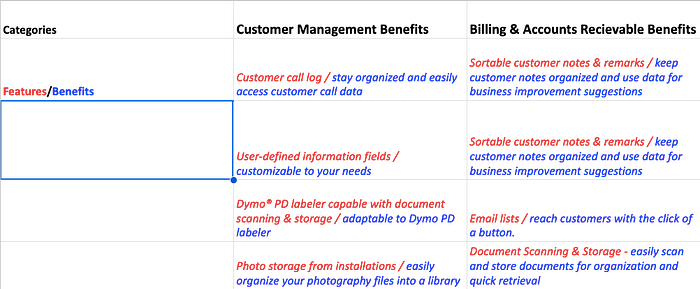
Finally, remember that in B2B, proof is paramount. Whenever possible, quantify your benefits with data. As the article from Beetle Beetle Media states, instead of "Our software saves time," you should write, "Companies using our platform reduce report generation time by 73%." Numbers build credibility.
3. Making Your Copy Scannable
Now that you have your benefit-driven messages, you need to present them in a way that respects a buyer's limited attention. Dense paragraphs of text are the fastest way to get someone to leave your page.
Let's return to the Voxturr article, which has excellent, actionable advice on this.
10 Tips and Tricks to Write B2B SaaS Website Copy
We'll now look at another section from the same Voxturr article, this time focusing on formatting your copy for easy scanning.
Please read the section 'Tip 5: Keep It Scannable and Concise'. Pay close attention to the 'How to Structure Copy for Scanning' tips and the 'Before and After' example, which provides a powerful demonstration of these principles in action.
The "Before and After" example is particularly telling. The "Before" text is technically correct but exhausting to read. The "After" version communicates the same core value propositions almost instantly through:
- A clear headline
- Short, punchy sentences
- Strategic use of bullet points
- Bolding key terms
This is your goal: deliver maximum information with minimum reader effort.
4. Your Turn: A Quick Writing Exercise
Let's put this into practice. Below are three common B2B software features. Your task is to rewrite each one as a scannable, benefit-driven piece of copy. Use the "So what?" framework and the scannability rules we just covered.
Features:
- Single sign-on (SSO) integration
- Automated weekly performance reports
- A centralized digital asset library
Take a few minutes to write your versions.
My Examples
Here’s how I might approach them:
-
For Single Sign-On (SSO):
Log in with one click. Securely.
Stop forcing your team to remember another password. Our SSO integration with Google and Microsoft lets them access everything with their existing company account.- Benefit: Reduces friction for users and enhances security for IT.
-
For Automated Reports:
Know your numbers. Without the manual work.
Get a clear summary of team performance delivered to your inbox every Monday morning. So you can stop chasing data and start making decisions.- Benefit: Saves time and enables faster, data-driven decisions.
-
For a Digital Asset Library:
Find any file. Instantly.
No more searching through shared drives or asking colleagues for the latest version. Our centralized library ensures your entire team always has the most up-to-date sales decks, marketing images, and brand assets.- Benefit: Increases team efficiency and ensures brand consistency.
Notice how each example leads with the outcome and uses short sentences and bolding to make the core value pop.
Conclusion
Excellent work. Today you've moved from the high-level structure of a landing page to the critical details of its body copy. You now have a framework for writing the 'Solution' section in a way that resonates with busy B2B buyers.
Key Takeaways:
- Translate Features into Outcomes: Always ask "So what?" to connect what your product does to what your customer achieves.
- Quantify When Possible: B2B decisions are driven by ROI. Use data and numbers (e.g., "reduce costs by 21%") to make your benefits concrete and credible.
- Design for Scanning, Not Reading: Use short paragraphs, clear subheadings, bullet points, and bold text to ensure your key messages are absorbed in seconds.
Preview of the Next Lesson:
We've now crafted a powerful, scannable message. But what if your audience isn't one person, but a committee? A Chief Financial Officer (CFO) cares about different outcomes than an IT Manager. In our next lesson, we'll tackle how to adapt the messaging on a web page to address the primary concerns of different stakeholders in the buying committee.