Hello! Welcome back to our work on crafting high-conversion B2B web pages.
In our last lesson, we focused on writing scannable, benefit-driven copy. We practiced translating product features into clear business outcomes using the "so you can" and "So what?" frameworks. This gave us the building blocks for a powerful message.
Today, we address a fundamental reality of B2B sales: you're almost never selling to just one person. Your message needs to survive and persuade a buying committee. This lesson focuses on a crucial skill: how to adapt the messaging on a web page to address the primary concerns of different stakeholders, such as the CFO, an IT manager, or the end-user.
You’ll learn how to craft a single, coherent page where each key decision-maker can find the specific answers and value they're looking for.
1. The Challenge: The Multi-Audience Problem
In B2C, you might sell a pair of shoes to an individual. In B2B, you're selling a complex software solution to a company, and the decision involves a team of people with different jobs, priorities, and worries.
A Chief Financial Officer (CFO) asks, "What's the ROI?" An IT Manager asks, "Will this integrate with our current systems? Is it secure?" The person who will use the software every day asks, "Will this make my job easier or harder?"
If your web page only speaks to one of them, you risk alienating the others. Let's watch a short clip that introduces this concept.
How To Create a Results-Driving B2B Marketing Strategy for 2026
The video 'How To Create a Results-Driving B2B Marketing Strategy for 2026' from Exposure Ninja clearly explains why you need to think about the different people involved in a purchase decision.
Please watch from the beginning until 03:15. Pay attention to how the speakers distinguish between marketing to a company versus marketing to the people within it (CFO, marketing leader) and their different decision-making criteria. The key idea is to create marketing that doesn't 'turn off' other stakeholders.
As the video highlights, your initial contact might love your solution, but if their CFO visits your website and only sees technical jargon without a clear mention of cost savings or ROI, the deal could stall.
This visual guide helps to picture how messaging needs to be adapted for different levels of an organization.
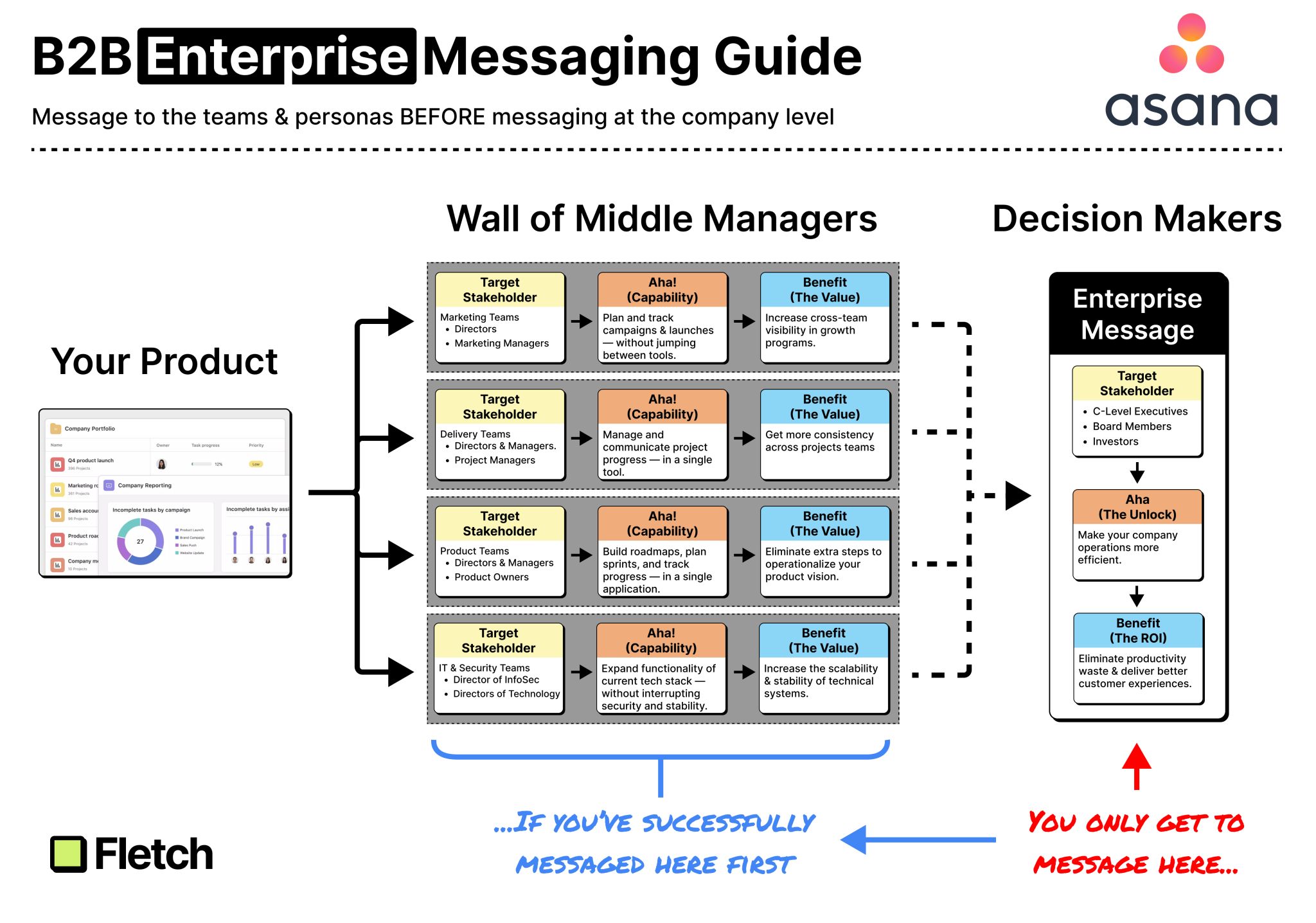
2. The Solution: Layered Messaging
So, how do you speak to the CFO, the IT manager, and the end-user all at once without creating a confusing mess? The answer isn't to write three different web pages. It's to use layered messaging.
This concept is explained brilliantly in an article by Vivien Leung. It provides a framework for building a message that works for the entire committee.
How to Write to your B2B's Buying Committee Without Losing Half ...
The article 'How to Write to your B2B's Buying Committee' breaks down the psychology of the buying committee and introduces the idea of 'layered messaging.' This is the core concept for today's lesson.
Please read the following sections: Start at 'Why Messages Fall Apart in Committees' and read to the end of that section. Notice the list of questions each person asks themselves ('What does this mean for me?'). Continue with 'Mapping the Committee.' This section lists the common roles and their core questions (e.g., Budget Holder: 'What’s the ROI?'). Finally, read the short section 'Layer your messaging.' The 'chocolate cake: same flavour, different slices' analogy is a perfect way to understand this concept. Focus on how each role has a different 'filter' for your message.
The key takeaway is that you're creating one cake (your core value proposition), but ensuring everyone gets the slice they want. The CFO gets the ROI slice, the IT manager gets the security and integration slice, and the user gets the "makes my life easier" slice.
3. How to Build the Layers on a Web Page
Layering your message on a web page is about strategic content placement. You use different sections, headlines, and content formats to speak to different stakeholders.
This article gives concrete examples of what these "layers" can look like in practice.
Best Practices for Designing B2B SaaS Landing Pages – 2026
The article 'Best Practices for Designing B2B SaaS Landing Pages' lists specific content elements you can use to address different stakeholders. This will help make the 'layered messaging' concept more tangible.
Please read the section titled 'Content elements that support multi-stakeholder decisions.' It's a short, bulleted list that gives you a menu of content types to choose from.
As you can see, these aren't just words; they are page elements:
- An ROI calculator is a 'layer' for the finance team.
- A downloadable technical spec sheet is a 'layer' for the IT team.
- A video testimonial from a happy user is a 'layer' for the future end-user.
4. Your Turn: Writing in Layers
Let's put this into practice.
Scenario: You are writing copy for the landing page of "SyncUp," a new project management software.
Task: Write three short copy blocks for the same landing page. Each block should target a different member of the buying committee. You can frame them as a headline and a short paragraph, or as a small section of the page.
- For the Project Manager (End-User): Their main concern is managing daily chaos and keeping their team on track without complex software.
- For the Head of IT (Expert): Their main concerns are data security and ensuring any new tool works with their existing tech stack (e.g., Slack, Google Drive, Microsoft 365).
- For the CFO (Budget Holder): Their main concern is financial return. They want to see how this investment improves productivity and impacts the bottom line.
Take about 10 minutes to write your three copy blocks.
My Examples
Here’s how I might approach this, showing how each "layer" could live on the same page.
1. For the Project Manager (Hero Section Headline & Sub-headline):
Finally, a project management tool your team will actually use.
Stop wrestling with complicated Gantt charts and endless spreadsheets. SyncUp gives you a clear, visual overview of every project, so you can deliver on time and your team can focus on what they do best.
2. For the Head of IT (A Dedicated "Security & Integrations" Section):
Enterprise-Grade Security, Seamless Integration.
SyncUp is built for the modern enterprise. With SOC 2 Type II compliance, end-to-end encryption, and native integrations for Slack, Google Workspace, and Microsoft 365, you can deploy with confidence. Our platform fits into your existing workflows, it doesn't disrupt them.
[Link to Technical Documentation]
3. For the CFO (An ROI-focused Section with a "Calculator"):
Deliver projects 20% faster and reclaim your team's time.
Companies that switch to SyncUp reduce time spent in status meetings by an average of 5 hours per week, per team. What could your business achieve with that extra time? Calculate your potential ROI.
[Interactive ROI Calculator Widget]
Notice how all three messages support the same product, but each one emphasizes a completely different type of value. Together, they build a comprehensive case for the entire buying committee.
Conclusion
Fantastic work today. You've now learned how to evolve your copywriting from a monologue to a conversation that includes the entire buying committee. By understanding each stakeholder's unique motivations and concerns, you can build a more persuasive and resilient message.
Key Takeaways:
- B2B involves a Committee: Don't write for a single persona. Identify the key roles (e.g., user, expert, budget holder) in the decision.
- Use Layered Messaging: Craft a single narrative with different "layers" of value that appeal to each stakeholder. Think "one cake, different slices."
- Tailor Content Formats: Use headlines, specific page sections, ROI calculators, and technical documentation to deliver the right message to the right person.
Preview of the Next Lesson:
We've defined how to structure a page and how to tailor its message for different stakeholders. But B2B buyers are skeptical; they need proof. In our next lesson, we will focus on how to integrate social proof elements (testimonials, logos, case study data) effectively within a B2B landing page to build the trust and credibility needed to close the deal.