Hello! Welcome back to our B2B copywriting course.
In our last lesson, we focused on analyzing and improving B2B email sequences to earn that crucial click. We saw how a well-structured sequence maintains momentum and relevance, guiding a prospect to take action.
But what happens after the click? That prospect arrives at your landing page. This is the moment of truth where you must convert their initial interest into a concrete next step. This lesson will teach you how to structure a B2B landing page using a logical persuasion flow: problem, solution, proof, and action. Mastering this structure is the key to building pages that don't just inform, but persuade.
1. The Persuasion Flow: Guiding the Buyer's Mind
A high-converting B2B landing page isn't a random collection of information. It's a carefully structured argument that follows a buyer's natural decision-making process. This journey can be broken down into four key stages:
- Problem: Does this page understand my pain or my goal? (Grabs attention)
- Solution: How does their product or service solve my problem? (Explains value)
- Proof: Can I trust them? Have they done this for others like me? (Builds credibility)
- Action: What should I do next, and why should I do it now? (Drives conversion)
This Problem-Solution-Proof-Action (PSPA) flow is a reliable blueprint for organizing your landing page content.
Let's start with a simple visual of how these elements come together on a page.

To give this structure more detail, let's look at an excellent article that presents a very similar framework called "What, How, Why, Why Now."
How to Write a B2B Landing Page That Converts
The article 'How to Write a B2B Landing Page That Converts' by Gil'ad Idisis for The Logonaut provides a clear, practical flow for structuring a landing page. We'll focus on the section that outlines this persuasive sequence.
Please read the section titled 'Keep the “What, How, Why, Why Now” Flow'. Pay close attention to the table that breaks down the purpose and example copy for each stage.
As you can see, this flow directly maps to our PSPA framework:
- WHAT (Emotion) → Problem: You start by agitating a pain point or promising a desired outcome to create an emotional hook.
- HOW (Logic) → Solution: You logically explain how your offering delivers on the promise or solves the pain.
- WHY (Confidence) → Proof: You build confidence and trust using testimonials, data, or recognizable brand logos.
- WHY NOW (Urgency) → Action: You give the visitor a compelling reason to act now, with a clear call to action (CTA).
2. Deconstructing a Real B2B Landing Page
Now that we have the framework, let's apply it. Your ability to recognize this structure in the wild is crucial for learning to build it yourself.
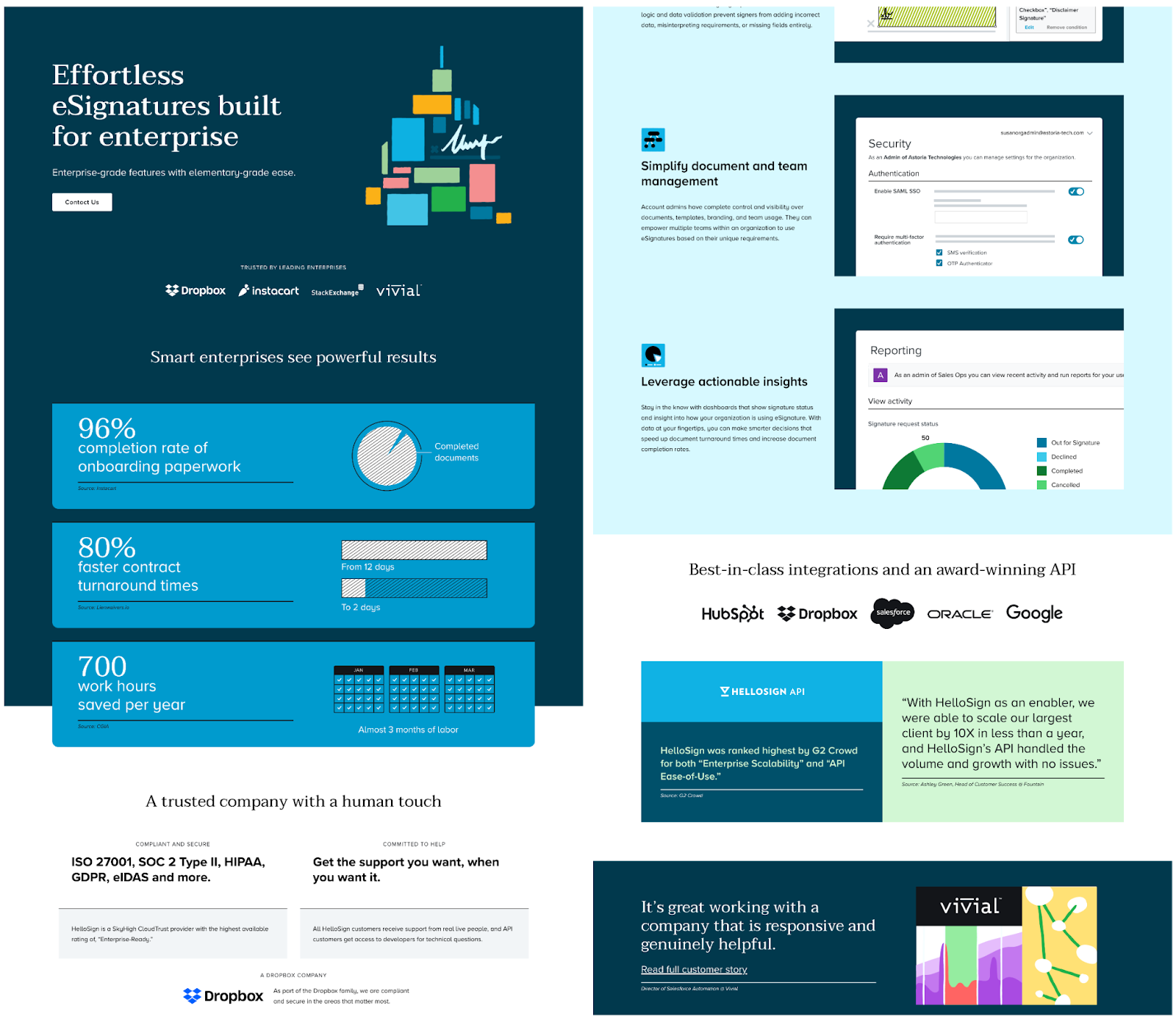
Below is the landing page for HelloSign, an e-signature solution for businesses.
Your Turn: Identify the Flow
Take a moment to analyze the HelloSign landing page image. Can you identify the four key elements of our PSPA framework?
- Where do you see the Problem being addressed (even if implicitly)?
- Where is the Solution presented?
- What different types of Proof can you find?
- How is the Action prompted?
My Analysis
Here is how I would break down the HelloSign page using our framework:
- Problem/Solution (Above the Fold): The headline "eSignatures for your business" immediately presents the solution. The implicit problem is the slow, manual, and insecure process of traditional document signing. The sub-headline and the "Request a demo" CTA reinforce this.
- Proof: This is where the page is strongest. It uses multiple forms of proof stacked throughout the page:
- Quantitative Proof: The stats below the hero ("22% faster onboarding," "77% faster contract turnaround").
- Borrowed Credibility: The logos of well-known partners like Salesforce and Oracle.
- Third-Party Validation: The "Top Rated API" badge from G2.
- Customer Testimonial: The quote from the Director of Product at Counsyl.
- Solution (Deeper Dive): The section "Designed for your entire business" breaks down how the solution works by explaining features like Document and Team Management, Security, and Reporting.
- Action: The primary CTA, "Request a demo," is featured prominently in the hero section and is likely repeated further down the page, guiding the user toward the single most important next step.
3. Watching the Structure Take Shape
Theory and examples are great, but seeing the process in action solidifies the concepts. The following video shows a B2B landing page being built from scratch. As you watch, notice how the creator instinctively follows the PSPA flow.
Watch me build a $1M landing page in 20 minutes
In this video, 'Watch me build a $1M landing page in 20 minutes,' Arsh Sanwarwala of ThrillX walks through his process. We'll watch a few key clips that show him defining the problem, outlining the solution, adding proof, and driving action.
Please watch the following segments, paying close attention to how they map to our PSPA framework: Problem (0:02:20 - 03:00): Watch how he starts by defining the audience's pain points (e.g., 'struggling with low conversions'). Solution (04:06 - 05:25 & 10:02 - 11:10): First, see how he crafts the headline to promise a 'dream outcome' (Solution). Then, watch the later clip where he creates a dedicated section to address a pain point and complement it with the unique solution. Proof (08:46 - 09:46): Notice his emphasis on social proof (reviews, testimonials, logos) to build trust right away. Action (16:52 - 18:16): Finally, see how he builds the concluding section to create urgency and give a final reason to take action.
This practical demonstration shows that the PSPA framework isn't just a theoretical model; it's the working methodology behind successful landing pages.
Conclusion
Great work today. You've learned the fundamental architectural principle of high-converting B2B landing pages. By guiding a visitor through a logical sequence of problem, solution, proof, and action, you mirror their thought process and systematically build a case for your offering.
Key Takeaways:
- Structure is persuasion: A landing page's layout is a critical part of its copy. A logical flow is more persuasive than a random assortment of facts.
- Follow the PSPA flow: Start by identifying the Problem, present your Solution, back it up with credible Proof, and guide the visitor to a clear Action.
- Proof is essential: B2B buyers are skeptical. They look for evidence (data, testimonials, logos) to validate your claims and reduce their risk.
Preview of the Next Lesson:
We've built the skeleton of our landing page. Now, it's time to add the muscle. In our next lesson, we'll focus on the 'Solution' section and learn how to write scannable body copy that presents the solution by connecting features to specific business outcomes. This is where you translate what your product does into what your customer achieves.