Hello! Welcome back to our module on building the business case.
In our last lesson, we focused on adding the crucial element of proof to your case study narrative. You learned how to extract quantifiable results and present them with impact using headlines, bullet points, and before-and-after tables. We took the raw data from the Innovate Design & SyncUp scenario and turned it into a compelling business case.
Creating a data-rich case study is a significant investment of time and effort. So, how do you get the most value out of it? That's our focus today. This lesson is about content multiplication. Our learning outcome is to repurpose a single case study into multiple formats (e.g., testimonial quote, email snippet, social media post) to maximize its reach and impact.
1. The "One-to-Many" Strategy
Think of your full case study as a "pillar" asset—the comprehensive, authoritative story of customer success. A smart B2B copywriter doesn't just publish this pillar and hope people find it. They strategically break it down into smaller, "micro" assets, each tailored for a different channel and audience.
This approach saves time, reinforces your message across multiple touchpoints, and meets your potential buyers wherever they are—whether they're scrolling LinkedIn, reading emails, or browsing your website.

The most fundamental act of repurposing is extracting a short testimonial from a longer case study.
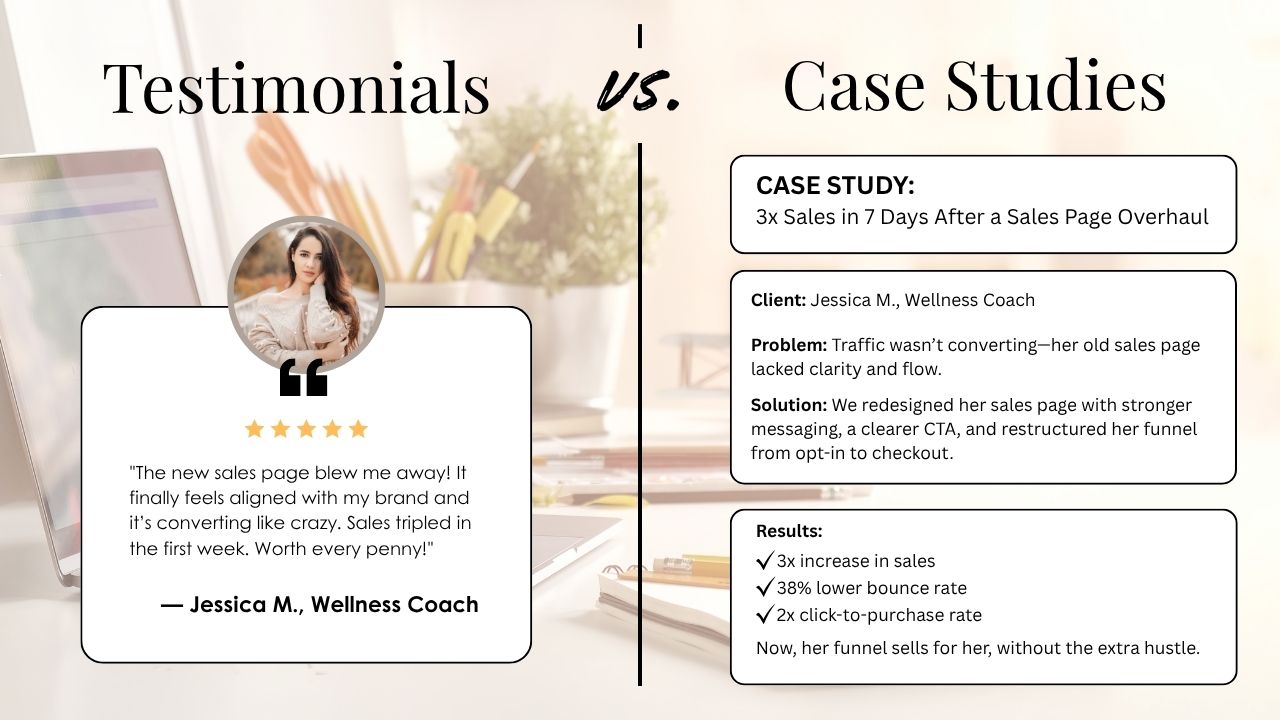
This distinction is key. As you'll see, you can easily pull a testimonial out of a detailed case study, but you can't create a full case study from just a testimonial. This is why starting with the full story is so powerful.
2. Mining Your Case Study for Micro-Assets
Let's get practical. We will take our Innovate Design & SyncUp case study from the previous lesson and break it down into three distinct formats.
Format 1: The Testimonial Quote
A great testimonial is short, specific, and captures the emotional or business impact of the result. It's the "sound bite" that makes a prospect pause and think, "I want that, too."
You can use these quotes everywhere: on your homepage, on product landing pages, in sales decks, and within email newsletters.
13 Ways to Repurpose Your Case Studies to Extend The Value
The article '13 Ways to Repurpose Your Case Studies' explains the power of quotes. Let's see what it says.
Please read section 6, 'Quotes or testimonials.' Notice the emphasis on how quotes build trust and can be shared on various pages to encourage readers to dive into the full story.
Your Turn: Write a Testimonial Quote
Imagine you're the Project Manager at Innovate Design. Based on the results from our last lesson (e.g., cutting admin time from 5 hours to 1 hour per week), write a one- or two-sentence testimonial quote that captures the value of SyncUp. Focus on the feeling of the transformation, not just the number.
(Take about 5 minutes for this.)
Model Answer
Here’s one possible approach:
"SyncUp didn't just organize our projects; it gave us back our week. We've cut our administrative busywork by 80%, allowing my team to focus on creative solutions for our clients instead of chasing down feedback."
This quote works because it combines a powerful metric (80%) with a clear business benefit (focusing on creative solutions).
Format 2: The Email Snippet
When you announce a new case study to your email list, your goal is to create curiosity and drive traffic to the full story. You don't need to retell the whole thing. Instead, use a concise, narrative format that hooks the reader and makes them want to learn how the result was achieved.
How To Write A Case Study That Converts
This article from Greg Faxon provides an excellent, field-tested template for an email that promotes a case study. It's structured as a mini-story.
Review the email template and the real-world example provided. Notice the structure: a compelling subject line with a result, a brief 'before' state, a mention of the 'after' state, a link to the case study, and a breakdown of the steps.
Your Turn: Write an Email Snippet
Using the template from the resource, write a short email to announce the Innovate Design case study. Use the headline we drafted in the last lesson as your starting point for the subject line.
- Headline from last lesson: "How Innovate Design Cut Project Admin by 80% in 4 Weeks with SyncUp"
(Take about 5-7 minutes for this.)
Model Answer
Here is one way to adapt the template:
Subject: This design agency just cut project admin by 80%. Here’s how…
The team at Innovate Design was drowning in administrative work. Project managers were spending hours every week just chasing approvals, and valuable client feedback was getting lost in endless email chains.
We worked with them to implement SyncUp, and in just four weeks, they slashed their project admin time by 80%.
Here's how we did it:
--> Read the Full Case Study: How Innovate Design Reclaimed a Full Day of Work Per Week
- We centralized communication, creating a single source of truth for all project feedback.
- We automated approval workflows, eliminating the need for manual follow-ups.
- We simplified client onboarding, cutting a multi-day process down to just a couple of hours.
Want to see how you can get these results?
Read the full story here.
Format 3: The Social Media Post (LinkedIn)
Social media requires an even more condensed approach. You're competing for attention in a fast-moving feed. The goal is to stop the scroll with a compelling story and encourage engagement.
For LinkedIn, a mini-story format works well, often ending with a question to spark conversation in the comments.
How To Create Case Studies That Get You Clients
Let's revisit this video by Greg Faxon. He explains how to adapt the case study for different channels, including social media.
Watch the clip from 18:25 to 19:15. Pay attention to his advice on using the same core copy but 'remixing it' for social media, and how you can distribute the story on your website, via email, and on social platforms.
Your Turn: Draft a LinkedIn Post
Draft a short LinkedIn post based on the Innovate Design & SyncUp story. Structure it as a simple Problem -> Solution -> Result narrative and end with a question to your audience.
(Take about 5-7 minutes for this.)
Model Answer
Here's a sample post:
The team at Innovate Design was facing a common problem: their project managers were spending more time managing emails than managing projects. Lost feedback led to costly rework, and chasing approvals was a full-time job.
They implemented SyncUp to centralize all client communication and automate their approval workflows.
The result? They cut project admin time by 80% in the first month. That's a full day per week that their PMs got back to focus on delivering amazing work for clients.
A simple process change led to a huge boost in efficiency.
What's the biggest time-sink in your team's workflow right now?
Conclusion
You've successfully taken one pillar asset and multiplied its value by creating three distinct micro-assets. You've learned that effective repurposing isn't just copying and pasting; it's about adapting the core message to fit the context of each marketing channel.
Key Takeaways:
- Work Smarter: Repurposing a case study maximizes the ROI on your content creation efforts.
- Adapt the Format: A testimonial quote, an email snippet, and a social media post each serve a different purpose and require a unique structure.
- Extract the Essence: Your job is to pull the most relevant part of the story—a powerful quote, a compelling result, a relatable problem—and highlight it for the right channel.
Preview of the Next Lesson:
So far, we've repurposed our case study for external marketing. But this asset is also an incredibly powerful tool for your sales team. In our final lesson for this module, you will learn how to write a one-page internal selling document that helps a champion pitch your solution to their colleagues. This is about turning your case study into direct sales enablement.