Hello! Welcome to the final lesson in our module on building the business case.
In our previous lessons, we crafted a detailed case study for SyncUp, complete with quantifiable results, and then learned how to repurpose it into various external marketing assets like testimonials and social media posts. You've mastered how to tell the success story to the outside world.
Today, we shift our focus inward. A case study's most critical job is often to help close the deal. To do that, it needs to be used effectively inside the buyer's organization. This lesson is about sales enablement. Our learning outcome is to write a one-page internal selling document that helps a champion pitch your solution to their colleagues.
1. Arming Your Champion
In B2B sales, you rarely sell to just one person. Your primary contact, often called the "champion," needs to convince a whole committee of stakeholders—like their boss, the CFO, or the head of IT. Your job as a copywriter is to create a tool that makes it easy for them to do this.
This document isn't a flashy marketing brochure. It's a concise, data-driven business case that your champion can forward internally to get the 'yes'.
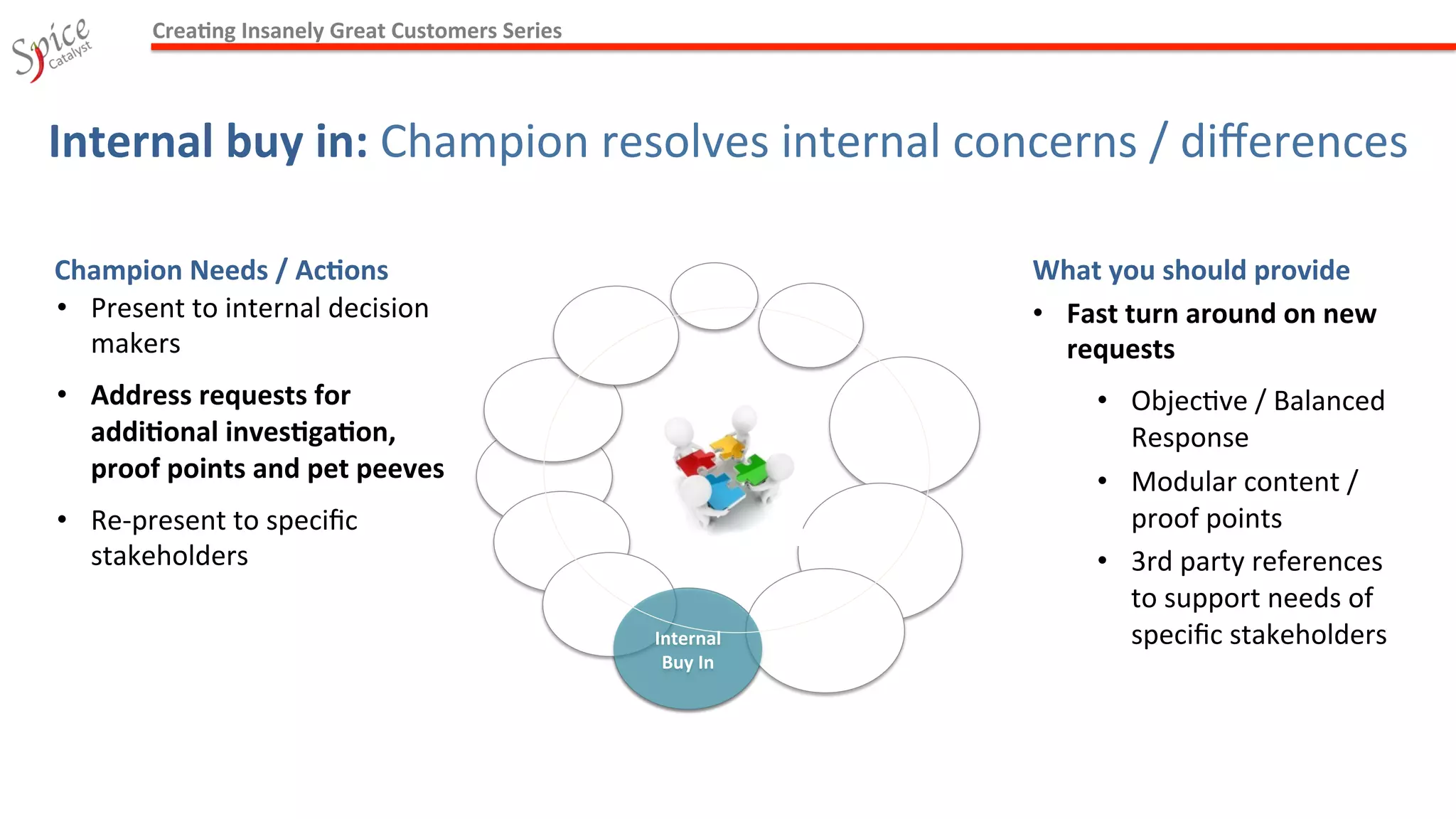
This document must be clear, compelling, and stand on its own without you there to explain it.
2. The One-Pager: A Champion's Best Friend
The "internal selling document" often takes the form of a one-pager—a short document that summarizes the case for your solution. Let's establish a clear definition.
17 Sales One-Pager Examples (+ Tips & Templates)
The article '17 Sales One-Pager Examples' from Dock.us provides a great definition and overview of this format. It explains what a one-pager is and its primary goal.
Please read the introduction, 'What is a sales one-pager?', and the section 'What makes a great one-pager (regardless of type)'. Notice the emphasis on making the document easy to share and understand internally.
As the article highlights, the goal is to "make it easy for buyers to understand and share a specific solution internally." A great one-pager for your champion must be:
- Easy to skim: Decision-makers are busy. They need the key points in seconds.
- Focused on the value proposition: It must answer "what's in it for us?" immediately.
- Built for sharing: It should make your champion look smart and prepared when they forward it.
3. The Anatomy of a Killer Internal Business Case
So, what exactly goes into this document? A slide deck from a demo won't work. You need a dense, text-based memo that speaks the language of business leaders—revenue, cost, and risk.
This next resource provides a fantastic, battle-tested structure.
How to Write a Business Case for Your Champion to Approve
Brandon Bornancin's LinkedIn post, 'How to Write a Business Case for Your Champion to Approve,' offers a powerful, five-part framework for exactly the kind of document we're building.
Read the main body of the post, which details the five key sections of the business case. Pay close attention to the specific bullet points for each section.
Let's break down this five-part structure. This is your blueprint.
- Five-Sentence Executive Summary: This is the most critical part. It's for the executive who reads nothing else. It must contain the ask, the impact, the urgency ("why now"), the payback period, and the owner.
- Problem Statement (in their exact language): This builds on our voice of customer research. You must use the prospect's own metrics and terminology. "Quote-to-cash cycle is 41 days" speaks to a CFO; "streamline processes" does not.
- Three-Option Table: This is a powerful persuasion tool. You frame the decision by comparing the Status Quo (the cost of doing nothing), a Competitor, and Your Solution across key criteria like cost, risk, and time to value.
- Impact Model: Here's where you translate features into money. Connect your solution directly to revenue gains, cost savings, or efficiency improvements. Crucially, including a "downside case" (a conservative estimate) builds immense credibility.
- Implementation Plan & Risk Caps: This shows you've thought through the practicalities. A simple "who does what, when" and an acknowledgment of potential risks (and how you mitigate them) makes the project feel controllable and less risky.
Before sending, the article suggests four tests. The most important one for you as a writer is the Forward Test: Can your champion forward it without you on the thread? If not, it fails.
4. Your Turn: Draft a Business Case for SyncUp
Let's apply this. You're going to write the core components of an internal business case using our Innovate Design & SyncUp scenario.
The Goal: Arm the Project Manager at Innovate Design (your champion) with a document they can send to their CFO to get budget approval for SyncUp.
The Task: Using the five-part structure, draft the Executive Summary and the Problem Statement. Use the facts from our case study.
- Recall the Key Result: SyncUp cut project admin time from 5 hours to 1 hour per week (an 80% reduction).
- Assume: The Project Manager's fully-loaded cost is $50/hour. This means the 4 hours saved per week is worth $200/week, or ~$10,000/year.
- Assume: SyncUp costs $3,000 per year.
Use this information to write the first two sections of the one-pager. Be as specific and quantitative as possible.
(Take about 10 minutes for this exercise.)
Model Answer
Here’s one way you could approach this, targeting a busy CFO:
1. Executive Summary
This proposal requests an investment of $3,000 for a one-year subscription to the SyncUp platform. Implementing SyncUp will reduce project administration overhead by 80%, generating approximately $10,000 in annual labor cost savings. Given the current risk of project delays due to administrative bottlenecks, immediate action is recommended to protect client revenue. The platform will pay for itself in under four months, with the project management team owning the implementation, targeting a go-live date of October 1st.
2. Problem Statement
Currently, our project managers spend an average of 5 hours per week on non-billable administrative tasks, primarily chasing client feedback and manual approvals. This equates to over 250 hours of lost productive time annually per PM, costing the business approximately $12,500 per PM. These administrative delays have resulted in an average of 3-day slippages on project timelines in the last quarter, putting client satisfaction and future retainer renewals at risk.
Conclusion
Excellent work. Today you've learned to create one of the most valuable assets in a B2B copywriter's toolkit: the internal selling document. This single page can be the difference between a stalled deal and a closed one.
Key Takeaways:
- Your goal is to arm your champion with a document they can use to sell on your behalf internally.
- The document must be a concise, data-driven business case, not a marketing brochure.
- The five-part structure (Executive Summary, Problem, Options, Impact, Plan) provides a robust framework for persuading business leaders.
- Always write with the Forward Test in mind. The document must stand on its own.
Preview of the Next Module:
This document is a powerful tool for proactively handling objections. In our next module, Overcoming Buyer Hesitation in Copy, we'll dive deeper into this theme. Your first lesson will focus on how to identify common B2B objections (price, risk, switching cost, timing) in real-world copy examples.