Welcome back! In our last lesson, we built the skeleton of a B2B case study using the Situation-Challenge-Solution-Results framework. We learned how to organize raw facts into a logical structure that appeals to a business buyer.
Today, we're going to add the flesh to those bones. Our goal is to write a case study narrative that highlights buyer transformation rather than just product features. This is the step that turns a dry report into a compelling story that resonates with prospects and persuades them to act. We'll move beyond simply listing facts to crafting a narrative that makes the customer the hero of their own story.
1. Your Role: The Guide, Not the Hero
The single most common mistake in case studies is making your company the hero. "We did this," "Our software achieved that." This approach feels like a sales pitch and alienates the reader.
The secret to a powerful case study narrative is to reposition the roles:
- The Hero: Your customer
- The Villain: Their business challenge or pain point
- The Guide: Your product or service
Your role is to be the wise guide (like Yoda or Gandalf) who gives the hero the tool or insight they need to win the day themselves. This framing makes the story relatable and positions your solution as an empowering enabler of success, not a boastful show-off.
Let's look at a concrete example of this reframing in action.
B2B case study copywriter: a deep-dive
This article from Alice Hollis, a B2B copywriter, does an excellent job of explaining this hero/guide dynamic. It shows how a simple tweak in wording can shift the focus from your company to your customer's success.
Please read the section titled 'Bad B2B case study writing: it’s not about you'. Focus on the before-and-after example of the sentence rewrite. Notice how the 'after' version emphasizes the customer's problem ('spiralled to £1M') and their achievement ('enabled the company to halve its expenditure').
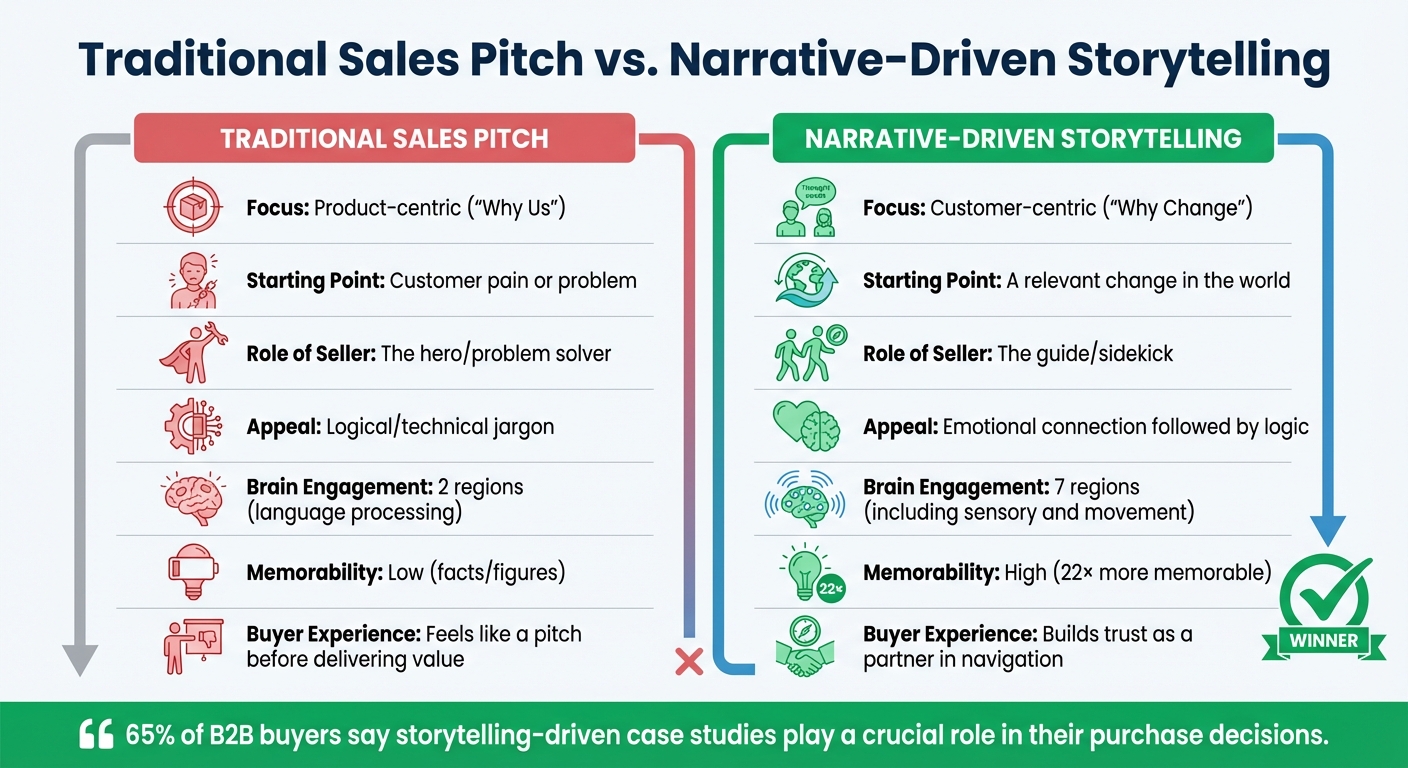
This shift from a product-centric pitch to a customer-centric story is what engages the reader and builds trust. This infographic provides a great visual summary of why this approach works.
2. Crafting the Transformation Story Arc
Great stories follow a predictable pattern of tension and release. In a case study, this story arc maps directly onto your customer's journey from struggle to success.

Here’s how the buyer's journey fits this arc:
- Set-Up: The "Situation" — who the customer is and the world they lived in.
- Inciting Incident & Rising Action: The "Challenge" — the pain points and struggles that made the status quo unbearable.
- Climax: The "Solution" — the moment they decide to act and choose your solution.
- Falling Action & Resolution: The "Results" — implementing the solution and achieving the transformation.
To write this story, you need to go beyond facts and capture the emotions and experiences of the journey. The following video explains how to gather these crucial details and use them to build the narrative.
9-Step Formula For Writing The PERFECT Case Study
In '9-Step Formula For Writing The PERFECT Case Study,' Alex Cattoni explains how to build the story by focusing on the 'before,' the 'decision,' and the 'transformation.' This is where the narrative comes to life.
Please watch the following three clips. The 'Before' (04:55 - 06:13): Notice the emphasis on the 'one big pain point' and using emotion to make the reader relate. The 'Smart Decision' (06:13 - 07:34): Focus on the 'straw that broke the camel's back'—the turning point that forced a decision. The 'Transformation' (07:34 - 08:42): Pay attention to the advice to include bumps along the way to increase believability.
By focusing on these narrative elements, you create a story of transformation that feels authentic and compelling. You're not just presenting data; you're illustrating a journey that your next prospect can see themselves taking.
3. Your Turn: Writing the Narrative
Now, let's apply this to the SyncUp and Innovate Design scenario from our previous lesson. You've already organized the facts. Your task now is to write the narrative for the "Challenge" section, turning the bullet points into a story of struggle.
Your Structured Facts (from last lesson):
- Situation: Innovate Design is a 50-person branding agency working with enterprise clients. Their old process used a mix of spreadsheets, email, and Slack.
- Challenge:
- Consistently missing project deadlines, hurting their reputation.
- Client feedback getting lost in email, leading to costly rework.
- Project managers spending ~5 hours/week chasing files and approvals.
- Solution:
- Used SyncUp's client portal for feedback and task board for progress.
- Chose SyncUp for its integrated client approval feature.
- Results:
- Reduced project overruns by 40%.
- Increased client satisfaction scores by 15%.
Your Task:
Write 2-3 paragraphs that cover the Challenge. Weave the facts into a story. Set the scene of their daily struggle. What did it feel like for the team at Innovate Design? Use the storytelling techniques we've just discussed to describe their "before" state.
4. Debrief and Model Answer
Excellent work. The goal of that exercise was to practice translating dry facts into a relatable narrative of business pain.
Here’s how I might have approached it:
For a 50-person branding agency like Innovate Design, reputation is everything. But their creative process was being strangled by administrative chaos. Project managers were losing nearly a full day every week, not to creative strategy, but to the soul-crushing task of hunting down files and approvals across endless email chains and siloed spreadsheets.
This internal friction inevitably spilled over to clients. Critical feedback would vanish into the digital ether, leading to frustrating rework and, even worse, missed deadlines. The very thing that made Innovate Design great—their creativity—was being undermined by a process that was no longer fit for purpose. They had reached a breaking point where the cost of inaction was not just wasted hours, but risking the client relationships they had worked so hard to build.
Notice the use of evocative language ("strangled by administrative chaos," "soul-crushing task," "vanish into the digital ether") to convey the feeling of the challenge, not just the facts. It frames Innovate Design as the hero struggling against a villain (inefficiency), setting the stage perfectly for a guide (SyncUp) to appear.
Conclusion
Today we moved from structure to story. You learned that the most persuasive B2B case studies are not about your product's features, but about your customer's transformation.
Key Takeaways:
- Frame your case study as a story where the customer is the hero and your product is the helpful guide.
- Structure your narrative around a transformation arc: a painful "before," a pivotal "decision," and a successful "after."
- Use evocative, emotional language to describe the customer's challenge and make it relatable to the reader.
- The goal is to help prospects see their own struggles in your hero's story and, by extension, see their own potential success with you as their guide.
Preview of the Next Lesson:
We've now built the structure and crafted the narrative. But for a skeptical B2B audience, a great story isn't enough. It needs proof. In our next lesson, we will focus on how to extract and present quantifiable results in a case study to build credibility. We'll learn how to find the hard numbers that make your story's happy ending undeniable.