
Hello! Welcome to the fourth lesson in our module on the Pre-Socratics.
In our last lesson, we wrestled with the cryptic fragments of Heraclitus. We saw his vision of a cosmos in perpetual flux, where everything flows like a river. Yet, this constant change was not chaotic; it was governed by a universal, rational principle—the Logos—which unifies all things through the tension of opposites. For Heraclitus, change is reality.
Today, we meet a thinker who takes the exact opposite position, creating one of the most significant and enduring debates in Western philosophy. Parmenides of Elea (fl. c. 475 BCE) will argue, with formidable logical rigor, that Heraclitus is profoundly mistaken. Using pure reason, he will attempt to prove that change is not just ordered, but is in fact a complete and total illusion.
Our learning outcome for this lesson is to reconstruct Parmenides' argument that change is impossible from his poem 'On Nature'. We will delve into his famous poem, which frames his philosophy as a divine revelation, and break down the deductive argument at its core.
The Journey to Truth
Parmenides presents his philosophy not as a dry treatise, but as an allegorical journey. He describes being carried in a chariot, guided by maidens, to the gates of Night and Day, where a goddess reveals to him the path of "well-rounded truth." This goddess presents him with a stark choice between two paths of inquiry.
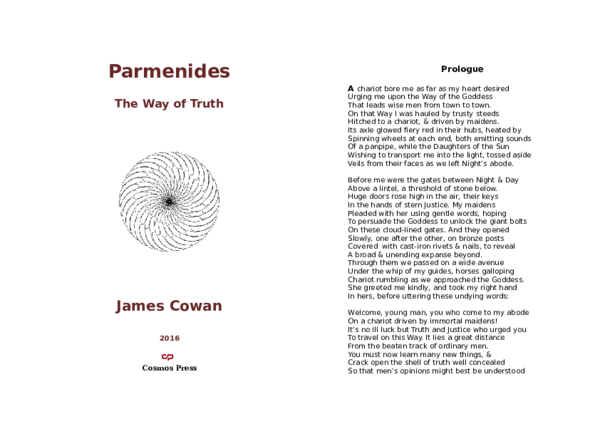
The goddess tells Parmenides he must learn about two "ways":
- The Way of Truth: This path follows the statement "It is" (esti in Greek) and leads to genuine knowledge.
- The Way of Seeming (or Opinion): This path follows the confused beliefs of mortals, who try to mix "It is" and "It is not." This is the world of our senses—the world of change, birth, and death—which Parmenides will argue is fundamentally illusory.
Let's begin by understanding the absolute first principle of the Way of Truth.
Parmenides: Pre-Socratic Philosophy
This video from Philosophy Overdose provides a concise reconstruction of the starting point of Parmenides' argument in the 'Way of Truth'. Pay close attention to the connection he establishes between thinking and being.
Watch from 04:52 to 08:20. The video breaks down the argument into its initial premises. Focus on the crucial claim that 'you cannot think not-being'. Try to understand why Parmenides believes this is a self-evident starting point.
As the video explains, Parmenides' argument begins with two core premises revealed by the goddess:
- The only real choice for thought is between "It is" (Being) and "It is not" (Not-being).
- You cannot think "It is not." To think of absolute nothingness is impossible; it is equivalent to not thinking at all.
From this, he draws a monumental conclusion, often summarized in Fragment 3: "For the same thing exists for thinking and for being." You can only think about what is. Therefore, reality (Being) is the only possible object of thought.
The Argument from the Way of Truth
With this foundation, Parmenides builds a deductive argument to prove that the world of our senses—a world of change, motion, birth, and death—cannot be real. He does this by showing that all of these phenomena would require the existence of "Not-being," which he has just established is unthinkable and impossible.
Now, let's engage directly with the central passage of his poem where he lays out this argument.
Parmenides - The Other and One
The website 'The Other and One' provides a good translation of the key fragments from Parmenides' poem. This section includes the famous Fragment 8, which contains the core of his argument against change.
Please read the section that begins with the line 'One word of the path remains, that it is;'. This is Fragment 8. As you read, identify the characteristics that Parmenides claims 'being' must have (e.g., 'un-generated and non-destructible'). Think about how each of these characteristics follows from the initial rule that 'Not-being' is impossible.
In that fragment, Parmenides systematically dismantles our common-sense view of the world. Let's reconstruct his logic.
The core idea is this: Any kind of change implies a transition involving "Not-being."
- Coming-to-be (Generation): For something to come into being, it must have come from not-being. But Parmenides has forbidden us from thinking or speaking of not-being. Therefore, nothing can come to be.
- Passing-away (Destruction): For something to be destroyed, it must pass into not-being. Again, this is impossible. Therefore, nothing can pass away.
- Movement: For something to move, it must move from where it is to a place where it is not (i.e., empty space or a void). Parmenides considers this void to be a form of not-being. Since not-being cannot exist, a void is impossible, and thus movement is impossible.
- Division/Multiplicity: For there to be many different things, there must be something (a void, or not-being) that separates them. Since not-being isn't possible, Being must be a single, continuous, indivisible whole.
Parmenides' reasoning is a powerful example of a reductio ad absurdum argument, which you may have encountered in mathematics or logic. It assumes the opposite of what you want to prove and shows it leads to a contradiction. Here is a formal reconstruction:
- Assumption for reductio: Let's assume change is real.
- If change is real, then things must come into being or pass away.
- Coming into being requires a transition from not-being. Passing away requires a transition to not-being.
- But "not-being" is unthinkable and impossible. It cannot be.
- Contradiction: Change requires the impossible (the existence of not-being).
- Conclusion: Therefore, the initial assumption must be false. Change is not real.
The following reading lays out the argument in a series of formal syllogisms, which may resonate with your background in IT analysis. It highlights the axiomatic, self-contained nature of Parmenides' reasoning.
Parmenides - The Other and One
This section from 'The Other and One' reconstructs Parmenides' argument as a series of linked syllogisms. This demonstrates how, once you accept his first premise, the radical conclusions about reality follow with deductive necessity.
Read the section titled 'Argumentation.' You don't need to memorize the syllogisms, but notice how the conclusion of one becomes a premise in the next, building an 'iron-clad' system from the simple premise that 'being does not come from non-being'.
The True Nature of Being
If Parmenides' argument holds, then what is reality—true Being—actually like? It is the complete opposite of the world we perceive with our senses. Based on his logic, Being must have the following attributes:
- Ungenerated and Imperishable: It has no beginning and no end.
- Eternal: It exists outside of time, in a single, timeless "now." Past and future are illusions tied to change.
- Motionless and Unchanging: It is perfect and complete, so it has no need or ability to move or alter.
- One and Indivisible: It is a single, continuous, unified whole. All distinctions are illusions.
- Complete: It lacks nothing. Parmenides uses the metaphor of a "well-rounded sphere" to convey this sense of perfection and completeness, not to suggest it is a literal ball in space.
This video provides a helpful summary of these attributes and the reasoning behind them.
Parmenides of Elea | Being and Non-Being | Philosophy Core Concepts
Philosopher Gregory B. Sadler here explains the characteristics of Parmenidean 'Being.' He reinforces the arguments against birth and destruction and introduces the interesting idea that Being is compelled by 'Necessity' or 'Justice' to be what it is.
Watch from 02:23 to 06:20 and then from 09:48 to 12:08. Focus on how each attribute (unborn, imperishable, complete) is a direct consequence of the impossibility of 'non-being'.
A Critical Evaluation: What does "to be" mean?
Parmenides' argument is logically powerful, but is it sound? For over two millennia, philosophers have pointed to a potential flaw in his reasoning that hinges on the ambiguity of the Greek word esti ("is").
The verb "to be" can be used in at least two different ways:
- The Existential "is": This asserts existence. For example, "Socrates exists." The negation is "Socrates does not exist" (absolute not-being).
- The Predicative "is": This ascribes a property to something. For example, "Socrates is wise." The negation is "Socrates is not wise."
Parmenides' argument that you cannot think of "what is not" is most plausible when "is" is used in the existential sense. It's difficult to conceive of absolute nothingness.
However, he seems to illegitimately extend this prohibition to the predicative sense. When we say "the apple is not red," we are not claiming the apple plunges into non-existence. We are simply denying it has the property of redness. But Parmenides' logic seems to rule out even this simple negation, leading him to conclude that Being cannot have different properties and must be a uniform whole. This is a subtle but crucial point of criticism.
Parmenides: Pre-Socratic Philosophy
Let's return to the Philosophy Overdose video for a clear explanation of this critical flaw. This is a key step in evaluating, not just reconstructing, the argument.
Watch from 13:46 to 18:48. Focus on the distinction between the 'existential' and 'predicative' senses of 'to be'. Grasping this distinction is key to understanding the most famous and powerful critique of Parmenides' entire system.
Conclusion
Parmenides stands as a monument to the power of pure, deductive reason. He begins with a seemingly simple premise—that one cannot think of "what is not"—and from it, logically derives a stunning and radically counter-intuitive picture of reality. He forces us to question the reliability of our own senses and to confront the difference between appearance and reality.
Key Takeaways:
- Parmenides presents a choice between the Way of Truth (reason) and the Way of Seeming (senses).
- His core argument is that "It is not" (Not-being) is unthinkable and unspeakable.
- From this, he reconstructs an argument showing that change, motion, and multiplicity are impossible because they all rely on the concept of Not-being.
- True Being, therefore, must be a single, eternal, unchanging, and indivisible whole.
- A major critique of his argument points to a potential confusion between the existential and predicative uses of the verb "to be."
Parmenides' conclusion that motion is an illusion was as shocking to his contemporaries as it is to us. In our next lesson, we will examine the famous paradoxes of his student, Zeno of Elea, who devised a series of brilliant arguments intended to defend his master's bizarre conclusion and prove that motion is, indeed, logically impossible.
Can't find a good explanation? Sign up and we'll make it for you
Sign up