
Hello! Welcome to your next lesson in our exploration of the Pre-Socratic philosophers.
In our last lesson, we confronted the radical and powerful arguments of Parmenides. Through pure deductive reasoning, he led us to the startling conclusion that reality—true Being—is a single, unchanging, eternal whole. All the change, motion, and multiplicity we perceive with our senses, he argued, are part of the "Way of Seeming" and are fundamentally illusory because they would require the existence of "Not-being," which is unthinkable.
This conclusion is profoundly counter-intuitive. If someone tells you that a flying arrow isn't actually moving, your natural reaction is to dismiss the claim as absurd. Parmenides' contemporaries felt the same way. In response to this ridicule, Parmenides' student, Zeno of Elea (c. 490 – c. 430 BCE), devised a series of brilliant arguments.
Today, we will focus on this defense. Our learning outcome is to explain Zeno's paradoxes as defenses of Parmenides' position. We will see that Zeno’s goal was not to provide new proofs for Parmenides' theory, but to demonstrate that the common-sense belief in motion, when examined logically, leads to its own set of absurdities and contradictions.
Zeno's Project: The Indirect Defense
Zeno's strategy is a classic example of philosophical argumentation known as reductio ad absurdum (reduction to absurdity), which you've encountered before. He essentially tells Parmenides' critics: "You think my master's view that motion is an illusion is absurd? Let me show you that your own belief—that motion is real—is even more logically problematic."
He does this by taking the ordinary assumptions about motion for granted and showing that they lead to inescapable paradoxes. This method serves as an indirect defense of Parmenides. It doesn't prove Parmenides is right, but it weakens the opposition by revealing the logical chaos underlying common sense.
Let's begin by understanding Zeno's motivations and the overall purpose of his arguments.
Zeno of Elea - Stanford Encyclopedia of Philosophy
The Stanford Encyclopedia of Philosophy offers a precise account of Zeno's purpose, drawing on Plato's dialogue 'Parmenides'. This section clarifies that Zeno's work was a 'sort of support' for Parmenides, aimed at paying back his master's critics 'with the same results and worse'.
Please read the section titled '3. Zeno’s Purposes'. Focus on how Zeno himself, in Plato's telling, describes his project: to show that the hypothesis 'if many are' (i.e., if motion and plurality are real) leads to 'even more ridiculous consequences' than Parmenides' hypothesis.
Now that we understand Zeno's goal, let's examine the paradoxes of motion themselves. We will focus on the four most famous ones recorded by Aristotle.
The Paradoxes of Infinite Divisibility
Two of Zeno's most famous paradoxes, the Dichotomy and the Achilles, rely on the idea that any distance can be divided into an infinite number of smaller parts. Zeno argues that it is impossible to complete an infinite number of tasks in a finite amount of time.
1. The Dichotomy (or "The Cutting in Two")
Imagine you want to walk across a room.
- To get to the other side, you must first cross half the distance.
- After that, you must cross half of the remaining distance (which is a quarter of the total).
- Then you must cross half of that remaining distance (an eighth of the total), and so on, forever.
Since there are an infinite number of these "halfway" points to cross, you must complete an infinite number of tasks. Zeno argues that it's logically impossible to complete an infinite series of tasks. Therefore, you can never even start your journey, let alone finish it. Motion is impossible.
Zeno of Elea | Paradoxes of Motion | Philosophy Core Concepts
This video from Gregory B. Sadler provides a very clear, step-by-step explanation of the Dichotomy paradox.
Watch from 02:20 to 04:05. Notice how the simple act of crossing a room is broken down into an endless sequence of required actions, which is the heart of the paradox.
2. Achilles and the Tortoise
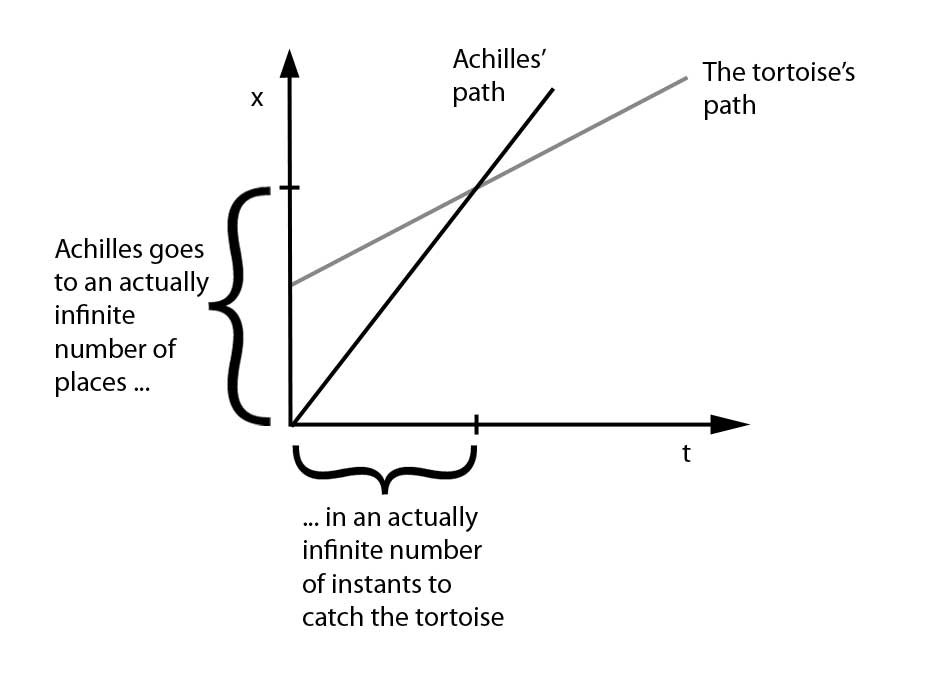
This is a more dramatic version of the Dichotomy. Imagine a race between the swift warrior Achilles and a slow tortoise. Being a good sport, Achilles gives the tortoise a head start.
- To catch the tortoise, Achilles must first reach the tortoise's starting point.
- During the time it takes Achilles to do this, the tortoise will have moved forward a small distance.
- Now, Achilles must reach this new point. But again, in that time, the tortoise will have moved forward a little more.
- This process continues forever. Every time Achilles reaches where the tortoise was, the tortoise has already advanced to a new position.
Logically, it seems Achilles can never overtake the tortoise, because he must cross an infinite number of ever-smaller gaps between them.
The Paradoxes of Instants and Relativity
The next two paradoxes challenge our understanding of time and relative motion.
3. The Arrow
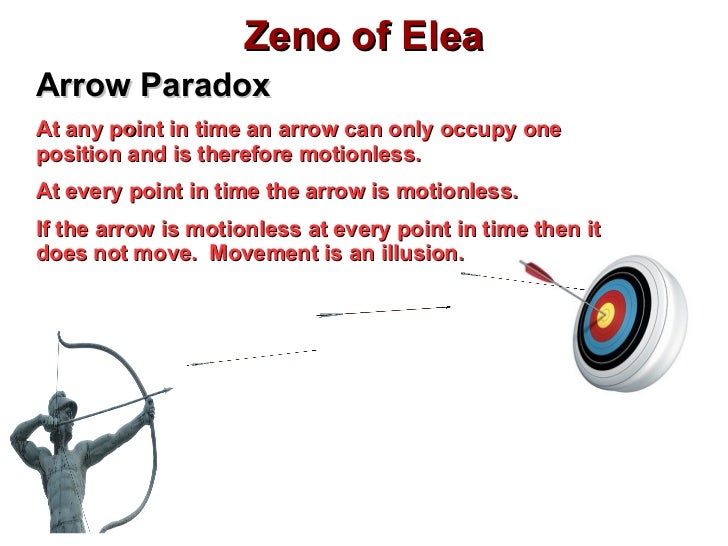
Consider an arrow in flight.
- At any single, indivisible instant of time, the arrow is in a specific location in space that is exactly equal to its own length.
- To be in a location exactly equal to its own length is to be at rest.
- If the arrow is at rest at every single instant of its flight, then it must be the case that it is never moving.
The "motion" we perceive is just an illusion, a series of still frames, much like a film strip. This directly supports Parmenides' claim that what is must be motionless.
4. The Stadium (or Moving Rows)
This paradox is the most complex to visualize. Imagine three parallel rows of bodies (let's call them A, B, and C), each with the same number of soldiers.
- Row A is stationary.
- Row B moves to the right at a certain speed.
- Row C moves to the left at the same speed.
They start in a position where the front of Row B and the front of Row C are aligned with the middle of Row A. They move until all three rows are aligned.
Zeno's argument, as reconstructed by Aristotle, shows that in the time Row B passes half of the stationary soldiers in Row A, it passes all of the moving soldiers in Row C. Since the speed is constant, Zeno argues that this implies a contradiction: the same amount of time must be equal to both half of itself and double itself.
Let's watch a short explanation to clarify this tricky setup.
Zeno of Elea | Paradoxes of Motion | Philosophy Core Concepts
Gregory B. Sadler explains the setup for the Stadium paradox, showing how the relative motion of the rows leads to a conclusion that Aristotle reports as 'half the time is equal to its double.'
Watch from 06:50 to 08:36. Focus on the core contradiction Zeno is trying to produce from the assumption of relative motion.
The crucial point is that by assuming motion is real, Zeno engineers a scenario that results in a logical contradiction. If an assumption leads to a contradiction, the assumption must be false. Therefore, motion cannot be real.
Synthesis: How the Paradoxes Defend Parmenides
Zeno's paradoxes are not isolated puzzles. They are a coordinated philosophical assault on the foundations of the common-sense world.
- The Dichotomy and Achilles attack motion by showing that it requires completing an infinite number of tasks, which seems impossible. They target the idea of space and time being infinitely divisible.
- The Arrow attacks motion by showing that it cannot be coherently defined at an indivisible instant of time.
- The Stadium attacks motion by showing that relative motion leads to logical contradictions about time.
Each paradox takes a different angle, but they all converge on the same point: the everyday world of motion and change, when scrutinized by logic, collapses into absurdity.
This final video clip summarizes how Zeno’s arguments function to support Parmenides.
Greek Philosophy 5.2: Parmenides and Zeno of Elea: A Philosophy of Eternity
The video from Delphic Philosophy concludes by connecting Zeno's paradoxes directly back to Parmenides' philosophy. It emphasizes that Zeno's aim was to reveal the 'problematic assumptions' within the common-sense view held by his master's critics.
Watch from 03:8:15 to 03:8:50. This short segment clearly articulates the dialectical role of Zeno's arguments as a defense of Parmenides.
By demonstrating these absurdities, Zeno shifts the burden of proof. The Eleatic view (Parmenides' and Zeno's) may seem strange, but if the alternative—the world of common sense—is logically incoherent, then perhaps the Eleatic view is the more rational one after all.
Conclusion
Today we've analyzed Zeno's famous paradoxes not as mathematical brain-teasers, but as powerful philosophical arguments with a clear purpose. Zeno of Elea stands as a master of dialectic, using the tool of reductio ad absurdum to defend his teacher, Parmenides.
Key Takeaways:
- Zeno's paradoxes are an indirect defense of Parmenides' doctrine that change and motion are illusions.
- His method is reductio ad absurdum: he assumes motion is real and then shows this assumption leads to logical contradictions.
- The Dichotomy and Achilles paradoxes argue that motion is impossible because it would require completing an infinite series of tasks.
- The Arrow paradox argues that an object is at rest at every instant of its flight, so motion cannot occur.
- The Stadium paradox argues that relative motion leads to a logical contradiction about the nature of time.
- Collectively, the paradoxes are designed to show that the common-sense view of reality is less logically sound than Parmenides' seemingly absurd conclusion.
The Eleatic challenge—posed by Parmenides' logic and defended by Zeno's paradoxes—was a major turning point in philosophy. It forced subsequent thinkers to take the problems of infinity, divisibility, and the void seriously. In our next lesson, we will see a direct response to this challenge in the form of Democritus' atomism, which proposes a world of indivisible atoms moving through an empty void—a concept Parmenides had explicitly forbidden.
Can't find a good explanation? Sign up and we'll make it for you
Sign up