
Hello! Welcome to your third lesson in our module on the Pre-Socratics.
In our last lesson, we traced the first steps of rational inquiry. We saw Thales propose an observable substance, water, as the fundamental principle (arche). Then, we saw his student Anaximander take a major leap into abstraction, arguing that the arche must be an unobservable, indefinite substance—the apeiron—from which the warring opposites of our world emerge and into which they return, governed by a cosmic justice.
Today, we meet one of the most enigmatic and influential of all the Pre-Socratics: Heraclitus of Ephesus (fl. c. 500 BCE). He takes Anaximander's idea of a world defined by the tension of opposites and radicalizes it, placing change and opposition at the very heart of reality. Our learning outcome is to analyze Heraclitus' doctrine of flux and the role of logos using his fragments. We will decipher his notoriously cryptic sayings to uncover a profound vision of a world in constant, lawful motion.
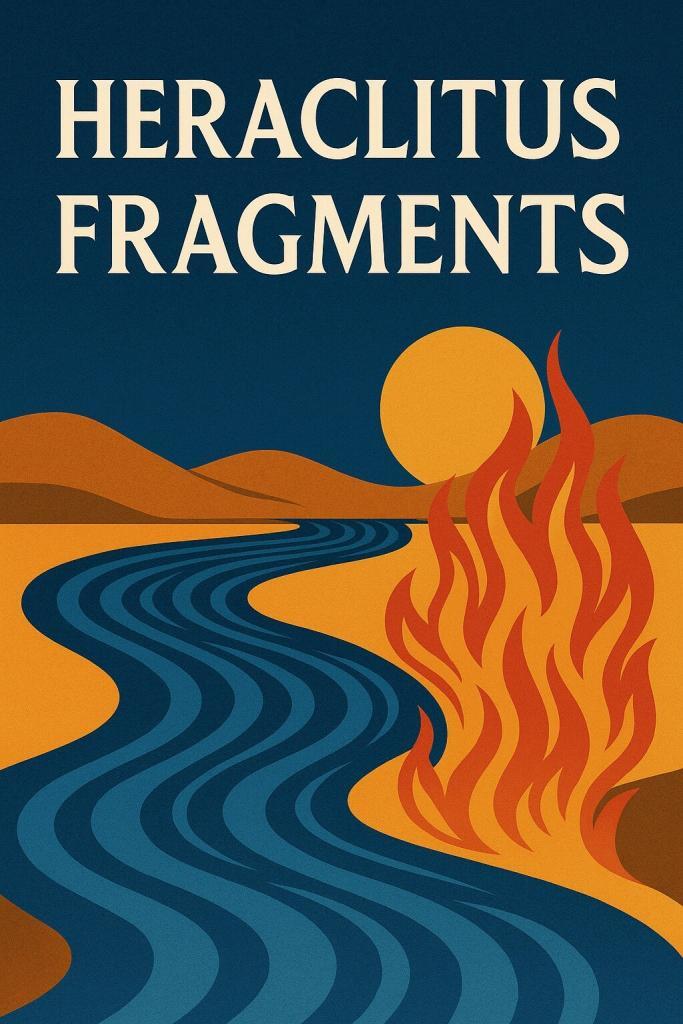
1. The Doctrine of Flux: "Everything Flows"
Heraclitus is most famous for the phrase panta rhei, or "everything flows." This is often summarized by the saying, "You cannot step into the same river twice." This captures a powerful intuition: the world is not static but is in a state of perpetual change. However, this popular summary, which comes to us from Plato, might oversimplify Heraclitus's more subtle point.
To understand Heraclitus's doctrine of flux properly, we must analyze his actual words. His fragments challenge us to think about how identity can persist through change.
Heraclitus - Stanford Encyclopedia of Philosophy
The Stanford Encyclopedia of Philosophy offers a precise, scholarly analysis of the famous 'river fragments.' This reading will help you move beyond the popular summary to a more rigorous understanding of Heraclitus's view on change and stability.
Please read section 3.1, 'Flux.' Pay close attention to the analysis of fragment B12. Focus on the argument that the river's identity as a 'river' is actually dependent on the fact that its waters are constantly changing. This is the core of Heraclitus's sophisticated view.
As the reading shows, the most reliable fragment (B12) suggests a paradoxical truth: "On those stepping into rivers staying the same other and other waters flow." The river remains the same river precisely because different waters are flowing through it. If the water stopped flowing, it would cease to be a river and become a lake.
Thus, for Heraclitus, change doesn't just destroy identity; in some cases, it's what constitutes identity. This profound insight applies not just to rivers, but potentially to all living things, societies, and even our own sense of self.
The following video explores these themes, connecting flux to relativism and its ethical implications.
Heraclitus: Pre-Socratic Philosophy
This section of the video 'Heraclitus: Pre-Socratic Philosophy' from Philosophy Overdose discusses the themes of relativism and flux, expanding on the river paradox and its consequences for how we understand identity.
Watch from 06:54 to 14:47. Notice how the speaker extends the problem of change and identity to the question of personal identity over time. How does this raise ethical questions, for example, about making promises?
2. Fire: The Symbol of Transformation
Where Thales chose water and his successor Anaximenes chose air, Heraclitus identified fire as the central element of the cosmos.
"This cosmos, the same for all, none of gods or men has made, but it was ever, is now, and ever shall be an ever-living fire, kindling in measures and going out in measures." (Fragment B30)
Unlike the Milesians who saw their arche as a stable substance from which things arise, Heraclitus's fire is a symbol for the process of transformation itself. Fire is never static; it flickers, it consumes, it transforms fuel into heat and light. It perfectly embodies the constant, orderly change that Heraclitus saw as fundamental.
He states: "All things are an exchange for fire, and fire for all things, as goods for gold and gold for goods." (Fragment B90). Fire is the common standard or measure of cosmic exchange, the process by which everything turns into everything else in a balanced, law-like way.
Let's watch a brief explanation of fire's role in his philosophy.
Heraclitus: Pre-Socratic Philosophy
This segment continues the video from Philosophy Overdose, explaining why fire is the perfect embodiment of Heraclitus's central ideas.
Watch from 14:47 to 18:11. Consider how fire represents not just flux, but also the unity of opposites (creation and destruction) and the importance of strife or tension.
3. The Logos: The Hidden Order of Things
If everything is in flux, how is the world not just pure chaos? Heraclitus's answer is his most important and enduring concept: the Logos.
Logos is a deeply layered Greek word. It can mean "word," "account," "reason," "measure," or "principle." For Heraclitus, it is all of these. The Logos is the universal, underlying principle or rational structure that governs the cosmos. While everything is changing, the Logos—the law of change—is eternal and common to all. The flux is not random; it is ordered and structured by the Logos.
Heraclitus begins his book by introducing this central idea, while also lamenting that most people fail to grasp it.
Heraclitus of Ephesus | The Logos | Philosophy Core Concepts
This video from philosopher Gregory B. Sadler provides a deep dive into the concept of Logos. We will start with his analysis of the crucial opening fragment of Heraclitus's work.
Watch from 07:54 to 12:11. Focus on how Heraclitus distinguishes between his own account (a logos) and the universal principle (the Logos) that his account aims to describe. Note the two levels: the underlying structure of reality and the true verbal account of that structure.
This Logos is not a private truth but a shared, objective reality. Yet, people live as if in a private dream, ignoring the common law that governs all things.
"Although the Logos is common, the many live as if they had a private understanding." (Fragment B2)
The ultimate message of the Logos is the unity of reality. Through all the change and opposition, everything is interconnected and forms a single, coherent system.
"Listening not to me but to the Logos it is wise to agree that all things are one." (Fragment B50)
The Logos manifests itself through the tension and unity of opposites. "The road up and down is one and the same" (B60). "God is day night, winter summer, war peace, satiety hunger" (B67). These are not contradictions. They are expressions of a unified process where opposites define and give way to each other, creating a dynamic harmony. The tension in a bow or a lyre is what makes it functional; similarly, the strife between opposites is what makes the cosmos function.
4. Paradoxical Style and Philosophical Method
This brings us to a final, crucial point: why did Heraclitus write in such a difficult, riddling style? Because his method mirrors his metaphysics. He believed that the nature of reality is itself a kind of paradox—a unity of opposites, a permanence in change. A straightforward, simple prose style could not capture this complex truth.
His goal was not to spoon-feed you information. Like the Delphic Oracle, which "neither reveals nor conceals, but gives a sign" (B93), Heraclitus gives you fragments that you must actively interpret. By wrestling with the puzzles in his language, you are forced to exercise your own reason—your own share in the universal Logos—and thereby come to a deeper understanding of the world's hidden structure.
Heraclitus: Pre-Socratic Philosophy
To conclude, let's return to the Philosophy Overdose video for an excellent explanation of why the paradox form is essential to Heraclitus's entire philosophical project.
Watch from 18:11 to 27:21. The key idea here is 'pragmatic self-refutation.' Try to grasp why, according to this interpretation, expressing his philosophy in plain prose would have contradicted the very message he was trying to convey.
Conclusion
Heraclitus presents a dynamic, challenging, and deeply unified vision of the cosmos. He moves beyond identifying a single material substance as the arche and instead points to a process, a law, a rational principle—the Logos—as the true foundation of reality.
Key Takeaways:
- Doctrine of Flux: Heraclitus argues that reality is in a state of constant change. However, this is not chaos. Stable identities, like a river, can be maintained through constant change.
- The Logos: This is the universal, rational principle that orders the flux. It is the "hidden harmony" that unifies all things, especially through the tension of opposites. Its core message is "all things are one."
- Fire: This serves as the perfect physical symbol for the Logos at work—an "ever-living" process of measured transformation.
- Paradoxical Method: Heraclitus's cryptic, riddling fragments are a deliberate philosophical tool. They mirror the paradoxical nature of reality (the unity of opposites) and compel the reader to engage their own reason to grasp the Logos.
In our next lesson, we will confront a philosopher who offers a radical and direct challenge to Heraclitus's entire worldview. Parmenides of Elea will use strict, deductive logic to argue that change is not just governed by a hidden law, but is in fact a complete illusion. Get ready for one of the most foundational clashes in the history of thought
Can't find a good explanation? Sign up and we'll make it for you
Sign up