
Hello! Welcome to your next lesson in our module on the Pre-Socratics.
In our last session, we explored the monumental shift from muthos (mythological explanation) to logos (rational explanation). You learned that the birth of philosophy was marked by a new commitment to explaining the world naturalistically—as an ordered kosmos with inherent principles that could be understood through reason and argument.
Today, we meet the thinkers who first put this revolutionary idea into practice. Our learning outcome is to explain Thales' and Anaximander's proposals for the fundamental substance (arche) of nature. We will examine the first philosophical attempts to answer the ultimate "what is it?" question: What is the single, underlying reality from which everything else comes? This is where the Western philosophical tradition of rational inquiry truly begins.
1. Thales: All is Water
Aristotle, looking back on the history of thought, identified Thales of Miletus (c. 624–546 BCE) as the very first philosopher. Why? Because Thales was the first to propose a naturalistic, universal principle for all of reality. He offered a logos instead of a muthos.
His famous claim, as reported by Aristotle, is that the arche is water. The Greek word arche means both "origin" and "ruling principle." So, for Thales, water is not just what everything came from originally, but also the fundamental substance that everything is.
This may seem simplistic today, but it's a profound conceptual leap. Thales is asserting that behind the immense variety of the world—rocks, clouds, plants, animals—there is a single, unified, natural substance.
But why water? Thales didn't just pull this idea out of thin air. His conclusion was based on observation. Aristotle speculates on what Thales's reasoning might have been. Let's delve into that with a reading.
Thales of Miletus | Internet Encyclopedia of Philosophy
The article 'Thales of Miletus' from the Internet Encyclopedia of Philosophy provides a concise, text-based account of Thales's core doctrine and the likely observational reasons behind it.
Please read section 3, 'Thales says Water is the Primary Principle,' and section 5, 'Thales’s Primary Principle.' Focus on how Aristotle distinguishes Thales's view from myth and the specific observations cited as potential reasons for the water hypothesis (e.g., moisture and life, different states of water, silt deposits).
As you read, the key reasons for Thales's hypothesis emerge:
- Life depends on moisture: The "nurture of all creatures is moist."
- Heat comes from moisture: "Warmth itself is generated from moisture."
- Seeds are moist: The "semina of all things have a moist nature."
- Water changes form: Water is unique in being easily observable as a solid (ice), a liquid, and a gas (vapor), suggesting it has the potential to transform into other things.
- Earth seems to arise from water: Thales would have observed the silt deposits of rivers like the Maeander near his home in Miletus, where land was visibly being formed from water.
For a slightly different perspective, the following short audio clip summarizes Aristotle's report on Thales.
HoP 001 - Everything is Full of Gods - Thales
This brief segment from the 'History of Philosophy Without Any Gaps' podcast succinctly explains Thales's water principle and Aristotle's conjectures about its origin.
Please listen from 17:47 to 19:34. Notice how the speaker distinguishes between water being the origin of all things versus everything being made of water, a subtle but important distinction in interpretation.
By positing water as the arche, Thales laid down a challenge: he made a universal claim about the nature of reality, based on evidence and reason, that could be publicly debated, criticized, and improved upon. And that is exactly what his student did.
2. Anaximander: A Step into Abstraction
Anaximander (c. 610–546 BCE), also of Miletus, took the next crucial step. He saw a logical problem with Thales’s proposal. If one of the existing, determinate substances—like water, with its property of "wetness"—were the infinite, primary principle, it would have long ago overcome its opposite (e.g., "dryness," as found in fire). The universe would have become entirely wet. Since we observe a world of balanced, opposing forces (hot/cold, wet/dry), the arche cannot be any one of them.
This critique led Anaximander to a far more abstract and radical conclusion. The arche must be something with no specific properties of its own. He called it the apeiron.
Apeiron is a fascinating term. It can be translated as:
- The Boundless or Unlimited: It is spatially and temporally infinite.
- The Indefinite or Indeterminate: It has no specific qualities of its own. It is not hot or cold, wet or dry. It is a neutral, primordial "stuff."
From this indefinite apeiron, the definite qualities and substances we see (the "opposites") are "separated out" to form the cosmos. Let's examine the arguments for this remarkable idea.
Anaximander | Internet Encyclopedia of Philosophy
The IEP article on Anaximander details his concept of the 'Boundless' and, crucially for our purposes, reconstructs the philosophical arguments he likely used to support his thesis.
Please read section 2, 'The “Boundless” as Principle,' and section 3, 'The Arguments Regarding the Boundless.' As you read, focus on a) how the 'apeiron' is defined, and b) the logic of the three arguments presented for why the principle must be boundless and indeterminate.
The arguments presented show a significant advance in reasoning:
- The Boundless has no origin: Because it is the origin. If it had an origin, that origin would be its limit, but it is by definition without limit.
- The origin must be boundless: To ensure that generation and decay can go on forever without the source running out. This is an argument from the principle of conservation.
- The origin must be indefinite: This is the argument against Thales. If the principle had a definite quality (like wetness), it would have destroyed its opposite (dryness) long ago.
The apeiron not only gives rise to the world but also governs it. The only surviving fragment from Anaximander’s book describes this process in poetic, quasi-legal terms.
"Whence things have their origin, thence also their destruction happens, as is the order of things; for they execute the sentence upon one another – the condemnation for the crime – in conformity with the ordinance of Time."
Anaximander pictures the opposing substances (like fire and water) as being in a constant struggle. When one dominates the other (e.g., summer's heat overpowering winter's cold), it commits an "injustice." Over time, the balance is restored as the other element reasserts itself, paying "retribution." The apeiron is the ultimate governor of this cosmic process, ensuring no single element can ever win permanently.
This model of a dynamic, self-regulating cosmos is far more complex than Thales's. Anaximander also proposed a revolutionary model of the universe to go with it.
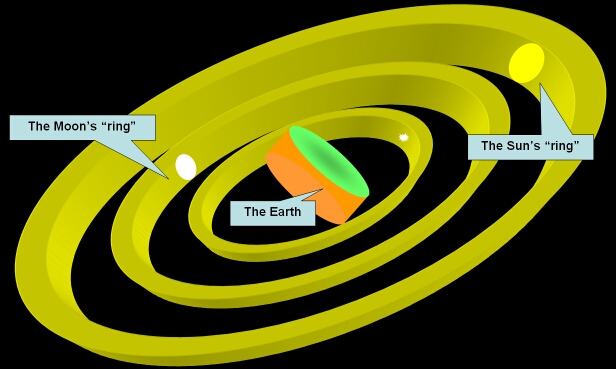
This is the first known attempt to use mechanical, geometric principles to describe the heavens, a stark departure from the idea of the sky as a simple dome.
3. From Concrete to Abstract: A Comparison
Thales and Anaximander represent the first turn of the philosophical engine: thesis, critique, and new thesis.
| Aspect | Thales | Anaximander |
|---|---|---|
| Arche | Water | The Apeiron (The Boundless/Indefinite) |
| Nature of Arche | A concrete, observable substance. | An abstract, unobservable principle. |
| Reasoning | Empirical generalization from observations of the natural world. | Logical deduction based on the problem of opposites and conservation. |
| Cosmology | The Earth floats on a sea of water. | The Earth floats freely in the center of a system of celestial rings. |
The move from Thales's water to Anaximander's apeiron is a pivotal moment. It is a move from explaining the world in terms of something in the world to explaining it in terms of a more fundamental, abstract principle that lies beyond immediate experience but is grasped by reason. This tension between the empirical (what we can observe) and the rational (what we can deduce) will become a central theme in the history of philosophy.
Conclusion
Today, we have examined the very first philosophical theories about the fundamental nature of reality. In doing so, you've seen the philosophical method in action for the first time.
Key Takeaways:
- Thales proposed that water is the arche, or fundamental principle of all things. He based this conclusion on empirical observations, such as the necessity of moisture for life.
- Anaximander criticized Thales's view, arguing that a definite substance could not be the arche. He proposed the apeiron—an infinite, eternal, and indeterminate substance—as the source of all things.
- Anaximander reasoned that the apeiron was necessary to explain the continued existence of opposing forces (like hot and cold) and to provide an inexhaustible source for all generation.
- The progression from Thales to Anaximander demonstrates a key philosophical dynamic: a move from concrete, observable principles to more abstract, rationally deduced concepts.
In our next lesson, we will continue this story by looking at two other major Pre-Socratic figures. We'll explore Heraclitus's doctrine of flux ("all is change") and the role of the logos, a concept that takes on a new, deeper meaning in his philosophy. This will build directly on Anaximander's idea of a cosmos governed by the constant tension of opposites.
Can't find a good explanation? Sign up and we'll make it for you
Sign up