
Hello! Welcome to the second module of our course, "The Pre-Socratics: The Birth of Rational Inquiry."
In our first module, you built a powerful toolkit for philosophical analysis. You learned to identify, reconstruct, and—most recently—evaluate deductive arguments for validity and soundness. Now, we leave the training ground of formal logic and step into the history of philosophy itself. This is where you'll begin to apply those skills to the foundational questions and arguments that have shaped human thought for millennia.
Today's lesson addresses a pivotal moment in intellectual history. Our learning outcome is to explain the significance of the shift from mythological to rational explanation, including the character of pre-philosophical mythological accounts of nature. We will explore the fundamental differences between explaining the world through stories about gods (muthos) and explaining it through reason and natural principles (logos). This transition marks the very birth of what we now call philosophy and science.
1. The World of Muthos: Story, Gods, and Purpose
Before philosophy, if you asked, "Where did the world come from?" or "Why do we have thunderstorms?" the answer would have been a story. These stories, or myths, explained the universe by narrating the actions, intentions, and relationships of divine beings.
To understand the shift to philosophy, we must first appreciate the character of this mythological worldview. A great way to start is by examining the kinds of questions myths were designed to answer.
Dr. Darren Staloff, Presocratics: Ionian Speculation and Eliatic Metaphysics
Dr. Darren Staloff provides a very clear and energetic contrast between the storytelling of ancient myths and the new type of inquiry introduced by the first philosophers.
Please watch from 03:39 to 08:27. Focus on the two key distinctions he makes: first, the difference in the form of explanation (story vs. non-narrative theory), and second, the difference in the questions being asked ('who/why' vs. 'what/how').
As Dr. Staloff explains, cosmogenic myths (creation stories) are fundamentally about who is responsible and why they acted—for what purpose. The world is explained as the product of personal will, conflict, and intention.
Let's look more closely at what this looked like in pre-philosophical Greece. The primary sources for this worldview are the epic poems of Homer (The Iliad, The Odyssey) and Hesiod (Theogony).
Here is a map that visualizes the world as it was understood in the Homeric epics. Notice how it blends geographical places with purely mythological locations.
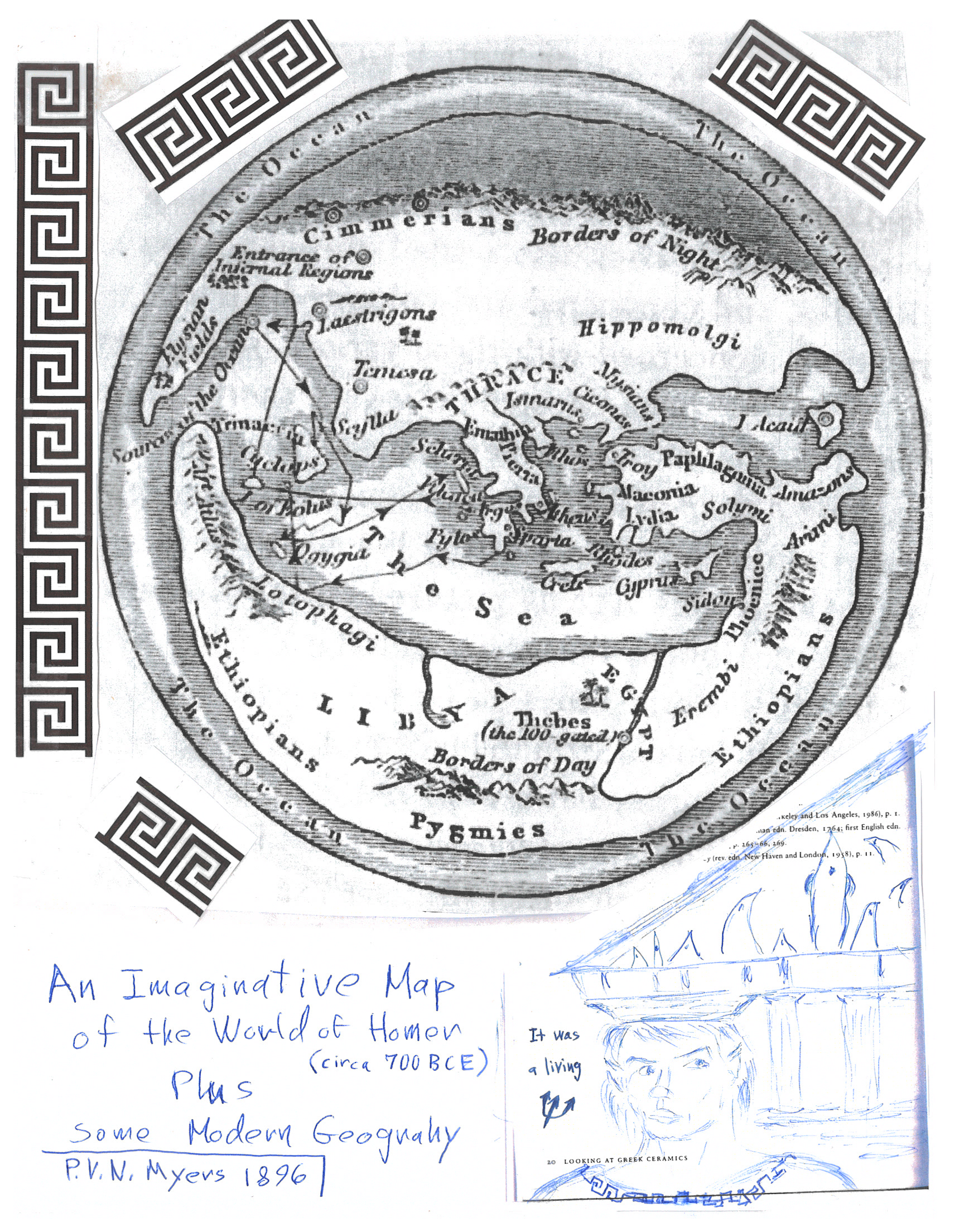
In Homer's world, natural phenomena are not impersonal processes; they are episodes in a divine drama. The following reading from the scholar Eric Havelock's analysis of Homeric myth demonstrates this with concrete examples from the text. This will give you a feel for the "rigorous, text-driven" approach you appreciate, applied to these foundational stories.
[PDF] The Cosmic Myths of Homer and Hesiod - Oral Tradition Journal
In 'The Cosmic Myths of Homer and Hesiod,' Eric Havelock analyzes how the Homeric poems describe the cosmos. This reading will show you how cosmological 'facts' were presented not as a coherent system, but as inconsistent, narrative-dependent episodes.
Please read the sections titled 'HOMER’S COSMIC IMAGERY' and the subsequent analysis. This runs from page 31 to the top of page 41 (ending before 'The significance is not a matter of mere stylistics'). Focus on Havelock's main point: cosmic descriptions in Homer are inconsistent because they are 'episodes' that serve the needs of the story at hand, not parts of a systematic, physical theory.
Havelock's analysis reveals a few key characteristics of the Homeric worldview:
- Narrative-Driven: The cosmos is described as it relates to the actions of gods and heroes. A description of the gates of heaven is given because goddesses are passing through them.
- Inconsistent: The details of the cosmos change from one story to the next to fit the narrative context. Tartarus is in a different place depending on which god is talking about it.
- Personified & Action-Oriented: The world is composed of agents. Gates are "self-moving," rivers "flow from" Ocean personified, and Zeus's power is the ultimate organizing principle.
A generation after Homer, the poet Hesiod made an attempt at a more systematic account in his Theogony. Yet, his system was not one of physical principles, but of divine genealogy. For Hesiod, to explain the world was to explain the family tree of the gods.
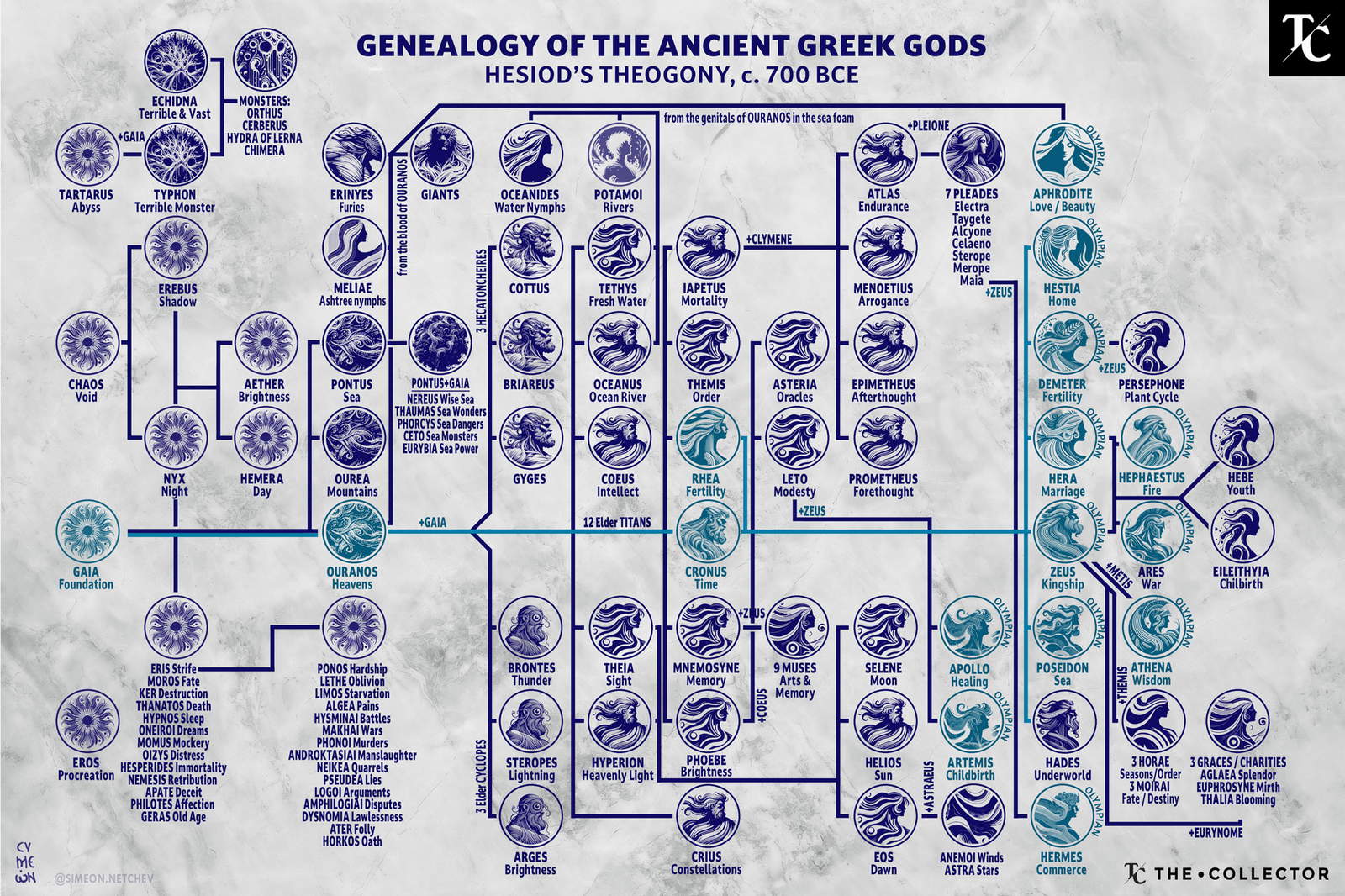
This is the intellectual world into which philosophy was born: a world explained by stories of divine will, where "why?" meant "for what purpose?" and where the structure of reality was a vast, often conflicting, family drama.
2. The World of Logos: Reason, Nature, and Mechanism
Around the 6th century BCE in the Greek cities of Ionia (modern-day Turkey), a revolutionary new way of thinking emerged. A group of thinkers, whom we now call the Pre-Socratic philosophers, began to ask different questions.
They rejected mythological accounts and sought to explain the world naturalistically. This meant looking for explanations within nature itself, using inherent, observable principles. The world was no longer seen as a stage for divine drama, but as a kosmos—an ordered, intelligible, self-regulating system.
This is the shift from muthos to logos. A logos is not just a word; it is a rational account, an explanation, a theory, or an argument.
The following reading from the Stanford Encyclopedia of Philosophy describes this transition, using Hesiod's Theogony as a direct point of contrast.
This entry on 'Presocratic Philosophy' clearly articulates the fundamental change in approach that marked the beginning of philosophy.
Please read the section '1. Who were the Presocratic Philosophers?'. Pay close attention to the paragraphs contrasting the Presocratic approach with Hesiod's 'Theogony'. Then, read the short section '3. Xenophanes of Colophon and Heraclitus of Ephesus', focusing on the example of the rainbow (Iris).
The example of Xenophanes and the rainbow is a perfect illustration of the shift:
- Mythological view: The rainbow is Iris, a messenger of the gods, a divine being who intervenes in the world. This answers "Who is it?" (Iris) and "Why is it here?" (to deliver a message).
- Philosophical/Naturalistic view: The rainbow is, by its nature, simply a colored cloud. Xenophanes explains it as a meteorological phenomenon, an inherent part of the kosmos. This answers "What is it?" (a cloud) and "How does it work?" (light interacting with water).
This new approach represents a profound change in perspective. The world is no longer fundamentally mysterious and subject to the whims of inscrutable gods. Instead, it is seen as having an underlying order that can be understood by human reason. Your background in IT analysis rests on this very foundation—the belief that systems operate on consistent principles that can be diagnosed and understood.
However, the distinction was not always a simple case of "myth vs. reason." For later thinkers like Plato, the crucial difference was not the source of one's belief, but whether one could provide a rational justification for it.
Greek Philosophy 4.1: The Presocratics: Sources, Myth, and Philosophy
This video explores how both modern scholars and ancient philosophers themselves viewed this transition. It adds important nuance to the story.
Please watch from 15:09 to 22:31, which covers the modern perspective on the radical break from myth. Then, watch from 27:40 to 32:29, which explains Plato's later perspective. For Plato, the key distinction is between holding a belief (even a true one from divine inspiration) and being able to provide a 'logos'—a rational account or argument—for it.
This final point connects directly back to our work in Module 1. To be a philosopher, in this emerging sense, was to be someone who could offer and defend a logos. It is the commitment to providing reasons, to building arguments, and to subjecting claims to critical evaluation that defines the philosophical enterprise.
Conclusion
Today we have traced the outlines of one of the most significant developments in human history: the birth of rational inquiry.
Key Takeaways:
- Mythological Explanation (Muthos): Characterized by narrative form, it explains the world through the actions and purposes of personified, divine agents. Homeric and Hesiodic accounts are prime examples. It answers the questions "Who?" and "Why?"
- Rational Explanation (Logos): Characterized by systematic and naturalistic theories, it explains the world in terms of its own inherent principles and mechanisms. It seeks to answer the questions "What?" and "How?"
- The Significance of the Shift: This transition established the idea of the universe as an ordered kosmos that is intelligible to human reason. It founded the traditions of both science and philosophy by asserting that claims about the world should be supported by evidence and logical argument, not just tradition or sacred stories.
- Philosophy as Logos: The ability to provide a logos—a rational account backed by argument—became the hallmark of the new philosophical method.
In our next lesson, we will meet the very first philosopher, Thales of Miletus. We will examine his claim that all things are made of water and see how his student, Anaximander, built upon and criticized his teacher's logos. This is where you will begin to apply your analytical skills to the earliest philosophical arguments.
Can't find a good explanation? Sign up and we'll make it for you
Sign up