
Hello! Welcome to your next lesson in our journey through Pre-Socratic philosophy.
In our last lesson, we wrestled with Zeno's brilliant and confounding paradoxes. We saw how he used pure logic to defend Parmenides' radical claim that motion is an illusion. By showing that our common-sense belief in motion leads to logical absurdities—like Achilles never catching the tortoise—Zeno presented a powerful challenge. If motion and plurality are real, how can we describe them in a way that is logically coherent?
Today, we meet the thinkers who provided one of the most powerful and enduring answers to this question: Leucippus and his student Democritus (c. 460 – c. 370 BCE). They developed a theory known as atomism. This theory aimed to reconcile Parmenides' demand for an eternal, unchanging reality with the undeniable evidence of our senses that the world is full of change, motion, and variety.
Our learning outcome is to explain the core tenets of Democritus' atomism, including the concepts of atoms and the void. You will learn how the atomists proposed a model of the universe built from just two fundamental principles, a model that would echo through the history of science and philosophy.
Responding to the Eleatic Challenge
Parmenides had argued that reality must be One, eternal, and unchanging, because change would require something to come from "what-is-not" (nothing), which is impossible. The pluralists we've seen, like Empedocles, tried to solve this by positing multiple eternal elements (earth, air, fire, water). The atomists pushed this idea to its logical extreme.
They agreed with Parmenides that true being must be eternal and unchanging. However, they argued that this "Being" is not a single entity but an infinite number of tiny, indivisible, and solid particles: atoms.
Then, they made their most audacious move. They directly contradicted Parmenides by asserting that "what-is-not" does exist. They called it the void—empty space. For the atomists, the universe is composed of these two fundamental realities: atoms ("what-is") and the void ("what-is-not").
Let's begin by seeing how this framework was designed to resolve the paradoxes of change and motion.
Democritus and Leucippus | The Atomists of Presocratics Philosophy
The video 'Democritus and Leucippus' provides a concise explanation of how atomism emerged as a response to Parmenides, alongside other pluralist theories.
Please watch the segment from 03:07 to 04:25. Focus on how the atomists, like other pluralists, accepted that the fundamental components of reality are eternal and unchanging, but proposed that there are many of these 'ones' rather than just a single block of Being.
Now, let's delve into the two core principles of this revolutionary theory.
Tenet 1: Atoms ("What Is")
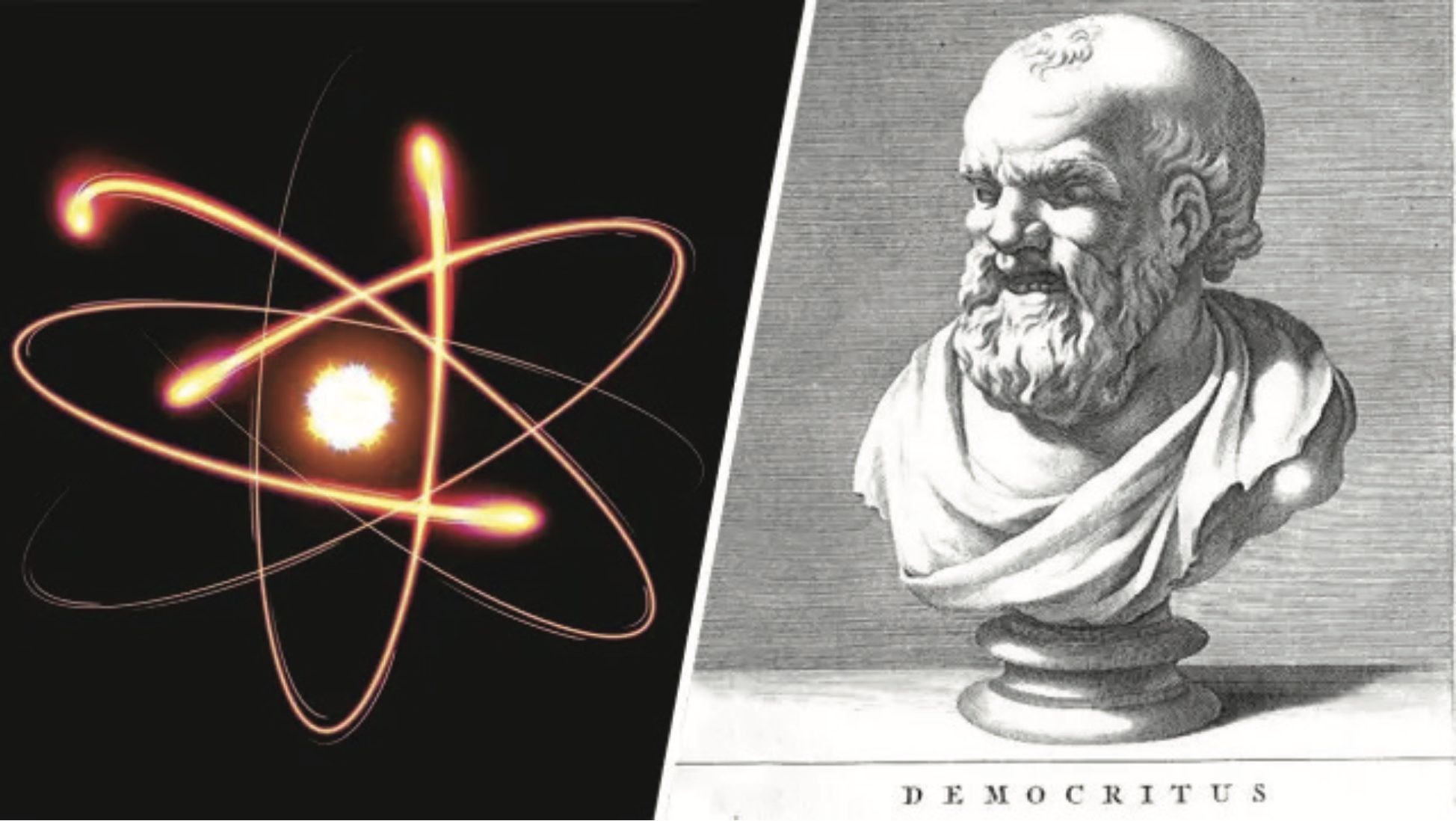
The word atom comes from the Greek atomos, meaning "uncuttable" or "indivisible." According to Democritus, atoms are the fundamental building blocks of everything.
Here are their key properties:
- Eternal and Indivisible: Atoms are uncreated and indestructible. They are perfectly solid, containing no gaps or empty space within them, which is precisely why they cannot be cut or divided further. They are the ultimate, unchanging reality Parmenides was looking for.
- Infinite Number, Infinite Shapes: There are infinitely many atoms, and they come in an infinite variety of shapes and sizes. Some are smooth and round, others are jagged, hooked, or irregular.
- In Perpetual Motion: Atoms are constantly moving through the void. This motion is not guided by any intelligence or purpose; it is an inherent property of reality.
The sheer variety of the world we see is explained by the differences between atoms and their arrangements. Democritus used an elegant analogy: atoms are like the letters of the alphabet. The letters themselves are fundamental elements, but by combining them in different ways (shape, arrangement, position), we can create an endless number of words and stories. Similarly, the combination of different atoms creates everything from rocks and water to plants and people.
To get a more direct feel for their arguments, let's turn to the surviving fragments and reports from ancient commentators.
Leucippus and Democritus: Fifth-Century Atomism
This PDF from a Presocratics reader collects key passages describing atomist doctrine, many of which come from Aristotle's critiques. Reading them allows us to reconstruct the theory from the original (though filtered) sources.
Please read the following fragments from the 'Passages' section: Fragment 3 (Aristotle, Metaphysics): Focus on the definition of 'the full' (what-is) and 'the empty' (what-is-not) as the elements, and the three ways atoms differ: shape, arrangement, and position. Fragment 5 (Aristotle, On Democritus): Note the description of atoms as 'small substances' with 'all kinds of forms and shapes' that move in the void and become entangled. Fragment 12 (Simplicius): This passage explicitly states the reason for indivisibility: atoms are compact and 'have no share of void.' These fragments provide the core definitions of atoms and their properties.
Tenet 2: The Void ("What Is Not")
The boldest and most controversial part of atomism was the assertion that the void, or empty space, is real.
- Parmenides' Prohibition: Remember, Parmenides had declared that "what-is-not" cannot be. Thought and being are the same, and you cannot think of "nothing."
- The Atomists' Solution: Democritus cleverly replied with the famous phrase: "What-is is no more than what-is-not, because the void is no less than body is." He put the void on equal ontological footing with atoms. The void is not "nothing" in the sense of non-existence; it is "nothing" in the sense of being empty of matter.
- Necessity for Motion: The void was not just a philosophical novelty; it was a logical necessity. For motion to occur, there must be empty space for things to move into. Without the void, the universe would be a completely full, motionless block (a plenum), just as Parmenides described. By positing the void, the atomists gave motion a place to happen, thereby saving our experience of change from Zeno's paradoxes.
This next video clip explains this crucial distinction between the atomists and other philosophers who tried to avoid postulating a void.
Democritus and Leucippus | The Atomists of Presocratics Philosophy
Let's return to 'The Living Philosophy' to see how the atomists' belief in the void set them apart and why it was so essential to their system.
Watch from 04:34 to 05:52. Pay close attention to the contrast between the atomists' 'atoms and void' and the 'plenum' or 'great soup' of other pluralists. This highlights the radical nature of accepting the void's existence.
A Mechanistic and Materialist Universe
With these two principles—atoms and the void—Democritus constructed a complete, self-contained, and shockingly modern picture of the cosmos.
- Cosmos Formation: The universe didn't need a creator. The perpetual, random motion of atoms in the infinite void is enough. Atoms collide, and their various shapes cause them to hook together or rebound. Over vast periods, these collisions form larger and larger clusters, creating vortices or whirlpools that gather more atoms, eventually forming worlds (kosmoi), stars, and everything in them.
- Change Explained: All change is simply the rearrangement of atoms. Coming-into-being is the joining of atoms; passing-away is their separation. The atoms themselves are eternal.
- No Purpose, Only Necessity: This is a purely mechanistic and materialist system. Events happen not for a purpose (telos) but from necessity (ananke)—the unavoidable consequences of atoms colliding according to their nature. This rejection of teleological explanation in favor of efficient, mechanical causation was a profound departure from both mythological accounts and other philosophical theories.
This led to another revolutionary idea: the distinction between what is real and what is merely a product of our perception.
Reality vs. Convention
For Democritus, the only things that exist in reality are atoms and the void. The properties of atoms are their size and shape. Qualities like color, taste, sound, and temperature are not properties of the atoms themselves. Instead, they are produced by the interaction of atoms from external objects with the atoms that make up our sense organs.
This is captured in his most famous surviving quote:
"By convention sweet, by convention bitter, by convention hot, by convention cold, by convention color; but in reality atoms and void."
What you experience as "sweetness" is not a quality inherent in the food itself, but the effect of certain smooth, round atoms on the atoms of your tongue. "Bitterness" is the effect of sharp, jagged atoms. This distinction is a direct forerunner of the modern scientific distinction between an objective world of quantifiable properties and our subjective, qualitative experience of it.
This final clip explains this critical separation between the human-projected world and the underlying mechanistic reality.
Democritus and Leucippus | The Atomists of Presocratics Philosophy
The distinction between primary qualities (of the atoms themselves) and secondary qualities (of our perception) is a cornerstone of atomism and a massive step in the history of thought.
Watch from 05:52 to 07:24. Focus on how Democritus strips the world of human qualities like 'sweet' or 'cold', leaving a reality of pure matter in motion. This is the essence of his materialism.
Conclusion
Today we have unpacked the core tenets of one of the most influential theories in the history of thought. In response to the Eleatic challenge, Democritus and Leucippus constructed a system that preserved the experience of change and motion while grounding it in an eternal, unchanging reality. Their vision of a universe composed of nothing but indivisible particles moving in an empty void was a monumental achievement of rational inquiry.
Key Takeaways:
- Democritus' atomism posits two fundamental principles: atoms ("what-is") and the void ("what-is-not").
- Atoms are eternal, solid, indivisible, and infinite in number and shape. They possess primary qualities like size and shape.
- The void is real empty space, which is logically necessary for atomic motion to occur.
- All change, from the formation of worlds to the taste of honey, is explained by the mechanical interaction (collision, entanglement, separation) of atoms.
- The system is materialist and mechanistic, rejecting any form of divine creator or cosmic purpose (telos).
- Democritus distinguished between the reality of atoms and void and the "conventional" existence of sensible qualities (color, taste, etc.), which arise from our interaction with atoms.
In our next lesson, we will place Democritus in context. Now that you have a firm grasp of his theory, we will compare and contrast his atomistic cosmology with the systems of the earlier Pre-Socratics we've studied, such as Thales, Heraclitus, and Parmenides, to fully appreciate its originality and power.
Can't find a good explanation? Sign up and we'll make it for you
Sign up