
Hello! Welcome to our lesson on a pivotal and tumultuous moment in Bogotá's history.
In our last lesson, we saw how 19th-century Bogotá began to modernize despite continuous political conflict. We looked at the decades-long construction of the Capitolio Nacional as a symbol of a struggling republic and, more importantly, the arrival of the tramway, a technology that broke the city out of its colonial grid and began reshaping its physical and social fabric.
Today, we confront the event that violently halted that trajectory and forever altered the city's destiny. Our goal is to describe the 'Bogotazo' of 1948 as a critical turning point, visualizing its immediate impact on the city's landscape. We will explore how one man's murder on a downtown street unleashed a wave of destruction that not only leveled buildings but also bulldozed the city's path to modernity, setting it on a new, more chaotic course.
The Spark: The Man and the Moment
By the 1940s, Colombia was deeply divided. The simmering conflict between the Liberal and Conservative parties was at a boiling point. Into this tense political landscape stepped Jorge Eliécer Gaitán.
Gaitán was a lawyer and a riveting orator from the Liberal party, but his appeal transcended party lines. He spoke for the poor, the working class, and those who felt excluded by the ruling political and economic elites. To his followers, he was the "people's candidate" and a symbol of hope for a more equitable Colombia. To the establishment, he was a dangerous populist threat. By 1948, he was the most popular politician in the country and the clear frontrunner for the 1950 presidential election.
On April 9, 1948, that hope was extinguished.
To understand the explosive events of that day, watch the following segment from the History Hustle documentary, "The FORGOTTEN Colombian Civil War". It vividly captures the assassination and the immediate chaos that followed.
The FORGOTTEN Colombian Civil War (1948 – 1958) – La Violencia
This video clip details the assassination of Jorge Eliécer Gaitán and describes the immediate eruption of the 'Bogotazo' riot.
Please watch from 05:23 to 07:37. Pay close attention to the description of the riot as a 'total mayhem' and the specific examples of destruction mentioned.
The Explosion: A City in Flames
As the video explains, Gaitán's assassination was the spark that lit a powder keg of social and political frustration. The ensuing riot, known as the Bogotazo, was a 10-hour storm of destruction that consumed downtown Bogotá.
This was not just random chaos. It was a visceral and violent expression of rage against a system that the people felt had failed them. The targets of the mob were not arbitrary.

The rioters systematically attacked symbols of power, wealth, and authority. The article "Urbanism as Warfare" notes that the crowds targeted the presidential palace, Congress, national ministries, and even the archbishop's palace. They weren't just breaking things; they were attempting to tear down the very fabric of the established order.
One of the most significant casualties of the riot was a symbol of the very modernization we discussed in our last lesson: the tramway.
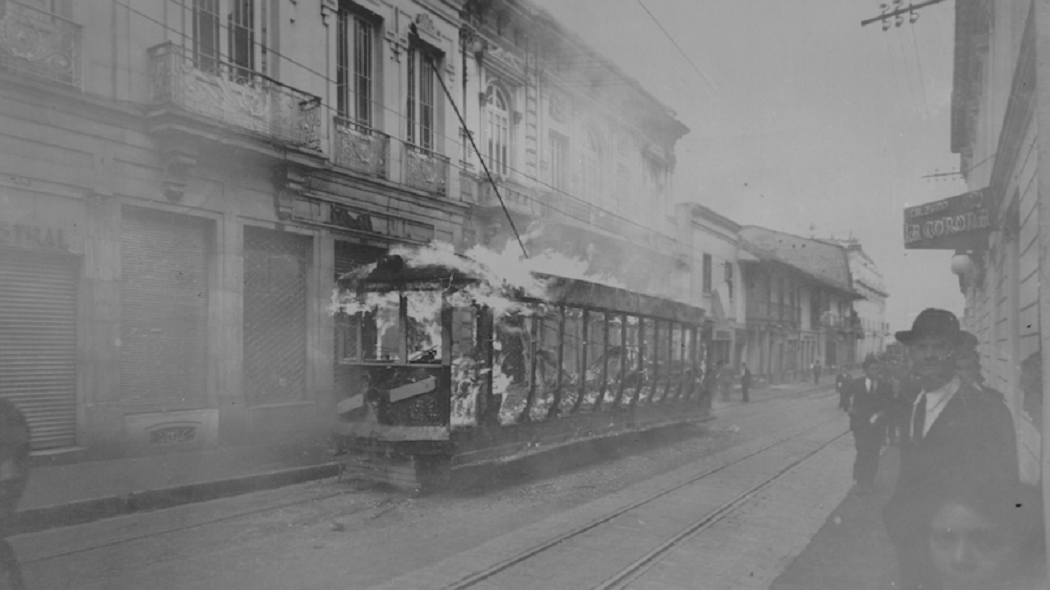
The destruction of the trams was both symbolic and strategic. For a deeper analysis of the events and their impact on the city's fabric, please read the following brief excerpts.
The Octopus, the Spider and the Braying Burros / Urbanism as Warfare
These texts provide a powerful analysis of the Bogotazo's immediate impact. The first, from Harvard's ReVista magazine, gives a raw account of the chaos. The second, from 'Urbanism as Warfare,' offers a fascinating perspective on the destruction of the tramway, suggesting it was more than just collateral damage.
From the ReVista article, 'The Octopus, the Spider and the Braying Burros,' please read the final paragraph of the first section, which begins 'With the April 9, 1948, assassination...'. It vividly quantifies the destruction.
From 'Urbanism as Warfare', read the section titled 'Counterrevolutionary Urbanism' (starting with 'The traces of the urban destruction...') and the following section (starting with 'These broader conflicts...'). Focus on two key ideas: 1) how the Bogotazo was used as a pretext to dismantle the tram system, and 2) the argument that the mob's destruction was not random but targeted at 'symbols of power, inequality, and exclusion'.
The key takeaway here is that the Bogotazo was a complex event. It was a spontaneous outpouring of grief and rage, but it was also channeled towards specific targets that represented the populace's grievances. Furthermore, opportunistic political and business interests used the chaos to advance their own agendas, like the private bus companies who wanted the municipal tramway gone.
Test your understanding!
Thinking from a user experience (UX) and systems design perspective, how would you characterize the actions of the mob during the Bogotazo? If you see the city as a "product" and its citizens as "users," what does the mob's targeted destruction of government offices, luxury stores, and the tram system tell you about their "user experience"?
Show answer
This is a great way to analyze the event.
- A Violent Form of User Feedback: The riot can be seen as the most extreme form of negative user feedback imaginable. The "users" (citizens) felt the "product" (the city and its political system) was fundamentally broken, unresponsive, and unfair.
- Targeting Broken Features: The destruction wasn't random. By attacking ministry buildings, they were protesting a bureaucratic system they felt was inaccessible and corrupt. By attacking luxury stores, they were protesting economic inequality.
- Rejecting a System Change: The destruction of the tramway is particularly interesting. While on one hand it was a municipal service for the working class, it was also a part of the city's formal structure. Its destruction, as the article suggests, was co-opted by interests wanting to replace a public system with a private one. In UX terms, the rioters were trying to crash the entire operating system, but in the process, they inadvertently helped usher in a new, less-regulated "software" (private buses) that would have its own profound consequences on the city's design.
The Aftermath: A City Redesigned by Trauma
The Bogotazo was a critical turning point because its impact went far beyond the immediate physical damage. It fundamentally altered the city's social and urban design trajectory.
-
The Flight from the Center & Social Stratification: The downtown core, once the heart of the city for all classes, was now perceived as dangerous and chaotic. As the article "The Octopus, the Spider and the Braying Burros" explains, the city's elite fled the center, accelerating a process of social and spatial segregation. The north of the city became the exclusive enclave of the wealthy, while the south was officially designated for the working class. The Bogotazo carved this social divide into the very map of the city.
-
Disorderly Urban Expansion: The event triggered a new wave of migration to the capital, as violence spread to the countryside in the period known as La Violencia (The Violence), which we'll touch on more later. This, combined with the destruction in the center, led to explosive and chaotic urban growth. The article you read uses the powerful metaphor of the city expanding "like an octopus with many tentacles," a far cry from the planned, linear growth of the tramway era.
-
"Counterrevolutionary Urbanism": The destroyed city center became a blank slate. But as the "Urbanism as Warfare" text argues, the reconstruction was not neutral. It was a form of "counterrevolutionary urbanism." The old, dense, and "unruly" colonial and republican architecture was replaced with modernist high-rises and wide avenues. This new design was not just about modernization; it was about creating a city that was easier to control, with wide-open spaces and imposing structures that projected state power. The urban landscape itself became a tool of security and control.
Conclusion
The Bogotazo of April 9, 1948, was far more than a one-day riot. It was a violent rupture that ended one chapter of Bogotá's history and began another.
- A Turning Point: It marked the assassination of a leader who represented hope for many and unleashed a decade of civil war known as La Violencia.
- Visual Impact: The immediate effect on the landscape was devastating. More than a hundred buildings were burned, downtown streets were left in ruins, and the tramway system was fatally wounded.
- A Traumatic Redesign: The aftermath saw the city redesigned not by planners' blueprints, but by trauma. This led to the elite abandoning the city center, a deepening of class-based segregation, and a chaotic, sprawling pattern of growth. The reconstruction of the center itself was a political act, imposing a new modernist order on the ruins of the old city.
In our next lesson, we will look at the longer-term consequences of this period. We'll analyze the visual results of the rapid, chaotic urbanization that characterized the second half of the 20th century and see how the ghost of the Bogotazo and the legacy of La Violencia continued to shape the city's growth, leading to many of the contemporary challenges Bogotá faces today.
Can't find a good explanation? Sign up and we'll make it for you
Sign up