
Hello again. Last lesson treated the periodic table as a map: periods run across, groups run down, and an element’s period and group identify its position. Now we connect that map to the atom itself.
This lesson introduces electron shells: the energy-level layers in which electrons are arranged. You will learn to identify the valence electrons in the outermost shell and distinguish them from inner electrons (also called core electrons) closer to the nucleus. This distinction will later explain why elements in the same group often behave similarly.
Electron shells: layers around the nucleus
Recall that a neutral atom has the same number of electrons as protons. The atomic number therefore tells you both counts for a neutral atom.
Electrons occupy regions around the central nucleus in organized energy levels called electron shells. In the simplified Bohr model, shells are drawn as circles around the nucleus:
- The shell closest to the nucleus is the first shell.
- The next ring out is the second shell.
- Then comes the third shell, and so on.
- Shells farther from the nucleus have higher energy.
A Bohr diagram is a useful learning picture, not a literal photograph of electrons circling like tiny planets. In modern chemistry, electrons occupy probability regions called orbitals. For beginning periodic-table work, though, shell diagrams clearly show the arrangement that matters most: which electrons are on the outside.
The periodic table, electron shells, and orbitals (article)
Read Khan Academy’s introduction to the Bohr shell model and valence electrons. It gives the physical idea behind the diagrams you will use throughout this course.
In the section “Electron shells and the Bohr model,” read the shell model. Focus on the facts that inner shells are lower in energy and that electrons occupy lower-energy shells before higher ones. Then continue to the paragraph beginning “The number of electrons in the outermost shell” and read the valence examples. Notice the contrast between sodium, chlorine, and the stable noble gases.
For the first few periods, the simplest shell arrangements are:
| Shell | Maximum useful capacity at this level |
|---|---|
| First shell | 2 electrons |
| Second shell | 8 electrons |
| Third shell | 8 electrons for the first 18 elements |
Thus, electrons fill from the inside outward. For example:
- Hydrogen, atomic number 1, has one electron: .
- Lithium, atomic number 3, has three electrons: .
- Sodium, atomic number 11, has eleven electrons: .
The brackets list electrons shell by shell, beginning nearest the nucleus. Sodium’s means:
- 2 electrons in its first shell,
- 8 in its second shell,
- 1 in its third, outermost shell.
For now, treat this as a reliable model for the first three periods, which you will soon memorize in detail. The full arrangement of larger atoms becomes more intricate, so we will not use shell capacities alone to describe every element.
Reading shells in a Bohr diagram
The supplied Bohr-model chart compares elements from periods 1 through 3. The red outer ring identifies the outermost occupied shell in each atom, while the blue dots represent electrons.
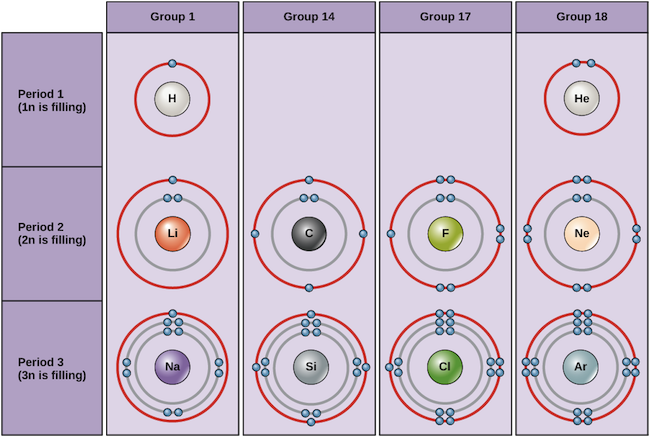
Read one atom by following this routine:
- Use the element symbol or atomic number to identify the atom.
- Count the blue electron dots altogether. For a neutral atom, this equals its atomic number.
- Find the outermost occupied ring.
- Count the dots on that outer ring. Those are its valence electrons.
- All dots on rings closer to the nucleus are inner electrons.
Consider nitrogen, , atomic number . Its shell arrangement is:
Nitrogen has:
- 2 inner electrons in the first shell;
- 5 valence electrons in the second, outermost shell;
- 7 total electrons, matching its atomic number.
Now consider chlorine, , atomic number :
Chlorine has 17 total electrons. Of those, 7 are valence electrons on the third shell, and 10 are inner electrons in the first two shells.
The accounting relationship is always:
For a neutral chlorine atom:
Valence electrons versus inner electrons
The word valence refers to the electrons most involved in an atom’s chemical interactions.
| Type of electron | Location | Main importance |
|---|---|---|
| Valence electrons | The outermost occupied shell | Most involved in bonding and chemical reactions |
| Inner electrons or core electrons | All shells inside the valence shell | Usually stay close to the nucleus and do not directly determine ordinary chemical behavior |
The difference is not merely a naming convention. Electrons in outer shells are farther from the positively charged nucleus, so the attraction holding them is weaker than for inner electrons. This makes outer electrons more available for interactions with other atoms.
Compare these two examples:
-
Sodium:
It has one valence electron and ten inner electrons. -
Chlorine:
It has seven valence electrons and ten inner electrons.
Although both sodium and chlorine have ten inner electrons, they act very differently because their outer shells differ. Sodium’s single outer electron is relatively easy to lose; chlorine’s outer shell is one electron short of a particularly stable arrangement. This is why sodium and chlorine readily react with one another, while the inner electrons largely remain unchanged.
The image also shows a useful pattern without requiring you to memorize every group rule yet:
- Hydrogen, lithium, and sodium each show one outer electron.
- Carbon and silicon each show four outer electrons.
- Fluorine and chlorine each show seven outer electrons.
- Neon and argon show full outer shells of eight electrons.
This is the electron-level reason that vertical groups on the periodic table are chemically meaningful.
Valence Electrons and the Periodic Table
Watch “Valence Electrons and the Periodic Table” by The Organic Chemistry Tutor for two quick worked examples. The diagrams reinforce how to separate total, inner, and valence electron counts.
Watch nitrogen’s shells, identifying its five outer electrons and two inner electrons. Then watch aluminium’s count. In each example, verify that the valence and inner electron counts add to the atomic number.
A full outer shell and chemical stability
Atoms tend to be less reactive when their outer electron arrangement is full. This helps explain the elements in group 18 on the far right of the periodic table.
- Helium has the arrangement . Its first and only shell is full with 2 electrons.
- Neon has . Its outer shell is full with 8 electrons.
- Argon has . Its outer shell is also full with 8 electrons.
These elements are called noble gases. They are generally very unreactive because their valence shells are full.
For introductory chemistry, a useful rule of thumb is that many atoms tend toward an outer shell containing eight electrons. It is called the octet rule. It helps explain many common reactions, though chemistry has exceptions that you will meet only after the essential periodic-table patterns are secure.
Two important cautions:
- A full first shell contains only 2 electrons, which is why helium is stable with two rather than eight.
- “Full outer shell” is a guide to basic chemical behavior, not a complete explanation for every possible compound or reaction.
Periods and shells: the connection to the table
The period number you learned last time corresponds to the outermost occupied shell for the elements you are currently studying.
| Element | Period | Shell arrangement | Outermost occupied shell |
|---|---|---|---|
| Hydrogen, | 1 | First | |
| Helium, | 1 | First | |
| Carbon, | 2 | Second | |
| Neon, | 2 | Second | |
| Sodium, | 3 | Third | |
| Chlorine, | 3 | Third | |
| Argon, | 3 | Third |
So the earlier statement “periods go across” can now be expanded:
An element’s period indicates the number of its outermost occupied electron shell.
For example, chlorine is in period 3 because its valence electrons occupy the third shell. Carbon is in period 2 because its valence electrons occupy the second shell.
This gives the periodic table a deeper meaning. It is not simply a list ordered by atomic number; it is arranged around repeating outer-electron patterns.
A short visual routine for building the idea
When you see a Bohr diagram, use this compact mental script:
Count total. Find outside. Outside is valence; inside is core.
Apply it to these familiar atoms:
| Atom | Electron arrangement | Valence electrons | Inner electrons |
|---|---|---|---|
| 1 | 0 | ||
| 2 | 0 | ||
| 1 | 2 | ||
| 4 | 2 | ||
| 5 | 2 | ||
| 1 | 10 | ||
| 7 | 10 | ||
| 8 | 10 |
A useful five-minute study activity is to redraw three simple shell diagrams: lithium, nitrogen, and chlorine. Put the atomic number in each nucleus, add the electrons by shell, and circle the outermost shell in a different color. Then label the circled dots “valence” and all remaining dots “inner.” This makes the vocabulary visual rather than something to memorize as isolated definitions.
Key takeaways
- Electron shells are energy levels around an atom’s nucleus. In a Bohr diagram, they appear as concentric rings.
- Electrons generally fill lower-energy shells closer to the nucleus before occupying outer shells.
- The valence shell is the outermost occupied shell.
- Valence electrons are the electrons in that outer shell and are the ones most responsible for bonding and chemical behavior.
- Inner electrons, also called core electrons, occupy shells closer to the nucleus.
- For a neutral atom:
- For the first three periods, the period number tells you the outermost occupied shell.
Next, you will return to the layout of the periodic table and identify its four large regions: the s, p, d, and f blocks.
Can't find a good explanation? Sign up and we'll make it for you
Sign up