
Welcome back. In the previous lesson, you learned to read an individual element tile: its name, symbol, atomic number, and relative atomic mass. Now we zoom out from one tile to the map that holds all of them.
By the end of this lesson, you should be able to locate an element using its period and group, such as “carbon is in period 2, group 14.” These two labels work like a table address: one tells you the row, and the other tells you the column.
The periodic table is a map of rows and columns
The periodic table has two kinds of lines:
- A period is a horizontal row, running across the table.
- A group is a vertical column, running down the table.
There are 7 periods and 18 groups in the modern numbering system.
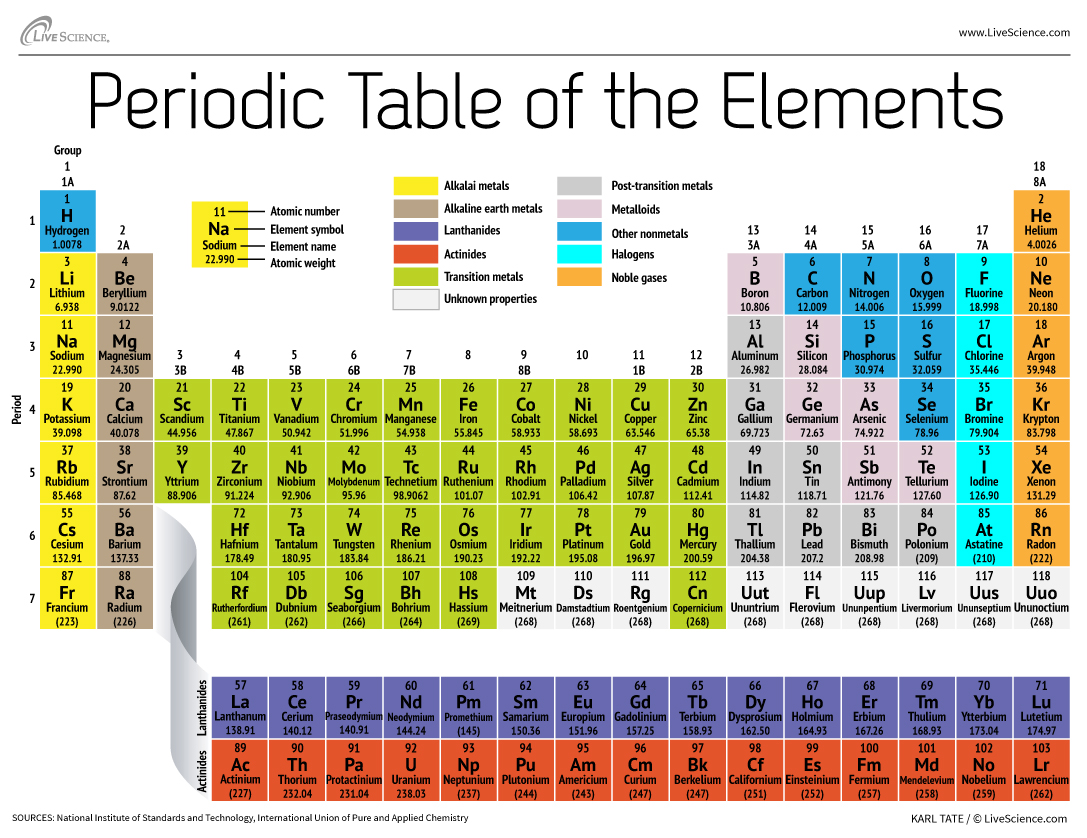
A useful memory phrase is:
Periods go across; groups go down.
To find an element’s location, first trace horizontally to the left to identify its period number. Then trace vertically upward to the top to identify its group number.
For example, find carbon, , on the table:
- Carbon is in the second horizontal row, so it is in period 2.
- Carbon lies under the heading 14, so it is in group 14.
Its position is therefore:
The numbers are not extra facts to memorize separately from the table. They are labels on the table’s coordinate system.
The periodic table | Atoms, elements, and the periodic table | High school chemistry | Khan Academy
Watch The periodic table from Khan Academy Organic Chemistry for a concise visual tour of group and period numbering. It also points out an older group-labeling system that you may see on some printed tables.
Watch group numbering to see how the 18 vertical columns are numbered from left to right. Then watch period numbering for the seven horizontal rows. Focus on the direction of each label rather than trying to memorize element names yet.
How to state an element’s position
An element’s period and group together give a precise location in the main body of the periodic table. Say the period first, then the group:
“This element is in period [row number], group [column number].”
Here are several examples from the provided table.
| Element | Symbol | Atomic number | Period | Group |
|---|---|---|---|---|
| Hydrogen | H | 1 | 1 | 1 |
| Helium | He | 2 | 1 | 18 |
| Magnesium | Mg | 12 | 3 | 2 |
| Carbon | C | 6 | 2 | 14 |
| Copper | Cu | 29 | 4 | 11 |
| Chlorine | Cl | 17 | 3 | 17 |
| Krypton | Kr | 36 | 4 | 18 |
Notice a few important features.
Period numbers run from top to bottom
The top row, containing hydrogen and helium, is period 1. The next row is period 2, then period 3, and so forth until period 7 at the bottom.
Within a period, atomic number increases from left to right. For instance, period 3 begins with sodium, atomic number 11, and ends with argon, atomic number 18. You will memorize that sequence later in the course.
Group numbers run from left to right
Groups are numbered through , beginning with the leftmost column and ending with the far-right column.
- Group 1 is the far-left column: hydrogen, lithium, sodium, potassium, and more.
- Group 2 is the next column.
- Groups 3–12 fill the broad middle section of the longer rows.
- Groups 13–18 are the six columns on the right.
The far-right column, group 18, contains helium, neon, argon, krypton, xenon, and radon.
Some tables—including the supplied image—also show labels such as 1A, 2A, and 8A. Those are from an older convention. For this course, use the modern international system: groups 1–18. Thus chlorine is group 17, even if a table also labels that column 7A.
Elements, atoms, and the periodic table (article) | Khan Academy
Read the short “Elements with similar characteristics are grouped together on the periodic table” section from Khan Academy. It reinforces the row-and-column map and introduces why groups are scientifically useful, not merely labels.
In the section “Elements with similar characteristics are grouped together on the periodic table,” read from the period and group explanation. Read the surrounding two paragraphs as well, beginning with “The periodic table is divided into seven rows and eighteen columns,” and stop before the next heading, “The periodic table separates metals and nonmetals.” Focus on the meanings of horizontal, vertical, period, and group, and on the example of group 18.
Why rows have gaps
At first glance, the periodic table may not look like an ordinary rectangle. The first period has only two elements, and periods 2 and 3 have apparent gaps in their middle. This does not mean those rows have missing group numbers.
For example, period 2 contains:
Boron is the third element encountered when reading across period 2, but it is in group 13, not group 3. The groups between 2 and 13 appear only in the longer periods below.
So, do not find a group by counting how many tiles appear to the left of an element. Instead, trace upward to the numbered label at the top of the column.
This distinction matters for carbon:
- It is the fourth element in period 2.
- Yet it belongs to group 14.
The group number is a column label, not the element’s position within that particular row.
The two detached rows still belong to periods 6 and 7
The two rows displayed beneath the main body are often confusing at first. They are called the lanthanide series and actinide series.
They are shown below the table simply to keep the chart compact enough to read. They are not periods 8 and 9.
- The upper detached row belongs within period 6.
- The lower detached row belongs within period 7.
If those rows were inserted in their full positions, the periodic table would be much wider. For now, the key point is simple: when you see an element in the upper detached row, identify it as being in period 6; an element in the lower detached row is in period 7.
You will learn the names and positions of those elements much later, after you have built confidence with the first few periods.
Why elements in a group resemble one another
Groups are more than vertical filing columns. Elements in the same group often have similar chemical behavior. That repeating pattern is the reason the chart is called the periodic table.
For a first example, consider group 18:
| Group 18 element | Period |
|---|---|
| Helium | 1 |
| Neon | 2 |
| Argon | 3 |
| Krypton | 4 |
These are the noble gases. They are very unreactive compared with most other elements. Although helium and krypton are different elements with different atomic numbers, their shared group position signals an important similarity.
Later, you will learn the electron-based reason: elements in the same main-group column have similar outer-electron patterns. Those outer electrons largely control chemical reactions.
For now, keep the distinction clear:
- Period tells you an element’s horizontal row.
- Group tells you its vertical family or column.
- Elements in the same group often share important properties.
A period also has a deeper meaning related to electron shells, which is the subject of the next lesson.
A practical locating routine
Use this routine whenever you look up an element:
- Find the element’s tile by name, symbol, or atomic number.
- Trace left across the row to identify the period.
- Trace up the column to identify the group.
- Say the complete location aloud: “ is in period , group .”
For a brief memory-building drill, use the supplied table for five minutes:
- Locate oxygen and say: “Oxygen, period 2, group 16.”
- Locate sodium and say: “Sodium, period 3, group 1.”
- Locate calcium and say: “Calcium, period 4, group 2.”
- Locate bromine and say: “Bromine, period 4, group 17.”
- Locate gold and say: “Gold, period 6, group 11.”
Then cover the group and period labels with paper or your hand. Use the table’s layout to recall each location before uncovering the labels. This is a small example of active recall: trying to retrieve an answer before checking it.
Key takeaways
The periodic table is organized as a coordinate map:
- A period is a horizontal row. There are 7 periods.
- A group is a vertical column. There are 18 groups.
- State an element’s location as period first, group second.
- The period-group pair identifies an element’s position in the main table, such as carbon in period 2, group 14.
- Atomic number rises from left to right across a period.
- Elements in the same group often have similar properties.
- The two detached rows belong to periods 6 and 7, not new periods.
Next, you will connect the table’s rows to the structure of atoms by learning about electron shells, inner electrons, and valence electrons.
Can't find a good explanation? Sign up and we'll make it for you
Sign up