
Hello again. In the previous lesson, you learned that a period is a horizontal row and that its number tells you the outermost occupied electron shell. You also distinguished the outer valence electrons from inner electrons.
Now we add a second map feature: the periodic table is divided into four large regions called the s, p, d, and f blocks. You do not need to write complicated electron configurations yet. Your goal is to look at any normal periodic table and quickly point to each block.
Why are there “blocks”?
Electrons occupy shells, but each shell has smaller sections called subshells. The subshell types are named s, p, d, and f.
The periodic table’s shape is not random. Its four differently sized regions reflect those four subshell types:
| Block | Width | What to notice |
|---|---|---|
| s block | 2 columns | The narrow region on the left |
| p block | 6 columns | The region on the right |
| d block | 10 columns | The broad central region |
| f block | 14 columns | The two detached rows at the bottom |
The letters are lowercase: s, p, d, f. For this lesson, treat them as labels for four regions of the table. Later, you will use the blocks to make sense of electron arrangements and recurring chemical patterns.
Watch this short segment from Khan Academy’s Electron Configurations with the Periodic Table. It connects the periods and groups you already know with the four blocks.
Electron configurations with the periodic table | Chemistry | Khan Academy
In “Electron Configurations with the Periodic Table” from Khan Academy, the instructor identifies all four blocks directly on a periodic table and gives their group ranges.
Watch the block overview. Focus first on the locations: left, right, middle, and bottom. The electron explanation is useful context, but do not worry about memorizing electron configurations yet.
See the four regions as one shape
Use the colored table below as your main visual reference. Each color is one block.
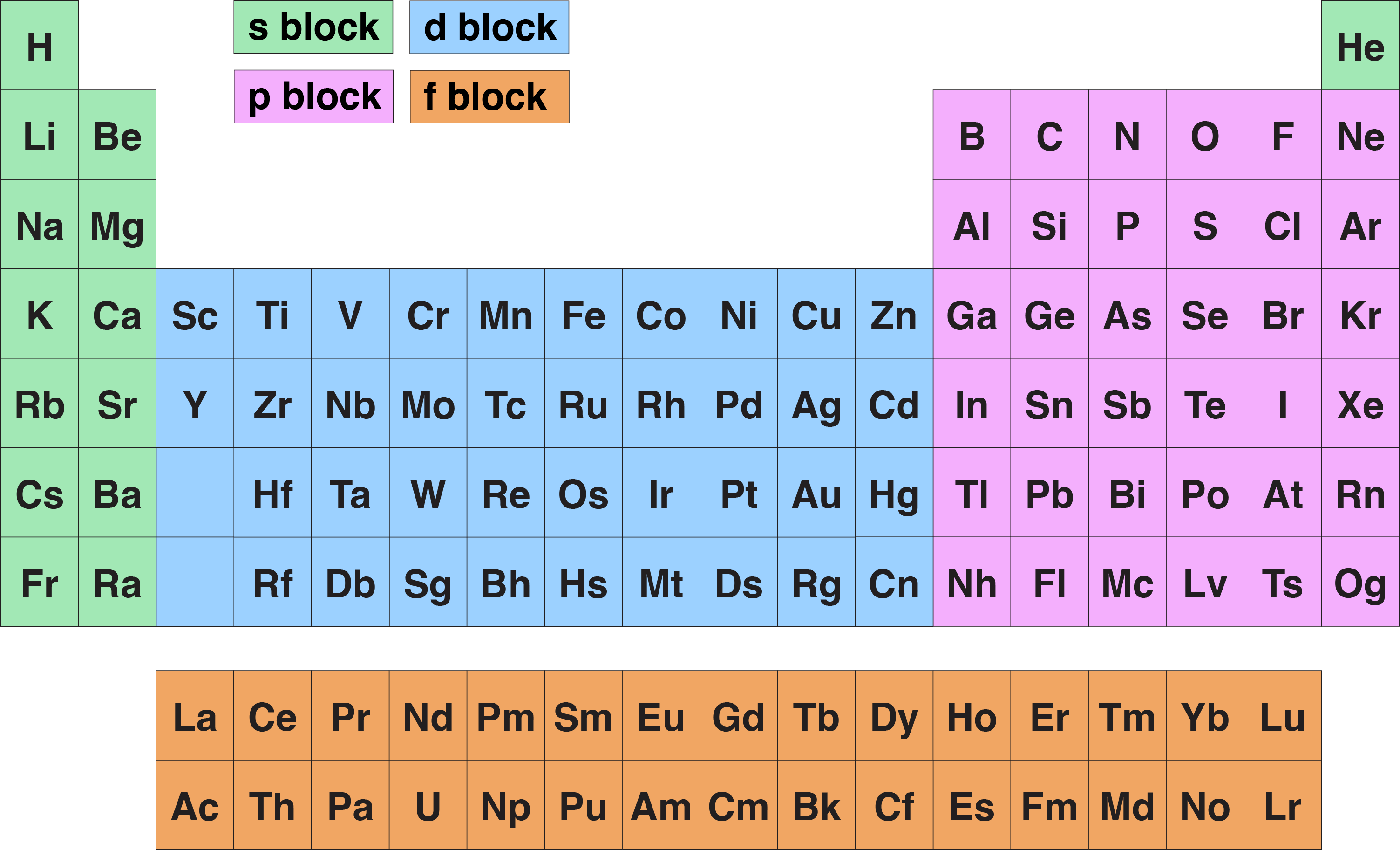
A reliable way to orient yourself is to read the table in four visual pieces:
- The left edge is the s block.
- The right edge is the p block.
- The middle bridge is the d block.
- The two rows below are the f block.
Notice that the table has a large gap between the left and right sides in periods 2 and 3. That is because the d block does not begin until period 4. The f block does not begin until periods 6 and 7.
The image’s colors are only a learning aid. Other periodic tables may use different colors, or no colors at all, so learn the position and width of each region rather than depending on color.
The s block: the two left-hand columns
The s block occupies the first two columns on the far left of the table:
- Group 1 is the first s-block column.
- Group 2 is the second s-block column.
Examples include:
- Hydrogen, , at the top left
- Lithium,
- Sodium,
- Beryllium,
- Magnesium,
A useful memory cue is:
s = start of the table.
That is not what the letter s scientifically means, but it is a helpful location mnemonic: the s block starts the row.
The helium exception
Helium, , is an important exception in its placement. It appears at the top right with the noble gases because its chemical behavior resembles theirs. However, its electron arrangement ends in an s subshell, so helium belongs to the s block in electron-configuration terms.
So remember both facts:
- Location on the printed table: top right.
- Block identity: s block.
This exception is worth learning now so it does not surprise you later.
The p block: the six right-hand columns
The p block is the six-column region on the far right. It covers groups 13 through 18, except that helium is not a p-block element despite being placed above group 18.
For the first three periods, you have already met several p-block elements:
| Element | Symbol | Position within p block |
|---|---|---|
| Boron | First p-block column | |
| Carbon | Second p-block column | |
| Nitrogen | Third p-block column | |
| Oxygen | Fourth p-block column | |
| Fluorine | Fifth p-block column | |
| Neon | Sixth p-block column | |
| Aluminium | First p-block column of period 3 | |
| Chlorine | Fifth p-block column of period 3 | |
| Argon | Sixth p-block column of period 3 |
The p block is easy to recognize because it forms the table’s right-hand rectangle, beginning with boron in period 2. The top-right position is occupied by helium, but the rest of the p block begins one row lower.
A memory cue:
p = the piece on the right.
Again, this is only a location mnemonic, not the scientific origin of the letter.
The d block: the ten-column middle
The d block is the wide, ten-column region in the center of the periodic table. It spans groups 3 through 12.
It first appears in period 4, beginning with scandium, , and ending with zinc, . In the colored image, it is the blue band between the green s block and purple p block.
Many d-block elements are called transition metals. You will study their properties later; for now, connect the label to its location:
The d block is the central region that transitions from the left-side s block to the right-side p block.
Examples from the first d-block row include:
- Scandium,
- Titanium,
- Iron,
- Copper,
- Zinc,
The d block has ten columns, which helps distinguish it from every other block. It is wider than the s and p blocks, but narrower than the f block.
The f block: the two detached bottom rows
The f block is displayed as the two long rows below the main body of the table. Each row contains 14 positions.
- The upper detached row is associated with period 6 and is called the lanthanide series.
- The lower detached row is associated with period 7 and is called the actinide series.
For example:
- Cerium, , is in the upper f-block row.
- Uranium, , is in the lower f-block row.
These rows are not truly separate from the rest of the table. They are placed underneath to keep the table compact enough to fit on a page. In a full-width version, they fit into periods 6 and 7 between the left-hand s block and central d block.
A useful memory cue:
f = the floor of the table.
The f block sits “on the floor,” below the main table.
Read the short LibreTexts explanation to reinforce why the regions have widths of 2, 6, 10, and 14.
6.8: Blocks of the Periodic Table - Chemistry LibreTexts
In “Blocks of the Periodic Table” from Chemistry LibreTexts, read the explanation of why the table can be divided into s, p, d, and f regions. It gives a little more electron-level reasoning behind the shapes you have just learned.
In the section “Periods and Blocks,” begin at the block definition. Then read the following paragraph beginning “The figure also illustrates” through its explanation of d and f subshell timing. Focus on the key visual idea: s is left, p is right, d is central, and f is below. The details about which numbered subshell fills in later periods are preview material; understand the general point without trying to memorize it yet.
A quick identification routine
When you are handed an unfamiliar periodic table, use this routine:
| If you see... | You have found... |
|---|---|
| The first two columns at the far left | s block |
| Six columns at the far right | p block |
| Ten columns in the middle, beginning in period 4 | d block |
| Two detached 14-element rows beneath the table | f block |
Then make one correction:
- If you are classifying blocks by electron configuration, helium is s block, even though it is drawn at the top right.
You can also identify an element’s block just by locating its square:
| Element | Where it sits | Block |
|---|---|---|
| Magnesium, | Left, second column | s block |
| Oxygen, | Right-hand region | p block |
| Iron, | Central region | d block |
| Neodymium, | Upper detached row | f block |
| Uranium, | Lower detached row | f block |
| Helium, | Top right, but exceptional | s block |
For a short memory practice, cover the block labels on the colored image. Point to each region and say: “s: left two; p: right six; d: middle ten; f: bottom fourteen.” Then uncover the labels and check yourself. Repeating that visual recall on a few separate days will make the layout much more durable than rereading it once.
Key takeaways
- The periodic table has four electron-configuration regions: s, p, d, and f blocks.
- The s block is the two-column region on the left.
- The p block is the six-column region on the right.
- The d block is the ten-column region in the middle, beginning in period 4.
- The f block is the pair of detached 14-element rows at the bottom.
- Helium is placed with the noble gases at the top right, but it is an s-block element.
- A compact recall phrase is: left two, right six, middle ten, bottom fourteen.
Next, you will return to memorization practice and extend your element knowledge beyond the first 18 elements, using the table’s structure as a guide rather than treating it as a random list.
Can't find a good explanation? Sign up and we'll make it for you
Sign up