Recommended resources
The freely available resources this lesson will direct you to.
- How to Create Content Pillars for Your Social Media Strategywww.youtube.com
- TURNING 1 PIECE OF CONTENT INTO 10 | My content strategy for juggling multiple platformswww.youtube.com
- Content Pillars for Social Media: A Complete Breakdown of 8 ...thedreamsagency.com
- How To Create Content Pillars For Social Media (+ A Free ...buffer.com
Introduction
Welcome back! In our last lesson, you built a fantastic seasonal content bank filled with timely ideas perfectly suited for your "cheap and cheerful lifestyle" niche. This puts you way ahead in the planning game.
But how do you get the most mileage out of a really good, juicy idea like "Back-to-School Shopping Hacks"? Creating one great post is good, but creating ten from the same core idea is what separates busy creators from strategic ones.
Today, we're diving into that strategy. This lesson focuses on how to identify a 'pillar' content idea and outline its core points for repurposing. You'll learn what "pillar content" is and why it's the secret to working smarter, not harder. By the end of this lesson, you'll have selected one of your big ideas and created a detailed blueprint that will serve as the foundation for a whole batch of content across your different platforms.
Step 1: Understanding Pillar Content
The "Pillar Content" strategy is a game-changer. The concept is simple: you create one large, in-depth, high-value piece of content (the "pillar") and then strategically break it down into many smaller pieces ("micro-content") to share across your social media channels.
This flowchart gives you a perfect visual of the process. You start with one big idea and end up with many different social media posts.
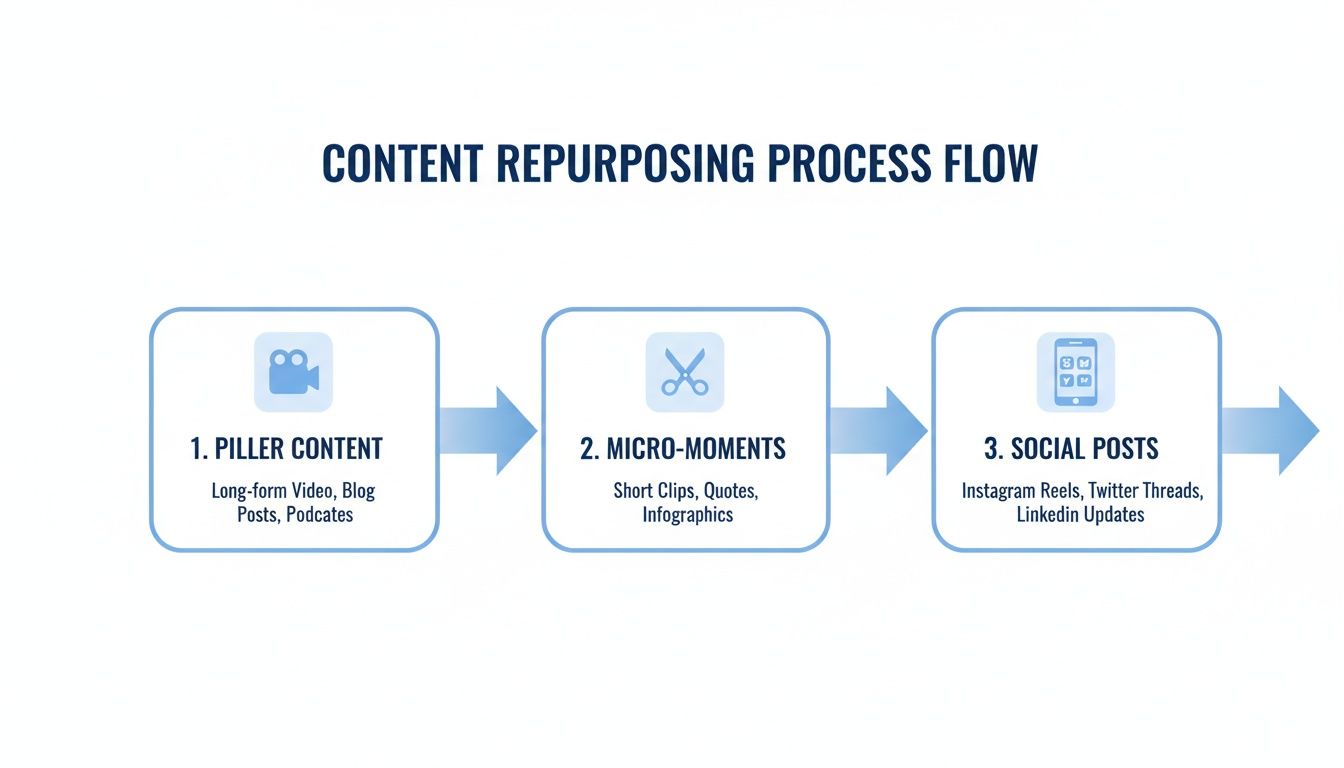
To see how this works in practice, let's watch a video from a creator who uses this exact strategy.
TURNING 1 PIECE OF CONTENT INTO 10 | My content strategy for juggling multiple platforms
Creator Modern Millie does an excellent job of explaining this concept, which she calls 'macro' content. Watch this first short clip to understand what counts as a big 'pillar' or 'macro' piece of content.
Watch from 00:51 to 01:24. Listen for the examples she gives of 'macro' content, like YouTube videos, podcasts, and blog posts. This is your 'pillar' content.
As Millie explained, your pillar is your most substantial piece of work on a topic. For your niche, this could be:
- A 10-minute YouTube video on "My Ultimate Guide to Saving Money on Groceries."
- A detailed blog post on "How We Paid Off $10,000 of Debt in One Year."
- A "how-to" guide on "Starting a Vegetable Garden on a Tiny Budget."
From that one piece, you can extract dozens of smaller posts.
Step 2: Pillar Content vs. Content Pillars
You might hear two similar terms: Pillar Content and Content Pillars. It's important to know the difference so you can build your strategy correctly.
-
Content Pillars (or Themes): These are the 3-5 broad topics or categories that your entire brand is about. For you, these might be "Frugal Recipes," "Budget Home & DIY," and "Personal Finance Tips." They are the main subjects you want to be known for.
-
Pillar Content: This is a single, substantial piece of content that falls under one of your Content Pillars. Today, we are focusing on creating a plan for one piece of Pillar Content.
Let's read a quick article that defines these themes and explains why they're important for building a brand.
How To Create Content Pillars For Social Media
This article from Buffer clearly defines what content pillars are and why they are important for your overall strategy.
Read the first two sections: 'What is a content pillar?' and 'Why are content pillars important for social media?'. Focus on how these pillars help you control 'what you're known for.'
By consistently creating content within your chosen pillars (e.g., Frugal Recipes, Budget Home), you build authority and make it easy for your audience to understand what you're all about. Our task today is to choose a big idea within one of those pillars and flesh it out.
Step 3: Action Step - Choose Your Pillar Idea
It's time for you to choose your first pillar content topic.
Look back at the Seasonal Content Bank you created in the last lesson. These are perfect candidates for pillar content because they are timely and address specific, high-interest problems.
Your task:
- Review the 12 ideas you brainstormed.
- Select one idea that feels "big" enough to be a pillar.
A good choice for a pillar idea has:
- Depth: You can break it down into at least 3-5 distinct tips, steps, or sub-topics.
- High Value: It solves a major pain point for your audience (e.g., saving money during an expensive season).
- Your Interest: You're genuinely excited to talk about it in detail.
For example, an idea like "How to have a budget-friendly Christmas" is an excellent pillar topic. You can break it down into tips on gifts, decorations, food, and travel. An idea like "Cheap stocking stuffer idea" is more of a micro-post.
Take 5 minutes now to review your list and choose your first pillar content idea. Write it down.
Step 4: Action Step - Outline Your Core Points
You've chosen your big idea. Now, let's create the blueprint. An outline breaks your topic into logical points. This structure will not only guide your long-form content (like a YouTube video) but will also give you the exact "micro-moments" to repurpose for other platforms.
Let's use a simple and effective structure for your outline:
- Hook: How will you grab your audience's attention in the first 3 seconds? (e.g., “Want to have an amazing Christmas without starting the new year in debt? Here’s how.”)
- Introduction: Briefly state the problem you're solving and what they will learn from your content.
- Core Point 1: Your first main tip, step, or sub-topic.
- Core Point 2: Your second main tip, step, or sub-topic.
- Core Point 3: Your third main tip, step, or sub-topic.
- (Continue with as many core points as you need, typically 3-5 is a great start).
- Conclusion / Call to Action (CTA): Briefly summarize the value and tell your audience what to do next (e.g., subscribe, comment with their own tip, save the post).
Let's see this in action. Imagine your chosen pillar idea is "A Guide to Back-to-School Savings."
Your outline might look like this:
- Hook: "Stop overspending on back-to-school season! I’m sharing my top 5 secrets to cut your costs in half."
- Intro: "Back-to-school is the second biggest shopping season of the year, but it doesn't have to break the bank. In this guide, I'll walk you through five key areas where you can save big."
- Core Point 1: School Supplies: My "buy this, not that" list from the dollar store.
- Core Point 2: Clothing & Uniforms: How to use second-hand apps and consignment stores to find like-new outfits.
- Core Point 3: Lunchboxes: My formula for cheap and healthy lunches they'll actually eat.
- Core Point 4: Electronics: When and where to find the best deals on laptops and calculators.
- Core Point 5: The "After-School" Stock Up: What to buy after school starts when items go on clearance.
- Conclusion/CTA: "With these five strategies, you can easily save hundreds. Which tip was your favorite? Let me know in the comments below, and don't forget to follow for more 'cheap and cheerful' tips!"
Your Turn:
Take the next 20 minutes to create an outline for the pillar idea you selected in Step 3. Use the structure above. Don't worry about writing full paragraphs; just use bullet points to capture the key ideas for each section.
Conclusion
Excellent work! You have now created the strategic blueprint for a huge amount of future content. By identifying a pillar topic and outlining its core points, you've done the hardest part of the creative process. You're no longer just thinking post-by-post; you're building a content engine.
Key Takeaways:
- Pillar Content is a single, substantial piece of content (like a long video or guide) that can be broken down into many smaller posts.
- This "work smarter, not harder" strategy ensures you have consistent, high-value content for all your platforms without reinventing the wheel every day.
- A simple outline with a Hook, Intro, Core Points, and CTA is the perfect structure to plan your pillar content and identify ideas for repurposing.
Preview of the Next Lesson:
The real magic happens next. In our upcoming lessons, we will take the outline you just created and start repurposing it. You'll learn how to transform your core points into a fast-paced short-form TikTok/Reel video and a visually engaging Instagram carousel post. You'll see your single idea come to life in multiple ways.