
Introduction
In our last lesson, we confronted the difficult history of the Spanish colonial project and its systematic campaign to suppress indigenous belief systems through the "Extirpation of Idolatry." We saw how this process led to the loss, demonization, and reinterpretation of a vast body of oral tradition, leaving us with sources that are often filtered through a hostile colonial lens.
However, destruction and suppression are not the complete story. Indigenous cultures demonstrated remarkable resilience. This lesson addresses the learning outcome: Identify examples of syncretism between indigenous myths and Catholic beliefs. We will explore how, instead of disappearing, many indigenous traditions blended with Catholicism, creating new, hybrid forms of belief, art, and ritual.
For you as a designer and storyteller, this concept is crucial. Syncretism is a form of cultural negotiation—a way of embedding old meanings within new forms, often as a subtle act of resistance and survival. The myths you wish to illustrate are not just ancient tales; they are living traditions that have been shaped by this very process of blending and adaptation.
1. What is Religious Syncretism?
Syncretism is the merging of different, often contradictory, beliefs and practices. In colonial Latin America, it was the process through which indigenous peoples integrated elements of their ancestral religions with the Catholicism forced upon them. This wasn't a simple replacement of one faith with another, but a complex fusion that allowed old ways of understanding the world to persist under a new religious framework.
This process often happened in plain sight, through powerful symbolic acts. To see a striking and quite literal example of this, let's start with a short video about the construction of a church on the ruins of an Aztec temple in Mexico City.
Aztec Resistance Was Built Into a Catholic Church | Native America | PBS
This clip from the PBS series 'Native America' shows how Aztec builders embedded their own sacred symbols into the very foundation of a Catholic church, a profound act of resistance and cultural preservation.
Watch the segment from 01:36 to 02:06. Pay close attention to historian Davíd Carrasco's explanation of why the builders placed a stone with the face of an Aztec god into the church's foundation.
As the video explains, this was a way of saying, "We may be becoming Christians, but we are Christians of another sort, and we still believe in and worship Old Gods." This act perfectly encapsulates the spirit of syncretism: the simultaneous adoption of the new and preservation of the old.
2. Forms of Syncretism: Case Studies from Mexico
Syncretism manifested in countless ways, from the materials used to create religious art to the reinterpretation of major holidays and divine figures. The following video provides an excellent visual survey of examples from colonial Mexico, which parallel developments throughout Latin America.
Colonial Mexican History: Syncretic Religion & the Survival of Aztec Art & Religion in New Spain
The video 'Colonial Mexican History: Syncretic Religion' offers a rich tour of how indigenous beliefs and aesthetics were woven into Christian art and practice. We'll look at a few key examples.
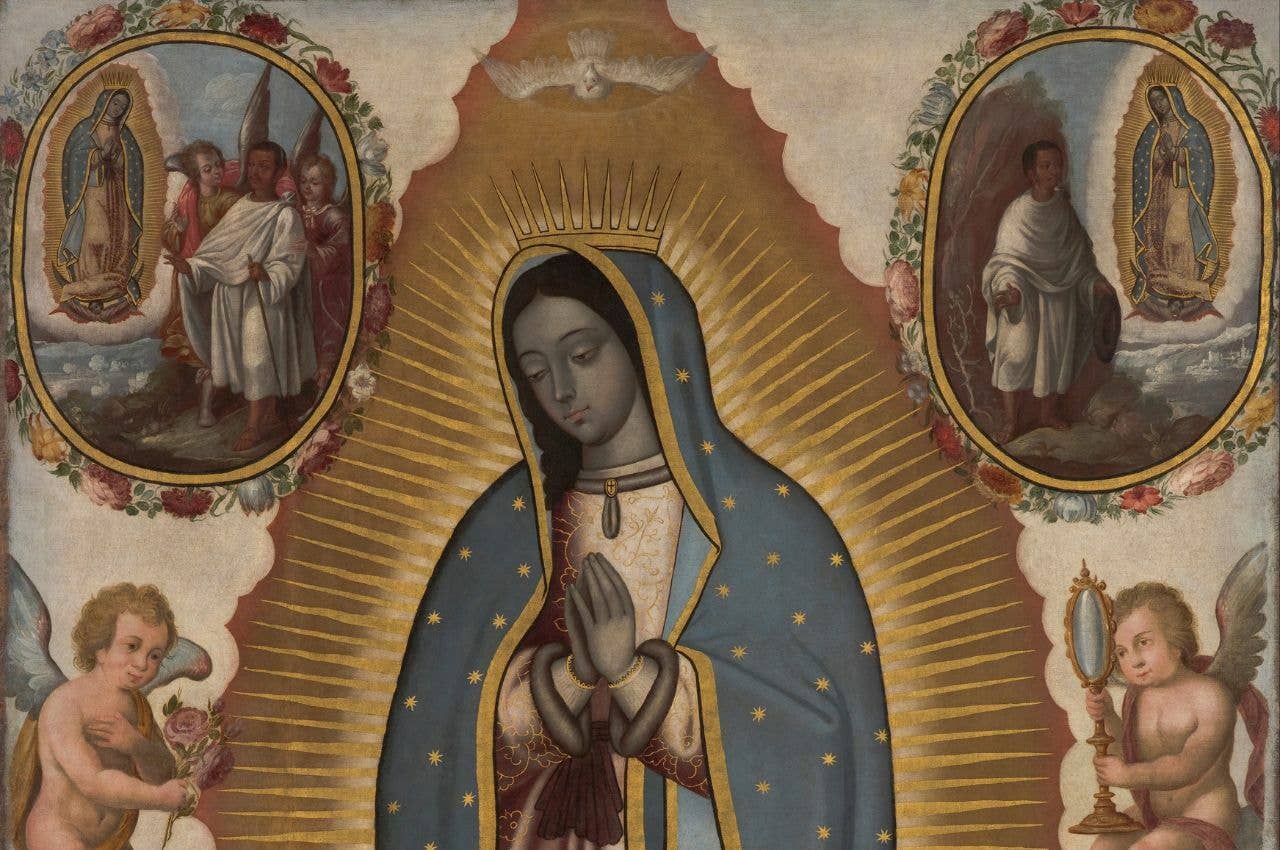
Please watch the following segments, focusing on the how and why of each syncretic example: Materials as Meaning (04:16 - 08:20): This section discusses the use of sacred indigenous materials, like feathers, to create Christian art. Notice how the medium itself carries a pre-Hispanic religious meaning, creating a work with a 'double meaning.' Ritual and Remembrance (18:56 - 21:43): This part explains the syncretic origins of the Day of the Dead (Día de los Muertos). Observe how a pre-Columbian festival for the dead was merged with the Catholic All Souls' Day, retaining many of its core indigenous elements like altars, marigolds, and specific foods. The Syncretic Mother (22:25 - 24:24): This final segment introduces the most famous example of syncretism in the Americas: the Virgin of Guadalupe. Pay attention to all the elements that connect her to indigenous identity: her brown skin, her appearance at a sacred Aztec site, her Nawatl language, and the possible indigenous origin of her name.
These examples reveal a spectrum of syncretic strategies:
- Appropriating Materials: Using sacred materials like feathers or corn paste to create Christian figures infused those figures with indigenous spiritual power.
- Merging Rituals: The Day of the Dead shows how an entire ceremonial complex could be preserved by aligning it with the Catholic calendar.
- Fusing Identities: The Virgin of Guadalupe is the ultimate example of a fused identity, a figure who is simultaneously the Christian Mother of God and an indigenous mother figure,
La Morenita, who speaks to and represents the native people.
Test your understanding!
From your perspective as a product designer, think about the "user experience" of religion. Why would a figure like the Virgin of Guadalupe be more successful in gaining followers among the indigenous population than a traditional, pale-skinned European Madonna?
Show answer
A figure like the Virgin of Guadalupe offers a much more inclusive and relatable "user experience" for the indigenous population. She looks like them (brown skin), speaks their language (Nawatl), and appears at a place already sacred to them. This creates an immediate sense of identification and ownership. A European Madonna, by contrast, represents the foreign, conquering culture. Guadalupe allowed people to adopt the new faith without entirely abandoning their identity; they could see themselves reflected in the divine. It was a localization of a global "product" (Catholicism) to achieve product-market fit in a new cultural context.
3. Visual Syncretism in Andean Art
Further south, in the Andes, syncretism also produced an extraordinary artistic tradition, particularly in the "Cusco School" of painting. Here, indigenous artists trained in European techniques blended Catholic subjects with Andean cosmology.
Let's explore some key examples by reading a scholarly analysis. This will be highly relevant to your interest in visual storytelling, as it decodes the hidden symbols in these paintings.
Artistic Syncretism in Latin America: From Olmec to Spanish ...
The paper 'Artistic Syncretism in Latin America' provides detailed analysis of how Andean artists embedded their beliefs into Christian iconography. It's a great resource for understanding how to 'read' these complex images.
Please read the following sections, which are filled with visual analysis: Mary as the Mountain (Pages 30-34): Start at the paragraph 'The majority of the syncretic artwork...' and read to '...quite a different way.' This section explains how artists depicted the Virgin Mary with a triangular, mountain-shaped dress, visually equating her with Pachamama (Mother Earth), the most sacred Andean deity. The Virgin of Potosí (Page 37): Read the three paragraphs on this page, analyzing the 'Virgin of Potosí' painting. This is perhaps the most direct example, where Mary isn't just shaped like a mountain—she is the sacred silver mountain of Potosí, with Inca symbols of the sun and moon above her. The Andean Last Supper (Pages 38-39): Read the section discussing Marcos Zapata's painting of 'The Last Supper.' Focus on how he 'localizes' this universal Christian scene by replacing the traditional lamb with a roasted guinea pig (cuy), a ceremonial Andean food, and including other local produce.
These Andean examples show syncretism as a sophisticated visual language:
- The Virgin Mary becomes a stand-in for both Pachamama (Mother Earth, represented by the mountain shape) and Mama Quilla (the Inca Moon Goddess, referenced by the crescent moon at her feet).
- Even the traitor Judas in Zapata's Last Supper is given a syncretic role; some scholars argue his face resembles that of the conquistador Francisco Pizarro, turning a biblical betrayal into a political commentary on the conquest of the Inca Empire.
4. A Colombian Example: The Doctrine Temples of Tierradentro
While many famous examples come from Mexico and Peru, this process of cultural blending was central to the colonial experience in Colombia as well. A fantastic example can be found in the architecture of the Catholic doctrine temples built in the 18th century in the Tierradentro region of Cauca.
This UNESCO World Heritage application for the 'Catholic Doctrine Temples' explicitly describes them as products of syncretism. It shows how indigenous communities participated in building these churches, infusing them with their own knowledge and symbols.
Please read the following key statements within the text: In the 'Description' section, find the paragraph starting with 'The material representation of such evangelization process...'. It clearly states the temples are a product of 'transculturation' where the Spanish provided the layout and the indigenous peoples provided the materials, construction system, and labor. In the 'Justification' section, under 'Criterion (ii)', note the sentence calling the temples a 'unique example of the religious syncretism... as a result of the combination of traditional techniques and knowledge with Spanish building styles.' In the 'Statements of authenticity' section, find the paragraph starting with 'The temples are an invaluable historical document...'. It reveals a stunning detail: the belfry of the Santa Rosa de Lima temple ends in an effigy of a female indigenous chief, Angelina Gullumus, who promoted the construction.
The temples of Tierradentro are a powerful, tangible example of syncretism on Colombian soil. The fusion isn't just symbolic; it's structural. The Spanish floor plan is executed with indigenous rammed-earth techniques. And in a remarkable reversal of the usual power dynamic, a Catholic church is crowned not with a cross or a saint, but with the likeness of a local indigenous leader.
Conclusion
Today, we've seen that the collision between indigenous and Catholic worlds did not result in a simple victory for one over the other. Instead, it sparked a complex and creative process of fusion known as syncretism. This was a strategy for cultural survival, a form of hidden resistance, and the birth of a new, uniquely Latin American spiritual identity.
Key Takeaways:
- Syncretism is the blending of different religious beliefs and practices. In colonial Latin America, it was a way for indigenous traditions to survive under the veil of Catholicism.
- Examples in Art & Materials: Indigenous artists used sacred materials like feathers and embedded their cosmological symbols into Christian art, creating works with a "double meaning," such as equating the Virgin Mary with Pachamama in Andean paintings.
- Examples in Ritual: Major festivals like the Day of the Dead merged pre-Hispanic traditions of ancestor worship with the Catholic calendar.
- Examples in Deities & Figures: Powerful new figures emerged, like the Virgin of Guadalupe, who embodied both Catholic and indigenous identities and became a potent symbol for the new mixed-race populations.
- Examples in Architecture: Even the construction of churches, like the temples of Tierradentro in Colombia, became a syncretic act, combining Spanish designs with indigenous techniques and symbols.
Understanding this layer of meaning is essential for your project. The myths were not frozen in time; they were part of a dynamic process of adaptation. The images and stories that have come down to us are often rich with this hidden history of blending and resilience.
Preview of the Next Lesson:
These syncretic traditions are not just historical artifacts. Many are alive today. In our next lesson, we will shift from the colonial past to the present, exploring the current status of the indigenous communities who are the living keepers of these mythological traditions and the modern efforts to preserve and revitalize their ancestral knowledge.
Can't find a good explanation? Sign up and we'll make it for you
Sign up