
Introduction
Hello again. In our last lesson, we explored how the distinct environments of Colombia—the mountains, deserts, and rainforests—acted as a blueprint for the unique mythological themes of the Muisca, Wayuu, and Embera peoples. We saw how these worldviews were deeply interwoven with the land, developed over centuries of intimate connection.
Today, we confront a moment of profound disruption. This lesson addresses the learning outcome: Describe the impact of Spanish colonial policies of religious suppression on indigenous oral traditions. We will investigate the arrival of a colonial power that viewed these intricate belief systems not with curiosity, but as a threat to be eradicated.
From your perspective in design and storytelling, you can think of this as the forceful imposition of a new, non-negotiable "operating system" onto entire cultures. The Spanish didn't just seek to control land and resources; they sought to control the very way people thought and believed, a process some scholars call "colonizing the imaginary." Understanding this process is crucial for you as an artist, as it reveals the layers of conflict, alteration, and loss that are embedded in the myths you seek to illustrate.
1. The Ideology of Suppression: "Idolatry" vs. "Heresy"
To understand the Spanish colonial project, we must first understand its ideological and religious motivations. The Spanish conquest was inseparable from the Catholic Church's mission to convert the world's population. This created a clear binary: the "true" faith of Christianity versus everything else.
The core of this policy rested on a specific legal and theological distinction. To see how this worked, we'll examine a text that, while focused on Peru, describes the exact institutional and ideological framework applied across the Spanish Americas, including Colombia.
The Extirpation of Idolatry in Colonial Peru and Indigenous ...
This paper, 'Language, Discipline, and Power,' by Priya Shah, clearly explains the legal and religious logic behind the suppression of indigenous beliefs. It introduces the key concepts and institutions that were established to enforce religious conformity.
Please read the following sections to grasp the colonial mindset: Introduction (Page 101): Read the first full paragraph, starting with 'The Spanish conquest...' and ending with '...linguistic varieties.' This introduces the goal of religious hegemony and the institutions created to enforce it: the Inquisition and the Extirpation of Idolatry. Categorizing the Indigenous (Pages 102-103): Start at the paragraph 'The indigenous were initially deemed pagans...' and read to the end of the page. This is a critical section. Focus on why indigenous people were not tried by the Inquisition and were instead placed in a separate legal category as 'new Christians' or 'wards of the state.' Justifying Suppression (Page 107): Read the paragraph beginning 'This true versus false dichotomy...'. This short paragraph powerfully summarizes the worldview that justified the entire project, framing everything non-Christian as 'false' and in need of replacement by the Spanish 'truth.'
As the reading highlights, the Spanish established a powerful hierarchy:
- Heretics were baptized Christians who chose to defy the Church. They fell under the jurisdiction of the feared Holy Office of the Inquisition.
- Indigenous Peoples were initially considered pagans—people who had never known Christianity. Upon baptism, they were seen as perpetual "new Christians," viewed as childlike, inferior, and incapable of true reason (
gente sin razón).
Because of this classification, they were removed from the Inquisition's authority. Instead, a special institution was created just for them: the Extirpation of Idolatry. Its stated goal was to systematically uproot and destroy all vestiges of their ancestral beliefs, which were collectively labeled as "idolatry."
2. The Methods of Extirpation: Destroying a Worldview
The "Extirpation of Idolatry" was not a passive policy; it was an active and systematic campaign. These campaigns, or visitas de idolatría (visits of idolatry), involved sending ecclesiastical officials into indigenous communities to locate and destroy any evidence of native religion.
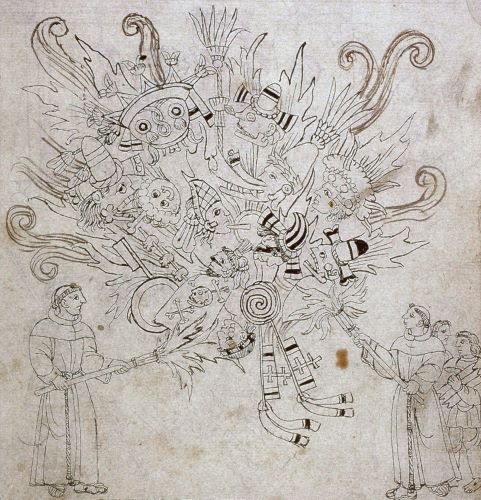
The methods were both physical and psychological:
- Destruction of Sacred Objects and Places: Officials would search for
huacas(sacred objects or places), ancestral mummies (malquis), and ceremonial items. These would be publicly burned or destroyed. Churches were often deliberately built on the ruins of major indigenous shrines to physically and symbolically replace the old faith. - Public Humiliation and Punishment: Indigenous priests, shamans, and leaders who continued to practice their traditions were targeted. They were often publicly shamed, flogged, or exiled to break the chain of spiritual knowledge.
- Forced Confession: An
edicto de gracia(edict of grace) would be announced, giving community members a short period to "confess" their idolatries and inform on their neighbors. This sowed mistrust and broke community cohesion. - Imposition of Christian Culture: Indigenous people were forbidden from using names associated with their gods or ancestors and were forced to adopt Spanish or saint's names. Rituals, from birth to death, were replaced with Christian sacraments.

3. The Impact on Oral Tradition: The Case of the Muisca
The most devastating and permanent impact of this suppression was on the oral traditions themselves. For cultures like the Muisca, who had no writing system, knowledge was held in the memories of priests (jeques), elders, and leaders, and transmitted through ceremony and storytelling.
When these individuals were killed, punished, or forced into hiding, entire libraries of knowledge vanished. The chain of transmission was broken. What we have left today is therefore incomplete and heavily filtered.
The 'Muisca mythology' article we are using provides an excellent analysis of how our knowledge of their myths is a direct product of the colonial encounter. It explains why the primary sources must be read with a critical eye.
Please read these sections to understand how the oral traditions were recorded and altered: Primary Sources and Transmission: Read the first paragraph. It clearly states that Muisca traditions were exclusively oral and that our surviving accounts come from Spanish chroniclers writing after the conquest. Note the mention of 'coercive or interpretive conditions.' Reliability of Spanish Chroniclers: Read this entire section. It is a crucial summary of the biases present in the sources. Focus on the key problems: reliance on hearsay, framing native figures in biblical terms (e.g., Bochica as an apostle), and demonizing non-Christian beliefs. Pre-Columbian vs. Syncretic Elements: Read the paragraph starting with 'In contrast, syncretic influences appear in moralizing narratives...'. This gives concrete examples of how Muisca myths were likely altered to parallel Christian stories, such as the great flood or the depiction of Bochica as a Christ-like civilizer.
The Spanish chroniclers who wrote down the myths were not neutral ethnographers. They were soldiers, priests, and officials with a specific agenda. As a result, the oral traditions were impacted in three main ways:
- Loss: Countless stories were never recorded and are lost forever.
- Demonization: Indigenous deities were often re-cast as demons or manifestations of the devil to justify their eradication. For example, a powerful earth spirit like Chibchacum could be framed as a malevolent figure who caused floods out of spite.
- Syncretism and Reinterpretation: To make sense of the myths (or to make them more palatable for a Christian audience), chroniclers often mapped them onto familiar European narratives.
- The Muisca civilizing hero, Bochica, was described as a bearded, white-robed elder, bearing a striking resemblance to an apostle or even Christ.
- A Muisca flood myth was interpreted through the lens of the biblical Deluge, with Bochica playing a role similar to Moses parting the sea by striking a rock to drain the Bogotá savanna.
This means that when we read these myths today, we are often looking at a reflection in a distorted mirror. It is a fundamental challenge for anyone trying to connect with the authentic pre-Columbian worldview.
Test your understanding!
Imagine you are a 16th-century Franciscan friar interviewing a Muisca elder about the creation myth of Bachué, who emerged from Lake Iguaque with a child to populate the earth. Your goal is to record this story for your superiors in Spain, but also to frame it in a way that supports your mission of conversion.
What specific details might you change or emphasize in your written account? How might you portray Bachué?
Show answer
Here are some likely changes a chronicler might make:
- Reframing Bachué: Instead of a primal creator goddess, you might portray her as a more human-like figure, perhaps a "princess" or "prophetess." You might describe her as a "sinner" who emerged from the "waters of ignorance" before the light of Christianity arrived.
- Minimizing Female Power: The original myth centers on a powerful female creator. To align with European patriarchal norms, you might downplay her role and emphasize the male child she is with, or invent a male sky-god who allowed her to emerge.
- Adding a Moralizing Tone: The original myth is a simple story of origin. You could add a moral, suggesting that after populating the earth, humanity fell into sin and idolarty, thus necessitating the arrival of the Spanish to bring them back to the true God.
- Connecting to Biblical Narratives: You might describe Bachué as an "Eve of the Indies," linking her directly to a biblical figure your audience would understand, while simultaneously framing her story as a lesser, pagan version of the "true" creation story in Genesis.
Conclusion
Today we have examined the painful and complex process through which Spanish colonial policies targeted indigenous belief systems for suppression. This was a systematic effort, driven by an ideology that saw native traditions as "idolatry" and sought to "colonize the imaginary" of indigenous peoples.
Key Takeaways:
- Ideological Justification: The Spanish categorized indigenous peoples as "pagans" or "new Christians," creating a separate institution—the Extirpation of Idolatry—to systematically eradicate their beliefs.
- Systematic Suppression: This was carried out through
visitas de idolatría, involving the destruction of sacred sites and objects, public punishment of spiritual leaders, and the forced imposition of Christian names and rituals. - Impact on Oral Traditions: For cultures without writing like the Muisca, this suppression led to the irreversible loss of knowledge. The traditions that were recorded were filtered through the biased lens of Spanish chroniclers, who often demonized, misinterpreted, or reframed myths to fit a Christian worldview.
As you move forward with your goal of illustrating these myths, this context is essential. It reminds us that the sources we have are not pure transcriptions of ancient beliefs, but are themselves artifacts of a historic collision between worlds. Recognizing the layers of alteration is the first step to respectfully and thoughtfully interpreting them.
Preview of the Next Lesson:
But suppression and destruction are not the whole story. Indigenous cultures proved to be incredibly resilient. In our next lesson, we will explore what happened when these traditions didn't disappear but instead went underground, blended with Catholicism, and created new, hybrid forms of belief and expression. We will explore the fascinating process of syncretism.
Can't find a good explanation? Sign up and we'll make it for you
Sign up