
Hello! Welcome back to our journey into the heart of Jain philosophy.
In our last lesson, we explored Nirjarā, the process of shedding karma. We made a crucial distinction between Akāma Nirjarā (the slow, passive exhaustion of karma) and Sakāma Nirjarā (the active, deliberate purification through spiritual practice, or Tapa). We saw that the most potent forms of Tapa, such as meditation (Dhyāna), are internal.
This brings us to a fundamental question: why is our inner state so important? Today, we will answer that by exploring the very core of karmic mechanics. Our learning outcome is to explain the relationship between actions, intentions, and karmic accumulation. This lesson is the bridge that connects the outer world of action to the inner world of consciousness, a connection that is central to the teachings of Acharya Mahapragya and your goal of understanding conscious rest.
1. The Act and the Intention: A Visual Analogy
Before we dive into the philosophical terms, let's start with a simple, visual scenario. Look at the image below. It shows six different people interacting with a single mango tree.
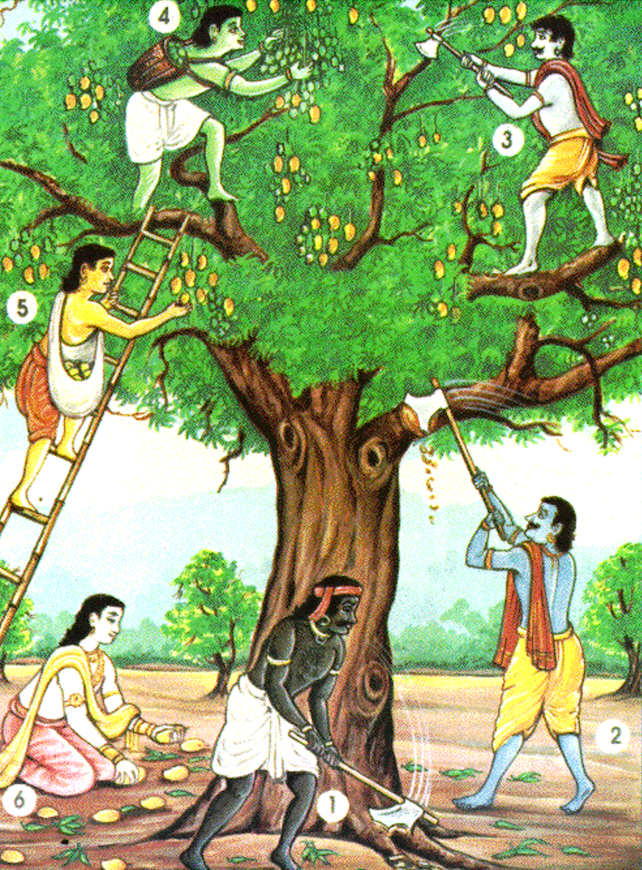
From a Jain perspective, are all these actions equal?
- Person 1 is destroying the tree entirely.
- Person 3 is getting mangoes, but perhaps violently, bruising the fruit and damaging the branches.
- Person 5 is taking great care to pick the fruit without harming the tree.
- Person 6 is simply taking what has already fallen.
While the physical action in each case involves "getting mangoes" (or interacting with the tree), the underlying intention and the degree of harm (hiṃsā) are vastly different. Jain philosophy teaches that it is the intention behind the action that is the primary factor in the accumulation of karma. Let's dissect this principle.
2. The Channels of Action and the Power of Intention
Jain texts state that karma flows into the soul through three channels, collectively known as Yoga (योग):
- Manas (मन): Activities of the mind (thoughts).
- Vacana (वचन): Activities of speech (words).
- Kāya (काय): Activities of the body (physical actions).
Any activity through these three channels creates vibrations in the soul, which attract karmic particles. However, this is only half the story. The particles are only bound tightly to the soul when the activity is accompanied by intention, specifically the "passions."
Let's watch a short video that introduces this concept.
*FOUR Laws of Karma* What is Karma and How to Remove it (Nikachit Good and Bad Karma)
The video 'FOUR Laws of Karma' by Acharya Shree Yogeesh provides a clear, accessible explanation of how actions and intentions combine to create significant karmic bondage.
Please watch the segment from 00:24 to 04:14. The speaker first introduces the three channels of accumulation (mind, speech, body) and then explains why intention, which he calls leshya, is the critical factor that determines the severity of the karma.
As the video explains, physical action, speech, or even thoughts alone do not create the most binding forms of karma. The critical ingredient is your inner disposition, your intention. This inner state is what determines the "stickiness" of the karma.
3. Dissecting Intention: Bhāva, Kaṣāya, and No-kaṣāya
To understand "intention" more deeply from a Jain technical perspective, we need to introduce a few key terms. The most encompassing term is Bhāva (भाव), which refers to the overall state or disposition of the soul at any given moment. This state is determined by the karmas that are currently active.
The most potent elements that shape our Bhāva and lead to karmic bondage are the Kaṣāyas (कषाय), or passions. As we've discussed, these are:
- Krodha (Anger)
- Māna (Ego/Pride)
- Māyā (Deceit)
- Lobha (Greed)
These passions act as the "glue" that binds karmic particles to the soul. However, the Bhāva is also colored by another set of mental states known as No-kaṣāya (नोकषाय), which are often translated as quasi-passions or emotions.
For a precise breakdown, let's consult a scholarly resource.
Emotions and Bhava in Jainism and Western Thought
The paper 'Emotions and Bhava in Jainism and Western Thought' by Dr. Narayan Lal Kachhara provides a detailed classification of the mental states that cause karmic bondage.
Please read the two sections that detail the sub-types of 'conduct deluding karma'. This begins around the text 'The right conduct deluding karma (Caritra-mohaniya) is of two sub types...' and continues through the explanation of the difference between passions and emotions, ending just before the discussion on the 'rise of karma'. Focus on understanding the lists of Kaṣāya and No-kaṣāya, and the relationship between them.
From the reading, we can summarize the key points:
- Kaṣāya (Passions): Anger, ego, deceit, and greed are the primary drivers of bondage.
- No-kaṣāya (Emotions): This list includes laughter/joking, indulgence/love, dissatisfaction/hate, sorrow, fear, disgust, and sexual desire.
- Relationship: The No-kaṣāyas (emotions) are described as "multiplying factors" for the Kaṣāyas (passions). In the absence of emotions like fear or desire, the core passions like anger or greed would not be as powerful.
This entire complex of passions and emotions falls under the category of Mohanīya Karma (deluding karma), which is the most difficult karma to overcome. The following chart provides a clear visual map of where these mental states fit within the broader classification of karmas.

4. The Intensity of Bondage: From Sand to Stone
If intention determines the "stickiness" of karma, does it also determine the intensity and duration of the bondage? Absolutely. Jain philosophy provides a brilliant classification of karma based on how tightly it is bound to the soul, which is a direct result of the intensity of the intention at the time of the action.
Let's return to the video from Acharya Shree Yogeesh, where he explains this with some powerful analogies.
*FOUR Laws of Karma* What is Karma and How to Remove it (Nikachit Good and Bad Karma)
We will now explore the four degrees of karmic bondage. The speaker explains each category and provides vivid analogies to make the concept clear.
Please watch the video from 04:14 to 07:51, and then from 08:46 to 15:47. The speaker explains four categories of karma, culminating in Nikachita karma, and uses analogies of sand, clay, and rock to illustrate their intensity. Pay close attention to the hunter example, which is a perfect illustration of how a celebratory intention solidifies bad karma.
This is a critical concept. Let's summarize the four types of bondage you just learned about:
- Spṛṣṭa (स्पृष्ट) or Sparsha: Like dry sand thrown at a dry wall. The karmic particles just touch the soul and fall away easily with little effort. This results from fleeting, weak intentions.
- Baddha (बद्ध): Like wet sand on a wall. The particles stick lightly and require some effort to clean. This results from a more definite, but still not intense, intention.
- Nidhatta (निधत्त): Like wet clay thrown on a wall. The particles stick firmly and require significant spiritual effort (sādhanā) to remove before they give their result.
- Nikācita (निकाचित): Like a carving in a rock. This karma is bound so intensely that it is practically impossible to shed without experiencing its consequences. It can only be slightly mitigated, not erased, by spiritual efforts.
What creates Nikācita karma? As the video explains, it's the combination of a potent action (good or bad) with an intensely joyful, celebratory, and confirming intention. The hunter who not only kills an animal but dances with joy, celebrating his skill, is creating Nikācita karma. His intense, positive emotion (No-kaṣāya) reinforces the negative passion (Kaṣāya) associated with the killing, carving the karma into the soul.
Test your understanding!
Two programmers fix a critical bug in a software system, preventing a major financial loss for their company.
- Programmer A feels a quiet sense of professional satisfaction and is glad to have helped. They quickly move on to the next task.
- Programmer B feels ecstatic. They boast to colleagues about their superior skill, celebrate their "win" for days, and feel a surge of ego, believing they are indispensable.
Based on the four levels of bondage, what kind of puṇya (meritorious) karma have they likely accumulated?
Show answer
Both programmers performed a good action and will accumulate puṇya karma. However, the intensity will differ.
- Programmer A likely accumulated Spṛṣṭa or Baddha karma. Their intention was positive but measured and not driven by intense ego or attachment. The meritorious karma is present but not bound with extreme intensity.
- Programmer B, by combining the good deed with intense ego (Māna Kaṣāya) and celebratory joy, has likely created Nikācita karma. They will have to experience the fruits of this good karma (e.g., receiving a promotion or major recognition), as it is now deeply bound to their soul. While the result is "good," it still represents a form of bondage that keeps the soul entangled in the worldly cycle. This illustrates that even good intentions, when coupled with intense passion, deepen the bondage.
Conclusion: The Path of Pure Perception
Today we've seen that in the mathematics of karma, intention is not just a variable; it's the exponent. It's what magnifies the consequence of our thoughts, words, and deeds, determining the strength and duration of our karmic bondage.
This is precisely why practices like Preksha Dhyaan are so central to the Jain path. The goal of Preksha Dhyaan is to cultivate a state of pure, impartial perception—to see what is happening within and without, free from the coloring of attachment (rāga) and aversion (dveṣa), which are the root of the passions. As one resource notes, "One whose 'perception' and 'knowledge' are pure, does neither attract new karmic matter nor does he suffer the effect of the old accumulated karmas." By purifying intention at its source, we change the very nature of our relationship with karma.
Key Takeaways:
- Karma is accumulated through the channels of mind, speech, and body (Yoga).
- The intention behind an action, driven by passions (Kaṣāya) and emotions (No-kaṣāya), is the deciding factor in karmic bondage.
- The same external act can result in vastly different karmic outcomes depending on the purity of the inner state (Bhāva).
- The intensity of the intention determines the intensity of the karmic bond, which ranges from the light Spṛṣṭa to the almost indelible Nikācita.
Preview of the Next Lesson:
We have established the supreme importance of intention. But where do our intentions come from? Are they always conscious choices? In our next lesson, we will delve into one of Acharya Mahapragya's key concepts: Adhyavasāya (अध्यवसाय), the deep-seated mental dispositions or psychic imprints that shape our Bhāva often without our conscious awareness. This will be a crucial step in connecting Jain psychology to the modern scientific understanding of the subconscious mind, bringing us closer to your ultimate goal.